EFFECTS OF THE USE OF ELECTRONIC PORTFOLIO ON THAI EFL NURSING STUDENTS’ ORAL COMMUNICATION
DOI:
https://doi.org/10.14456/nrru-rdi.2021.24Keywords:
EFL communication, EFL speaking, E-learning, E-portfolio, Oral communicationAbstract
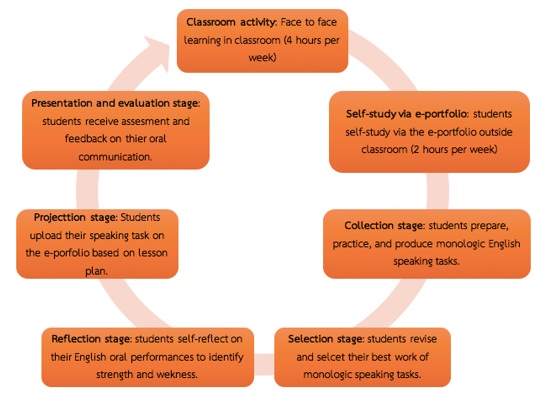
This quasi-experimental study aims at examining the limitation of Thai EFL nursing students' oral communication before and after e-portfolio treatment. The study investigated the types of errors as well as the improvement in oral communication skills after the use of the e-portfolio, and reinforce their English oral communication. The nursing students' opinions towards the e-portfolio implementation in speaking class was also reviewed as a part of the study. To achieve these objectives, 45 first-year undergraduate nursing students who enrolled in the English for Everyday Life course given in the academic year of 2018 (first semester) were chosen as the participants. The participants were engaged in spoken English lessons that was designed according to the Common European Framework of Reference for Languages (CEFR). During the semester, the participants were required to complete the monologic speaking tasks and submit them to the digital web-based e-portfolio. The researcher, who manages the e-portofolio, would provide them with feedback. The participants' oral communication skills were analyzed using surface structure taxonomy to identify their spoken limitations. The data were classified into four taxnomy surface strategies: omission, addition, misformation, and disordering. The findings of study demonstrates the improvement in communication and less frequent errors in the students' speech after the implementation of the e-portfolio.
References
Barrett, H. (2005). White paper: Researching electronic portfolios and learner engagement. The REFLECT Initiative. Retrieved April 20, 2019, from https://bit.ly/2LGeWBG
Buzzetto-More, N. (2006). Using electronic portfolios to build information literacy. Global Digital Business Review, 1(1), 6-11.
Cepik, S., & Yatibas, A. E. (2013). The use of e-portfolio to improve English speaking skill of Turkish EFL learners. Anthropologist, 16(2), 307-317.
Cooper, T. & Love, T. (2001). Online portfolios: issues of assessment and pedagogy. AARE. Retrieved August 20, 2019, from https://bit.ly/3bLHuEr
Dulay, H., Burt, M., & Krashern, S. (1982). Language two. New York : Oxford University.
Foster, P., & Skehan, P. (1999). The influence of source of planning and focus of planning on task-based performance. Language Teaching Research, 3(3), 215-247.
Hiranburana, K. (2017). A Framework of Reference for English Language Education in Thailand (FRELE-TH ) ― based on the CEFR, The Thai experience. LEARN Journal: Language Education and Acquisition Research Network Journal, 10(2), 90-119.
Huang, H. T. D., & Hung, S. T. A. (2010). Effects of electronic portfolios on EFL oral performance. Asian EFL Journal, 12(2), 192-212.
Lao-un, J., & Khampusaen, D. (2018). Using Electronic Portfolio to Improve English Speaking Ability of Thai Undergraduate Students. Prodeedings of 14th International Conference on Humanitices and Social Sciences 2018 (IC-HUSO 2018), (pp. 687-698). Faculty of Humanitices and Social Sciences, Khon Kaen University. (In Thai)
Lau, S. H. (2006). The implementation of portfolio assessment in an ESL/EFL Classroom. TESL Working Paper Series, 25-30.
Nunes, A. (2004). Portfolios in the EFL Classroom: Disclosing an Informed Practice. ELT Journal, 58(4), 327-335.
Pasiphol, S., & Sothaya, P. (2016). Development of Electronic Portfolio Model to Assess Learning Development of Elemenatary School Student. Kasetsart Journal of Social Science, 37, 291-305. (In Thai)
Paulson, F. L., Paulson, P. R., & Meyer, C. A. (1991). What Makes a Portfolio a Portfolio?. Educational Leadership, 48(5).
Pianpeng, T., & Koraneekid, P. (2014). Effect of Reflection Using Video Based on GIBBs’ Cycle in the Electonic Porfolio on The Level of Reflective Thinking of Teacher Students. OJED, 9(4), 150-163. (In Thai)
Safari, M., & Koosha, M. (2016). Instructional efficacy of portfolio for assessing Iranian EFL learners' speaking ability, 9(3), 102-116.
The EF English Proficiency Index. (2018). The world's largest ranking of countries and regions by English skills. Retrieved March 8, 2019, from https://www.ef.com/wwen/epi/
Wang, L. J., & Chang, H. F. (2010). Applying innovation method of assess English speaking performance on communication apprehension. Belt Journal, 1(2), 147-158.