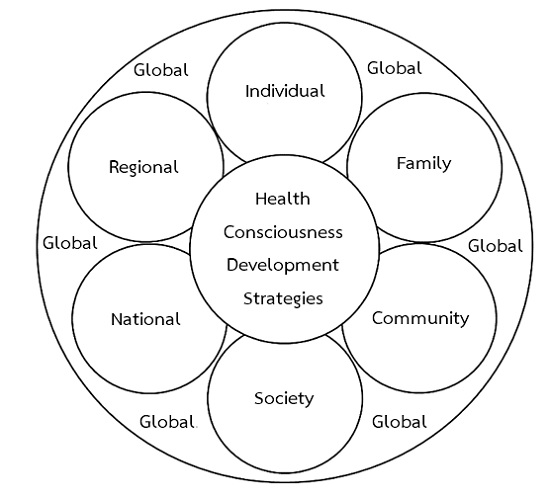
A HEALTH CONSCIOUSNESS DEVELOPMENT MODEL FOR THAILAND DURING AND POST COVID-19
DOI:
https://doi.org/10.14456/nrru-rdi.2021.23Keywords:
COVID-19, Emerging disease, Health consciousness development, PandemicAbstract
This research study employed a qualitative research methodology aims in studying the health relating to cognition consciousness strategies that applied to prevent the emerging diseases COVID-19, and propose a model in Thailand. Participants as the key informants using purposeful sampling technique. Data were collected from 60 key informants via telephone interviews and the communication between the researchers and the key informants was via the LINE application and a qualitatively directed content analysis. The COVID-19 pandemic, beginning in January 2020, has caused frightening effects to people across the world. It has been reported that the confirmed cases of infection and deaths in all countries as of 23 May 2020 were 5,103,006 and 333,401 persons, respectively. To stop the pandemic and to treat the infected patients in order to reduce the death toll and to prevent its recurrence are very important issues requiring urgent research. However, attention has been focused on the treating part which is considered a reactive approach. Preventive measures are considered proactive and effective approaches to reduce infections. It is considered that the chances of a recurrence of the pandemic have not been given sufficient attention. Health consciousness of the people is one of the most important factors contributing to this situation. This study aimed to develop a model for developing health consciousness to prevent emerging diseases at present and in the future after the COVID-19 pandemic in Thailand.
References
Andrade, N. S., Espey, D. K., Hall, M. E., & Bauer, U. E. (2009). A Holistic Approach to Chronic Disease Prevention: Good Health and Wellness in Indian Country. Preventing Chronic Disease 16. Retrieved May 31, 2020, from http://dx.doi.org/10.5888/pcd16.190081
Creswell, J. W., & Plano Clark, V. L. (2018). Designing and Conducting Mixed Methods Research. (3rd ed.). Los Angeles : SAGE.
Davidson, H. (2020). First Covid-19 Case Happened in November, China Government Records Show-Report. Retrieved May 11, 2020, from https://www.theguardian.com/world/2020 /mar/13/first-covid-19-case-happened-in-november-china-government-records-show-report
Espinosa, A., & Kadić-Maglajlić, S. (2018). The Mediating Role of Health Consciousness in the Relation Between Emotional Intelligence and Health Behaviors. Frontiers in Psychology. Retrieved June 14, 2020, from https://doi.org/10.3389/fpsyg.2018.02161
Exogenesis. (2017, online). HOLISTIC HEALTH CONCEPT. Retrieved April 7, 2021 from https://www.egogenesis.be/
Fiandaca, M. S., Mapstone, M., Connors, E., Jacobson, M., Monuki, E. S., Malik, S., Macciardi, F., & Federoff, H. J. (2017). Systems Healthcare: A Holistic Paradigm for Tomorrow. BMC Systems Biology 11. Retrieved May 31, 2020, from https://doi.org/10.1186/s12918-017-0521-2
Haleem, A., Javaid, M., Vaishya, R., & Deshmukh, S. G. (2020). Areas of Academic Research with the Impact of COVID-19. Elsevier Public Health Emergency Collection, 38(7), 1524–1526.
Hasina, S. (2020). Cooperation and Not Isolation will help us Fight COVID-19. Retrieved June 13, 2020, from https://www.weforum.org/agenda/2020/04/cooperation-not-isolation-will-help-fight-covid-19/
Hong, H. (2011). Scale Development for Measuring Health Consciousness: Re-conceptualization. Retrieved June 8, 2020, from https://www.instituteforpr.org/wp-content/uploads/Scale DvlpmentMeasuring.pdf
Hoque, M. Z., Alam, N., & Nahid, K. A. (2018). Health Consciousness and Its Effect on Perceived Knowledge, and Belief in the Purchase Intent of Liquid Milk: Consumer Insights from an Emerging Market. Foods, 7(9). Retrieved June 8. 2020, from https://doi.org/10.3390/ foods7090150
Hsieh, H-F., & Shannon, S. E. (2005). Three Approaches to Qualitative Content Analysis. Qualitative Health Research, 15(9), 1277-1288.
Hu, C. S. (2013). A New Measure for Health Consciousness: Development of A Health Consciousness Conceptual Model. Retrieved May 30, 2020, from https://www.researchgate.net/publication/ 299484743
Iversen, C. A., & Kraft, P. (2006). Does Socio-economic Status and Health Consciousness Influence How Women Respond to Health Related Messages in Media? Health Education Research, 21(5), 601-610.
Izmestiev, A., & Klingebiel, S. (2020). International (Development) Cooperation in a Post-COVID-19 World: A New Way of Interaction or Super-accelerator?. Retrieved June 13, 2020, from https://www.die-gdi.de/en/others-publications/article/international-development-cooperation-in-a-post-covid-19-world-a-new-way-of-interaction-or-super-accelerator/
Jindabot, T. (2015). The Relationship of Thai Consumers’ Health Consciousness and Perceived Value. Global Journal of Emerging Trends in e-Business, Marketing and Consumer Psychology (GJETeMCP), 1(1), 259-268.
Joungtrakul, J., Sheehan, B., & Aticomsuwan, S. (2013). Qualitative Data Collection Tool: A New Approach to Developing an Interview Guide. AFBE Journal, 6(2), 140-154.
Kipgen, N., & Bansal, A. (2020). Asean Needs to Come together Over Covid-19 Pandemic: Regional Solidarity Key to Effective Outbreak Response. Retrieved June 12, 2020, from https://www.bangkokpost.com/opinion/opinion/1922900/asean-needs-to-come-together-over-covid-19-pandemic
Koseoglu, M. A., Akdeve, E., Gedik, I., & Bertsch, A. (2015). Strategic Management Articles in Healthcare Management Literature. International Journal of Healthcare Management, 8(1), 27-33.
Maccuspie, R., Hyman, H., Yakymyshyn, C., Srinivasan, S., Dhau, J., & Drake, C. (2014). A Framework for Identifying Performance Targets for Sustainable Nanomaterials. Sustainable Materials and Technologies, 1-2, 17-25.
Maykut, P. S., & Morehouse, R. (1994). Beginning Qualitative Research: A Philosophic and Practical Guide. London : The Falmers Press.
Mullard, A. (2020). Flooded by the Torrent: the COVID-19 Drug Pipeline: The World is Rushing to Test Potential COVID-19 Treatments. But do We Really Need so Many Trials? World Report, 395, 1245-1246.
Namwat, C., Suphanchaimat, R., Nittayasoot, N., & Iamsirithaworn, S. (2020). Thailand’s Response against Coronavirus Disease 2019: Challenges and Lessons Learned. Outbreak, Surveillance, Investigation & Response (OSIR) Journal, 13(1), 33-37.
Perencevich, E. N., Diekerma, D. J., & Edmond, M. B. (2020). Moving Personal Protective Equipment Into the Community Face Shields and Containment of COVID-19. American Medical Association. Retrieved May 24, 2020, from https://jamanetwork.com/journals/jama/articlepdf/2765525/jama_perencevich_2020_vp_200089.pdf
Roman, A.. (2018). The Holistic Model of Health and Methods of its Evaluation. Preventive Medicine & Public Health, 3, 48.
Speziale, G. (2015). Strategic Management of a Healthcare Organization: Engagement, Behavioral Indicators, and Clinical Performance. European Hearth Journal Supplements, 17(A), A3-A7.
Tamornpark, R., Yeemard, F., Upala, P., & Apidechkul, T. (2020). Readiness in Response the Epidemic of Coronavirus Disease-2019 (COVID-19) among Young Adults in Chiang Rai Province, Thailand. Journal of Health Science and Alternative Medicine, 2(1), 25-30.
Tay, M. Z., Poh, C. M., Rénia, L., MacAry, P. A., & Ng, L. F. P. (2020). The Trinity of COVID-19: Immunity, Inflammation and Intervention. Nature Reviews: Immunology, 20, 363.
WHO. (2020). Coronavirus Disease (COVID-19): Situation Report-124. Retrieved May 24, 2020, from https://www.who.int/docs/default-source/coronaviruse/situation-reports/20200523-covid-19-sitrep-124.pdf?sfvrsn=9626d639_2