MOBILIZATION PROCESS AND COMMUNITY ADAPTATION IN THE IMPLEMENTATION OF ALTERNATIVE EDUCATION OF YAA PED NAAM LEARNING CENTER, MAE HONG SON PROVINCE
DOI:
https://doi.org/10.14456/nrru-rdi.2022.58Keywords:
Mobilization Process, Adaptation, Alternative Education, Learning CenterAbstract
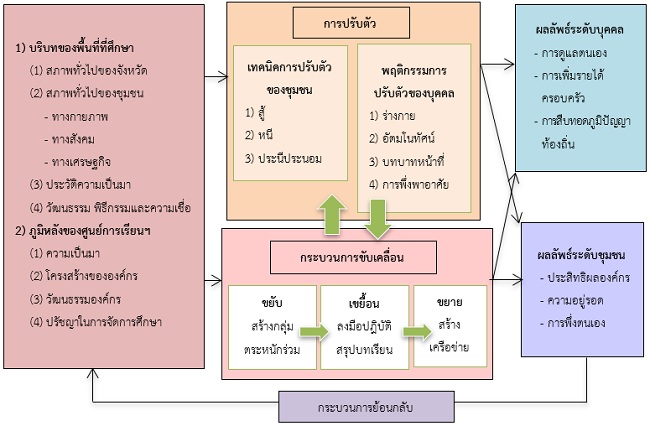
This research aimed to study the process of mobilization and the adaptation of a community in the implementation of alternative education at Yaa Ped Naam Learning Center. The research design adopted a qualitative research methodology, using a case study approach. The community selected purposively was Yaa Ped Naam Community located in Mae Hong Son Province. Data collection was conducted by means of in-depth interviews with 21 key informants. This was coupled with participatory observations. The research instruments consisted of structured questionnaires activity behavior logs, which had been checked for quality by the researcher’s advisors. Data analysis was performed using the content analysis, typological analysis, data interpretation, and logical reasoning methods. The results of the study revealed that the educational mobilization process in Yaa Ped Naam community consisted of 6 steps: 1) building awareness of being a local development agent among youth; 2) creating a group to establish the learning center; 3) conducting community-based education in accordance with the way of life of community members; 4) discussing lessons learned to review activities, identify arising problems, and find solutions; 5) extending results to improve students’ learning; and 6) creating educational innovations to enhance the quality of educational management in the 21st Century. There were 2 levels of adaptation in Yaa Ped Naam Learning Center: 1) at the community and organizational level that appeared in two types, aggressive reaction and compromise reaction; and 2) at the personal level which had 4 aspects, physical, self-conception, functional role, and interdependence.
References
A001. (2019, 15 November). Leader of the learning center. Interview. (In Thai)
A002. (2019, 20 November). Parent. Interview. (In Thai)
A003. (2019, 15 November). Leader of the learning center. Interview. (In Thai)
A004. (2019, 16 November). Partnership network. Interview. (In Thai)
A005. (2019, 15 November). Student. Interview. (In Thai)
A006. (2019, 20 November). Philosopher. Interview. (In Thai)
A007. (2019, 16 November). Leader of the learning center. Interview. (In Thai)
A008. (2019, 17 November). Partnership network. Interview. (In Thai)
A009. (2019, 15 November). Leader of the learning center. Interview. (In Thai)
Akkarasilachai, T. (2017). Guidelines for Alternative Education Management to Improve the Quality of Learners According to the Thailand 4.0 Policy. Reseacrh Report. Office of the Education Council, Bangkok. (In Thai)
Baxter, P., & Bethke, L. (2009). Alternative Education: Filling the gap in emergency and post-conflict situations. Retrieved September 20, 2021, from https://unesdoc.unesco.org/ark:/48223/pf0000184938/PDF/184938eng.pdf.multi
Chaiumporn, S. (2012). Styles and Steps of Community's Social Quality Movement. Bangkok : School of Social and Environmental Development, National Institute of Development Administration. (In Thai)
Chalermchai, Y. (2016). Guidelines for Organizing Education and Human Development through Alternative Education. Research Report. Office of the Education Council, Bangkok. (In Thai)
Chiangthong, S. (2015). The Role of the Community Organization Council in Promoting Community Democracy Learning. Local Administration Journal, 8(1), 52-60. (In Thai)
Katasila, S. (2005). 60 Years, Phipop Thongchai, "Alternatives" that Transcend Discourse. Bangkok : V.J. Printing. (In Thai)
Katawanit, T. (2003). General Psychology. Bangkok : Se-Education. (In Thai)
Krishnamurti, J. (2016). Krishnamurti on Education Part 1: Talk To Students. Bangkok : Amarin Printing and Publishing. (In Thai)
Office of the Education Council. (2010). National Education Act (No. 3) B.E. 2553. Retrieved March 5, 2019, from http://backoffice.onec.go.th/uploaded/Category/Laws/Act/Act2010/edactv353-23-08-2010.pdf (In Thai)
Panich, V. (2006). Knowledge Management Pactitioner Edition (3rd ed.). Bangkok : Sukkhapabjai. (In Thai)
Ponsri, S. (2013). Development of Abilities of Individuals and Qroups (2nded.). Bangkok : Odeonstore. (In Thai)
Research and Development Institute, Khon Kaen University. (1997). Community Organizations, Mechanisms for Solving Problems and Developing Society. Bangkok : The Thailand Research Fund. (In Thai)
Roy, S. C., & Andrews, H. A. (1999). The Roy Adaptation Model (2nd ed.). Stamford, Connecticut : Appleton & Lange.
Supaporn, D., Sriprasertpap, K., & Boriboon, G. (2018). Way of Learning with Administration of the Ban Huay Pern Natural Learning Community Center. Veridian e-Journal, 11(3), 1526-1543. (In Thai)
Suwannasuan, W., Chaiyakit, M., Markshoe, P., & Thamrongsotthisakul, W. (2013). A Model of Alternative Education for Disadvantaged Children on Highlands in the Upper North of Thailand. Journal of Education Naresuan University, 15(5), 182-192. (In Thai)
Downloads
Published
How to Cite
Issue
Section
License

This work is licensed under a Creative Commons Attribution-NonCommercial-NoDerivatives 4.0 International License.