THE DEVELOPMENT OF GUIDANCE ACTIVITY MODEL IN DEVELOPING ADVERSITY QUOTIENT OF PUPILS IN THE INTERMEDIATE GRADES OF UNDER SURIN PRIMARY EDUCATIONAL SERVICE AREA OFFICE 1
DOI:
https://doi.org/10.14456/nrru-rdi.2022.51Keywords:
Developing model, Guidance activity, Adversity quotientAbstract
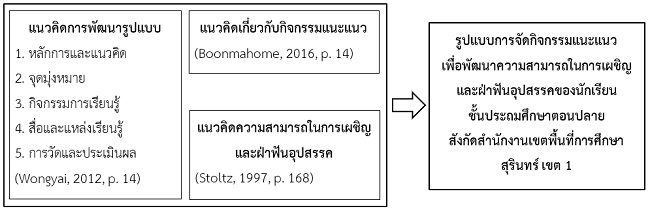
This research aimed to investigate problems and needs in student guidance, develop a guidance activity model, and examine the satisfaction of intermediate-grade students in Surin primary educational service area office 1. Purposively selected participants were twelve informants, 172 sample students, five academic dignitaries, two primary school teachers, and 104 experimental students. Research tools included document analysis form and questionnaires with high congruence, conversation topics with the highest congruence, model fitting outline evaluation form with the highest congruence, ability evaluation form (reliability = 0.93), and satisfaction evaluation form (reliability = 0.92). Data were collected from group discussions and answers to the disseminated questionnaires. Data analyses included content analysis, means with standard deviation, and t-tests. The results of the present study were as follows. First, problems in student guidance were teachers with low experience in teaching. Therefore, the need for this group of teachers was a training process for a professional community. In addition, the students also had a developmental problem at a moderate level. Secondly, a developed guidance activity model consisted of five components with the highest overall level of appropriateness. Lastly, the experimental group of students had improved their adversity quotient compared to the pre-test level with a high satisfaction level.
References
Boonmahome, J. (2016). Guidance Principles and Learner Development (5th ed.). Nakhon Pathom : Smile Printing and Graphic Design. (In Thai)
Khamsom, K. (2016). Introductory Guidance. Udon Thani : Faculty of Education Udon Thani Rajabhat University. (In Thai)
Laeheemi, K. (2021). The development of guidance activities model applying the learning learning managent theory of gagne and stad to enhance emotional intelligence of mathayomsuksa 2 students. Journal of Humanities and Social Sciences, 3(1), 115-144. (In Thai)
Limtasiri, O. (2013). Curriculum and Teaching at the Elementary Level (7th ed.). Bangkok : Ramkhamhaeng University. (In Thai)
Metheethammawat, M, Ratanarojnakool, P, Chaivichit, S, & Werathammo, A,. (2022). A Recreation Program for Increasing the Adversity Quotient (AQ) Score among Student Teachers in Bangkok. The Southern College Network Journal of Nursing and Public Health, 9(1), 174-185. (In Thai)
Ministry of Education. (1999). The National Education Act, B.E. 2542 and its amendments (No. 2), B.E. 2545. Bangkok : Teachers Council of Thailand Printing House Ladprao. (In Thai)
Nillapun, M. (2015). Educational Research Methods (9thed.). Nakhon Pathom : Educational Research and Development Center Education Silpakorn University. (In Thai)
Office of the Education Council. (2009). A Study of the Body of Knowledge about the Desirable Characteristics of Thai People. Bangkok : Office of the Education Council. (In Thai)
Onthanee, A. (2019). A develop an instructional model based on contemplative education to enhance Adversity Quotient for student teachers. Journal of Education Naresuan University, 21(3), 326-341. (In Thai)
Phiensub, T., & Mekkhachorn, N. (2021). The Enhancing Adversity Quotient of Mathayom Suksa Three Students of Karnkheha Thasai School in Bangkok Metropolis by Using a Guidance. Journal of Psychology, 19(1), 28-41. (In Thai)
Srisa-ard, B. (2017). Preliminary research (10thed.). Bangkok : Suviriyasan. (In Thai)
Srivirojn, W. (2014). Teaching Documents for The Course 1022230 Principles of Learning Management. Retrieved March 22, 2020, from http://edu.pbru.ac.th/e-media/08.pdf (In Thai)
Stoltz, P. G. (1997). Adversity Quotient : Turning Obstacles into Opportunities. New York : John Willey & Sons.
Surin primary Educational service area office 1. (2019). Educational basic information in Surin primary Educational service area office 1. Retrieved March 22, 2019, from http://www. surinarea1.go.th/srn1/index.php/2020-03-28-13-03-27/2019-03-02-08-37-57 (In Thai)
Thanatjiraphat, N., & Suksawat, J. (2021). The Effects of Using a Guidance Activities Package to Develop Digital Intelligence Quotient of Mathayom Suksa II Students at Tessaban Khao Thaphra School in Chai Nat Province. The Journal of Faculty of Applied Arts, 14(1), 1-10. (In Thai)
The Royal College Pediatricians of Thailand. (2018). Guide for Parents To Dsseminate Knowledge on Child Care and Development at School age Children 6-12 years old. Bangkok : Pediatrician Association of Thailand. (In Thai)
Tirakanan, S. (2014). Research Methods in Social Sciences: A Guide to Practice. Bangkok : Chulalongkorn University Printing House. (In Thai)
Wongyai, W. (2012). The Development of a Model for Developing Teachers in Curriculum Transformation to Learning. Silpakorn Educational Research Journal, 4(2), 10-24. (In Thai)
Downloads
Published
How to Cite
Issue
Section
License

This work is licensed under a Creative Commons Attribution-NonCommercial-NoDerivatives 4.0 International License.