Participation in Buddhist Art Conservation at Khao Thamorat, Si Thep Historical Park, Phetchabun Province
DOI:
https://doi.org/10.14456/nrru-rdi.2024.25Keywords:
Participation, Temples, Communities, Buddhist art ConservationAbstract
Background and Objective: The rich Buddhist heritage passed down through generations requires conservation for the future. This research focuses on the Buddhist art of Khao Thamorat, within the Si Thep Historical Park in Phetchabun Province. The study aims to: 1) explore conservation practices, 2) assess the participation of temples and communities in these efforts, and 3) strengthen conservation networks.
Methodology: This qualitative study engaged three groups of key informants through purposive sampling: 7 religious leaders, 23 community leaders, and 7 cultural and environmental leaders. Data were collected via ethically approved in-depth interviews and focus group discussions in Khok Sa-at and Si Thep Subdistricts, Phetchabun Province. The data were analyzed using interpretative content analysis to identify core concepts, main issues, and related factors simply.
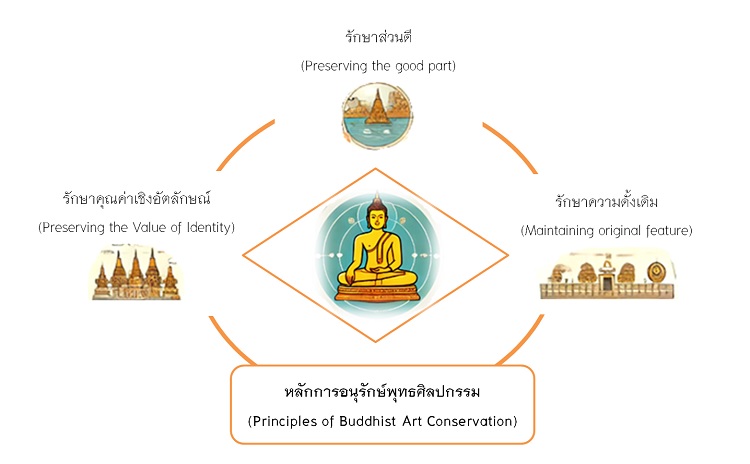
Results: 1) Conservation efforts focus on preserving key elements of identity, originality, and value. 2) The participation of temples and communities is characterized by collaborative efforts to maintain significance over time, embrace diversity, support conservation, and ensure sustainability. 3) The development of networks involving temples, communities, and government agencies has led to the formation of learning, investment, and management networks aimed at long-term maintenance and care.
Discussion: Effective conservation emphasizes maintaining original features of identity and value through a participatory process that fosters collaboration between temples, communities, and government agencies. The development of learning and investment networks, along with ongoing management efforts, is essential for sustainable conservation.
Suggestion: Establishing local cultural preservation volunteer groups will allow the community to participate in cultural conservation through knowledge exchange and joint activities, fostering pride in identity and strengthening community ties.
References
Barthel-Bouchier, D. (2016). Cultural heritage and the challenge of sustainability. Routledge. https://doi.org/10.4324/9781315431055
Beel, D., & Wallace, C. (2020). Gathering together: social capital, cultural capital and the value of cultural heritage in a digital age. Social & Cultural Geography, 21(5), 697-717. https://doi.org/10.1080/14649365.2018.1500632
Bolarinwa, O. A. (2020). Sample size estimation for health and social science researchers: The principles and considerations for different study designs. Nigerian Postgraduate Medical Journal, 27(2), 67-75. DOI: 10.4103/npmj.npmj_19_20
Campelo, A., Reynolds, L., Lindgreen, A., & Beverland, M. (Eds.). (2018). Cultural heritage. Routledge.
Creswell, J. W. (2016). Qualitative inquiry and research design: Choosing among five approaches (2nd ed.). Sage.
de Vries, G. (2020). Culture in the Sustainable Development Goals: The Role of the European Union (2nd reviesed ed.). ifa (Institut für Auslandsbeziehungen e. V.). DOI: https://doi.org/10.17901/AKBP1.06.2020
Denzin, N. K., & Lincoln, Y. S. (2005). The Sage handbook of qualitative research (3rd ed.). Sage.
El Amine, K. M. (2024). Conservation and Valorisation of Architectural and Urban Heritage. University of Abou bekr Belkaïd Tlemcen. https://elearn.univ-tlemcen.dz/pluginfile.php/252767/mod_resource/content/1/MIMEOGRAPHED.%20Conservation%20and%20Valorisation%20of%20Architectural%20and%20Urban%20Heritage.pdf
Fine Arts Department, Ministry of Culture. (2007). Si Thep Historical Park. Rungsilp Printing (1977).
Flyvbjerg, B. (1998). Rationality and power: Democracy in practice. University of Chicago press.
Fouseki, K., Swensen, G., & Guttormsen, T. S. (2020). Heritage and sustainable urban transformations-A ‘deep cities’ approach. In Fouseki, K., Guttormsen, G., and Swensen, G. (Eds.), Heritage and sustainable urban transformations deep cities (pp. 1–15). Routledge.
Guo, J., Bian, Y., Li, M., & Du, J. (2024). Assessing resilience through social networks: A case study of flood disaster management in China. International Journal of Disaster Risk Reduction, 104583. https://doi.org/10.1016/j.ijdrr.2024.104583
Habermas, J. (1984). The theory of communicative action (Vol. I). Beacon.
Hannerz, U. (1996). Transnational connections: Culture, people, places (Vol. 290). Routledge.
Khadijah, U. L. S., Winoto, Y., Shuhidan, S. M., Anwar, R. K., & Lusiana, E. (2024). Community Participation in Preserving the History of Heritage Tourism Sites. Journal of Law and Sustainable Development, 12(1), e2504-e2504. https://doi.org/10.55908/sdgs.v12i1.2504
Lehdonvirta, V., Oksanen, A., Räsänen, P., & Blank, G. (2021). Social media, web, and panel surveys: using non‐probability samples in social and policy research. Policy & internet, 13(1), 134-155. https://doi.org/10.1002/poi3.238
Li, L., & Tang, Y. (2023). Towards the contemporary conservation of cultural heritages: An overview of their conservation history. Heritage, 7(1), 175-192. https://doi.org/10.3390/heritage7010009
Lin, N. (2002). Social capital: A theory of social structure and action (Vol. 19). Cambridge University Press.
Pharkuwatchasuwannathon (Lokchub Ketkhieo), Phraworaphong Dhammavamso (Seechawong), & Balakula, A. (2020). The Comparative Study Between Lakhon Chatri in Petchaburi and Lakhon Chatri The Fine Arts Department [Research Report]. Mahachulalongkornrajavidyalaya University.
Phetchabun Provincial Statistical Office. (2023). Phetchabun Provincial Statistical Report: 2023. https://phchabun.nso.go.th/images/report/statistical_report/CoverReportPRO2023-01%20Final.pdf
Phonsri, S. (2007). Learning Network in Community Development (2nd ed.). Odeon Store.
Pinngern, C. (2009). Chakkawan Tipani : A prototype of Buddhist thought, symbols of Lanna. Social Research Institute, Chiang Mai University.
Pinthong, J. (1994). Rural development administration. Odeon Store.
Pratala, E., Sugara, A., & Supriadi, Y. N. (2024). Community Participation in Cultural Preservation in Gerendeng Pulo Village, Karawaci District, Tangerang City. International Journal of Business, Technology and Organizational Behavior (IJBTOB), 4(1), 12-19. https://doi.org/10.52218/ijbtob.v4i1.303
Sathapitanon, P., & Thiraphan, C. (2003). Communication with network society. In the training documents for Course 3 “Creating a Powerful Network”. Local Community Institute develops learning institutions and develops civil society.
SDG Compass. (2015). A guide for business action on the SDGs. https://ocm.iccrom.org/documents/sdg-compass-guide-business-action-sdgs
Suksawat, S. (1994). Sri Dvaravati to Sri Rattanakosin. Dan Suthakanphim.
The Committee on Culture of UCLG. (2018). Culture in the Sustainable Development Goals: A Guide for Local Action. https://www.agenda21culture.net/sites/default/files/culture_and_sdgs.pdf
Vecco, M. (2018). Value and values of cultural heritage. In Cultural heritage (pp. 23-38). Routledge.
Downloads
Published
How to Cite
Issue
Section
License
Copyright (c) 2024 Research and Development Institute, Nakhon Ratchasima Rajabhat University

This work is licensed under a Creative Commons Attribution-NonCommercial-NoDerivatives 4.0 International License.