Thai Land Laws in the Era of Globalization: Challenges from Foreign Ownership
DOI:
https://doi.org/10.14456/rc-sdj.2025.01Keywords:
land laws and policies, adaptive dynamics, foreign land ownership, impact of challengesAbstract
Introduction: Thailand is currently facing a land ownership crisis involving foreign nationals. This issue has emerged alongside the country's efforts to open up and promote foreign investment. While such policies aim to stimulate economic growth and modernize infrastructure, they have also raised concerns about economic inequality, potentially affecting citizens’ rights and local community identities. This academic article aims to examine the challenges associated with foreign land ownership in Thailand across legal, economic, social, cultural, and environmental dimensions. The findings lead to proposals for developing land management laws and policies in the digital age that align with Thailand's competitive advantages, attract sustainable foreign investment, maintain social stability, and balance economic benefits with public security.
Content: Foreign land ownership in Thailand is a critical issue in the context of globalization, especially due to the expansion of investment and the increased demand for land resources. Addressing this requires appropriate legal frameworks and ownership policies that promote economic growth while protecting the rights of local communities and stakeholders. Laws should be reformed to enhance transparency, reduce conflict, and reinforce land security. Additionally, policies should promote sustainable land use to minimize negative impacts on natural resources and the environment.
Conclusion: In the era of globalization, Thailand’s legal and policy frameworks concerning foreign land ownership must consider economic, social, and environmental implications. Collaborative efforts among stakeholders and the public are essential to facilitate knowledge exchange, identify solutions, and broaden the scope of relevant laws and policies. Such an approach supports transparent and fair investment while safeguarding local resources, reducing social conflict, and developing efficient and sustainable land management systems.
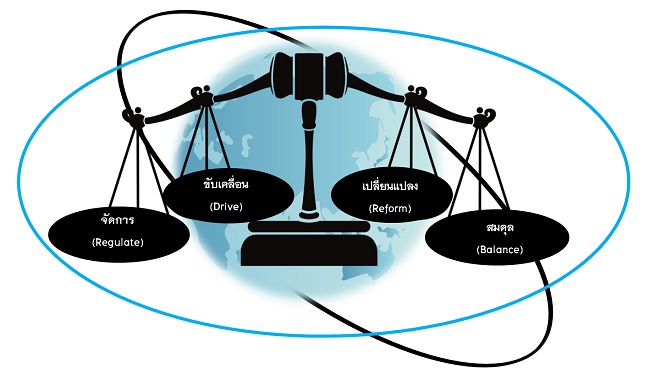
Innovation:The proposed innovation focuses on achieving legal and policy balance in land tenure and future strategic direction within a globalized context. This involves creating a regulated and clearly defined management framework that integrates economic, social, cultural, and environmental changes. Through technological adaptation and cross-border competition, the framework seeks to ensure long-term national security and sustainable development amid ongoing globalization.
References
Airiken, M., Zhang, F., Chan, N. W., & Kung, H. T. (2022). Assessment of spatial and temporal ecological environment quality under land use change of urban agglomeration in the North Slope of Tianshan, China. Environmental Science and Pollution Research, 1-18. https://doi.org/10.1007/s11356-021-16579-3
Barajas, J. A. R., Kubitza, C., & Lay, J. (2024). Large-scale acquisitions of communal land in the Global South: Assessing the risks and formulating policy recommendations. Land Use Policy, 139, 107054. https://doi.org/10.1016/j.landusepol.2024.107054
Belaws. (2022, November 21). Starting a business in Thailand. https://belaws.com/thailand/starting-a-business-in-thailand/
Blatter, J. (2022, February 23). glocalization. Encyclopedia Britannica. https://shorturl.asia/RPgda
Boonzaier, E. (1997). The Cape herders: a history of the Khoikhoi of southern Africa. New Africa Books.
Byamugisha, F. F. (2021). Experiences and development impacts of securing land rights at scale in developing countries: Case studies of China and Vietnam. Land, 10(2), 176. https://doi.org/10.3390/land10020176
Chavunduka, C., Dipura, R., & Vudzijena, V. (2021). Land, investment and production in agrarian transformation in Zimbabwe. Land Use Policy, 105, 105371. https://doi.org/10.1016/j.landusepol.2021.105371
Civil and Commercial Code B.E. 2468. (1915, September 11). Royal Gazette. Voume 42, pages 1-144.
Constitution Drafting Commssion. (2017). Constitution of the Kingdom of Thailand B.E. 2560. Printing Office, Office of the Secretariat of the House of Representatives.
De Juan, A., Geissel, D., Lay, J., & Lohmann, R. (2022). Large-Scale Land Acquisitions, Rural Change, and Social Conflict. German Institute for Global and Area Studies (GIGA).
Dieterle, C. (2022). Global governance meets local land tenure: International codes of conduct for responsible land investments in Uganda. The Journal of Development Studies, 58(3), 582-598. https://doi.org/10.1080/ 00220388.2021.1983165
Do, Q.-T., & Iyer, L. (2003). Land rights and economic development: Evidence from Vietnam. World Bank Policy Research Working Paper No. 3120. https://ssrn.com/abstract=445220
Dubertret, F. (2017, July). LandMark: Global platform of Indigenous and community lands. Paper presented at the XVI Biennial IASC Conference, International Association for the Study of the Commons (IASC), Utrecht, Netherlands. https://halshs.archives-ouvertes.fr/halshs-03961572
Eastern Special Development Zone Act B.E. 2561. (2018, May 14). Royal Gazette. Voume 135, Part 34 A, pages 1-33.
European Commission. (2011, May 6). Commission Staff Working Paper: Operational guidance on taking account of fundamental rights in Commission impact assessments (SEC(2011) 567 final). General Publications. https://shorturl.asia/eEyhL
Flynn, G., Ball, A., & Srey, V. (2022). Large-scale logging in Cambodia’s Prey Lang linked to politically-connected mining operation. Mongbay. https://shorturl.asia/JEvrR
Foreign Business Act B.E. 2542. (1999, December 4). Royal Gazette. Voume 116, Part 123 A, pages 1-15.
Gaukrodger, D. (2014). Investment Treaties and Shareholder Claims: Analysis of Treaty Practice. OECD Working Papers on International Investment, 2014/03. https://doi.org/10.1787/5jxvk6shpvs4-en
Ghahremani, H., Afsari Bajestani, S., McCarthy, L., & Jalalianhosseini, M. (2021). Transformation of urban spaces within cities in the context of globalization and urban competitiveness. Journal of Urban Planning and Development, 147(3), 05021026. https://doi.org/10.1061/(ASCE)UP.1943-5444.0000703
Grmelova, N. (2011). Contribution of the European ombudsman to limiting late payment by the European commission. In S. Gundmann & Y. M. Atamer (Eds.), Financial Services, Financial Crisis and General European Contract Law (Vol. 325, pp. 309-324). Kluwer Law International BV.
Hambloch, C. (2022). Land formalization turned land rush: The case of oil palm in Papua New Guinea. Land Use Policy, 112, 105818. https://doi.org/10.1016/j.landusepol.2021.105818
Held, D., McGrew, A., Goldblatt, D., & Perraton, J. (1999). Global transformations: Politics, economics and culture. In C. Pierson & S. Tormey (Eds.), Politics at the Edge: The PSA Yearbook 1999 (pp. 14-28). Palgrave Macmillan UK.
Hing, S., & Riggs, R. (2021). Re-thinking benefits of community protected areas in Mondulkiri, Cambodia. Trees, Forests and People, 6, 100128. https://doi.org/10.1016/j.tfp.2021.100128
Hire of Immovable Property for Commerce and Industry Act B. E. 2542. (1999, May 18). Royal Gazette. Voume 116, Part 39 A, pages 10-12.
Horsley, P. (2011). Property rights viewed from emerging relational perspectives. In D. Grinlinton & P. Taylor (Eds), Property Rights and Sustainability (pp. 87-116). Brill Nijhoff.
Ige, V. O., Akinbogun, S. P., & Jones, C. A. (2024). Achieving the Sustainable Development Goal Against Poverty in Developing Nations, Perspective from Urban Land Titling Potentials. Springer International.
Industrial Estate Authority of Thailand Act B.E. 2522. (1979, March 24). Royal Gazette. Voume 96, Part 41 speciall issue, pages 10-39.
Investment Promotion Act B.E. 2520. (1977, May 4). Royal Gazette. Voume 94, Part 38 speciall issue, pages 1-40.
Lähteenmäki-Uutela, A., Lonkila, A., Huttunen, S., & Grmelová, N. (2021). Legal rights of private property owners vs. sustainability transitions?. Journal of Cleaner Production, 323, 129179. https://doi.org/10.1016/j.jclepro.2021.129179
Lay, J., Anseeuw, W., Eckert, S., Flachsbarth, I., Kubitza, C., Nolte, K., & Giger, M. (2021). Taking stock of the global land rush: Few development benefits, many human and environmental risks. Analytical Report III. Bern Open. https://doi.org/10.48350/156861
Lehavi, A. (2023). The role of innovation in the globalization of property law. In E. Nordtveit (Ed.), The Changing Role of Property Law (pp. 81-102). Edward Elgar. https://doi.org/10.4337/9781839100659.00009
Lugo-Espinosa, G., Acevedo-Ortiz, M. A., Aquino-Bolaños, T., Ortiz-Hernández, Y. D., Ortiz-Hernández, F. E., Pérez-Pacheco, R., & López-Cruz, J. Y. (2024). Cultural Heritage, Migration, and Land Use Transformation in San José Chiltepec, Oaxaca. Land, 13(10), 1658. https://doi.org/10.3390/land13101658
Mahadew, B. (2024). An Assessment of the Impact of Corporate-Driven Foreign Land Investments on Selected Human Rights in Mozambique. African Journal of Legal Studies, 16(3), 225-248. https://doi.org/10.1163/17087384-bja10095
Martikainen, R. (2024). Navigating business challenges in Thailand: A critical analysis from the foreigner’s perspective [Bachelor’s thesis, Metropolia University of Applied Sciences]. https://urn.fi/URN:NBN:fi:amk-2024112329516
Meckelburg, R., & Wardana, A. (2024). The political economy of land acquisition for development in the public interest: The case of Indonesia. Land Use Policy, 137, 107017. https://doi.org/10.1016/j.landusepol.2023.107017
Montràs-Janer, T., Suggitt, A. J., Fox, R., Jönsson, M., Martay, B., Roy, D. B., Walker, K. J., & Auffret, A. G. (2024). Anthropogenic climate and land-use change drive short-and long-term biodiversity shifts across taxa. Nature ecology & evolution, 8(4), 739-751. https://doi.org/10.1038/s41559-024-02326-7
Ngoga, T. H. (2018). Rwanda’s Land Tenure Reform: Non-Existent to Best Practice. CAB International.
Oberndorf, R. B. (2006). Legal analysis of forest and land laws in Cambodia. Community Forestry International.
Office of the National Land Policy Board. (2023). National Land and Soil Resource Management Policy and Plan (2023-2037). Publication documents. https://shorturl.asia/nC0rT
Organization for Economic Co-operation and Development (OECD). (2020). OECD investment policy reviews: Thailand. OECD. https://doi.org/10.1787/7a9638cb-en
Pahrazi, R., & Rahayu, M. I. F. (2024). Juridical Study of Problematic Overlapping Land Ownership Status in Indonesia. Journal of Law, Politic and Humanities, 4(4), 820-828. https://doi.org/10.38035/jlph.v4i4.508
Petroleum Act B. E. 2514. (1971, March 26). Royal Gazette. Voume 88, Part 43 speciall issue, pages 1-23.
Raphaël, K. (2021). Reinforcing citizens’ participation by reforming European commission public consultations. In A. Alberto & O. James (Eds.), Democratic Participation in a Citizen's Europe: What next for the EU? (pp. 133-144). Routledge/ECPR Studies in European Political Science.
Roudometof, V. N., & Dessì, U. (Eds.). (2022). Handbook of culture and glocalization. Edward Elgar.
Royal Thai Embassy in Washington, DC. (2023, October 12). Thailand and ASEAN. https://washingtondc.thaiembassy.org/en/page/thailand-and-asean
Sermcheep, S., Sabhasri, C., Charoenseang, J., & Ariyasajjakorn, D. (2024). Chapter 5 Thailand’s Perspective. In L. Chen & A. D. Rillo (Eds.), Further ASEAN–China Cooperation for Joint Prosperity: Envisioning ACFTA 3.0 in the Digital Era (pp. 111-151). National Library of Indonesia Cataloguing-in-Publication Data.
Seutloali, J. (2024). Land of the ANCESTORS: Expropriation a Necessity for Justice. Shaka Imprint.
Sutedi, A. (2020). Implementasi prinsip kepentingan umum di dalam pengadaan tanah untuk pembangunan. Sinar Grafika (Bumi Aksara).
The Land Code Act B. E. 2497. (1954, September 13). Royal Gazette. Voume 71, Part 78 speciall issue, pages 1-30.
Thongpradab, S. (2008). Explanation of the Land Code. Nitibannakarn.
Tusing, C., & Leemann, E. (2023). Time as the Enemy? Disjointed Timelines and Uneven Rhythms of Indigenous Collective Land Titling in Paraguay and Cambodia. Land, 12(8), 1620. https://doi.org/10.3390/land12081620
UNESCO & Network of Education Policy Centers. (2021). Global Education Monitoring Report: Inclusion and education: All means all. Network of Education Policy Centers.
United Nations Conference on Trade and Development (UNCTAD). (2021). Trade and Development Report 2021: From Recovery to Resilience-The Development Dimension. United Nations.
United Nations Conference on Trade and Development (UNCTAD). (2023). Trade and Development Report 2023: Growth, Debt and Climate-Realigning the Global Financial Architecture. United Nations.
United States Agency for Internationa Development (USAID). (2013). Property Rights and Resource Governance Country Profile: Vietnam. LandWise Legal and Research Library. https://shorturl.asia/1Ds8g
United States Department of State. (2019). 2019 Investment Climate Statements: Vietnam. Vietnam. https://shorturl.asia/zw6yk
Valdeolmillos, N. A. A., Furlan, R., Tadi, M., Sinclair, B. R., & Awwaad, R. (2024). Towards a knowledge-hub destination: analysis and recommendation for implementing TOD for Qatar national library metro station. Environment, Development and Sustainability, 26(4), 9783-9815. https://doi.org/10.1007/s10668-023-03118-y
Vemuru, V., Stephens, M., Sarkar, A., Roberts, A. J., & Baare, A. K. G. (2020). From Isolation to Integration (Vol. 2): An Overview of the Borderlands of the Horn of Africa. United States of America.
World Bank. (2008). Viet Nam Land Administration Project, Project Appraisal Document; Report No. 39867-VN. World Bank.
Zhou, Q., & Huld, A. (2022, June 6). What is China’s green and low-carbon plan and why is it relevant to foreign investors. China Briefing. https://shorturl.asia/FjWiI