The Role and Scope of the Administrative Court's Jurisdiction in Disputes under Section 9 of the Administrative Court and Administrative Court Procedure Act, B.E. 2542: Direction and Development
DOI:
https://doi.org/10.14456/rc-sdj.2025.08Keywords:
role and scope of power, administrative court of Thailand, methods of administrative litigation, new direction development guidelinesAbstract
Introduction: The Administrative Court plays a vital role in controlling state power and protecting the rights of the people under the rule of law and the principle of separation of powers to prevent the abuse of power and create a balance between the administration and the people. The power of the Administrative Court under the Administrative Court Establishment Act and the Procedure of Administrative Cases B.E. 2542 has defined the scope of consideration of cases related to the exercise of administrative power and the liability of state agencies, which is a mechanism to enhance the transparency and accountability of the public administration system.
Content: Administrative considers the case in five main categories: unlawful acts, omissions, or delays in the performance of duties, tortious acts or other liabilities, administrative contracts, and compulsory performance or non-performance of acts. Administrative courts play a crucial role in interpreting and establishing norms to clarify adjudication. Overlapping jurisdictions, litigation is slow, and administrative laws are complex. The challenges must be fixed to develop more efficient adjudication guidelines and integrate digital technologies into adjudication processes.
Conclusion: An important mechanism for protecting the rights of citizens from the unfair use of state power is the role and scope of the administrative court's authority, which has five development guidelines; Expanding the power to scrutinize the executive branch, increasing access to justice, improving the quality of trial, promoting participation, and creating a network of cooperation in line with social and technological changes and to create a more solid rule of law.
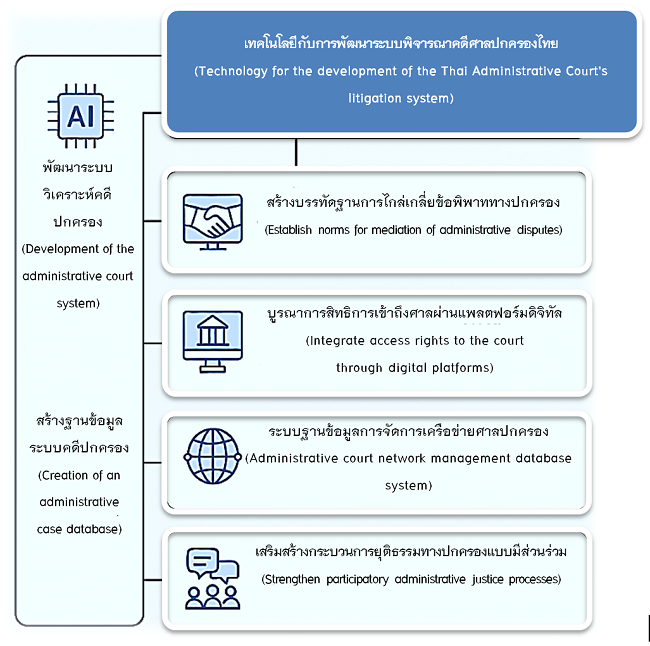
Innovation: The use of artificial intelligence technology, digital platforms, Blockchain, and Crowdsourcing to develop case trend analysis, adjudication, dispute mediation, filing and tracking cases, listening to complaints, and comparing data on administrative court network practices can increase quality, speed, reduce burdens, reduce costs, reduce time, reduce expenses, create standards, promote participation, and support the justice process for the public, which is comprehensive and creates continuity for the management system according to the role and scope of the administrative court's authority effectively.
References
Administrative Court Act and Administrative Court Procedure Act B.E. 2542. (1999, October 10). Government Gazette. Volume 116, Part 94 A, pages 1-40.
Atsawaroj, C. (2017). Administrative Litigation. Naphasorn Printing (Kittichai).
Bovens, M., Curtin, D., & Groenleer, M. (2008). Accountability in a European Union multi-level governance system. European Law Journal, 14(4), 447-468.
Cappelletti, M., & Garth, B. (1978). Access to justice: The worldwide movement to make rights effective. Giuffrè Editore.
Chularattana, A. (2006). Before becoming... the Administrative Court. Bophit Printing.
Constitution of the Kingdom of Thailand B.E. 2560. (2017, April 10). Royal Gazette. Volume 134, Part 40 A, Pages 1-94.
Dragos, D. C., & Neamtu, B. (Eds.). (2014). Alternative dispute resolution in European administrative law. Springer Berlin Heidelberg.
Dworkin, R. (1986). Law’s empire. Cambridge. Harvard University Press.
Gerber, S. D. (2008). The Court, the Constitution, and the History of Ideas. Vand. L. Rev., 61, 1067.
Hadjon, P. M., & Djatmiati, T. S. (2011). Hukum Administrasi Dan Tindak Pidana Korupsi. Gadjah Mada University Press.
Hauriou, M. (1925). Précis de droit administratif et de droit public général. Librairie du Recueil Sirey.
Hongsiri, R. (2012). Administrative Court and Litigation in Administrative Court (4th ed.). Winyuchon.
Hongsiri, R. (2024). Administrative Court and Litigation in Administrative Court (13th ed.). Lawyer.
Jumpa, M., & Liangboonlertchai, P. (2009). The Constitution of the United States: An Explanatory Guide to Sections and Supreme Court Decisions. Winyuchon.
Kelsen, H. (1929). Pure theory of law. University of California Press.
Kelsen, H. (1934). The Method and Fundamental Notion of the Pure Theory of Law. Journal of Metaphysics and Morality, 41(2), 183-204. http://www.jstor.org/stable/40897653
Kettl, D. F. (2002). The transformation of governance: Public administration for twenty-first century America. Johns Hopkins University Press.
Korniienko, M., Koval, M., & Pavliutin, Y. (2024). Development of administrative proceedings in the context of economic globalisation. Baltic Journal of Economic Studies, 10(1), 136-144.
Kraiwichian, T., & Mahakhun, W. (2005). Interpretation of the law (5th ed.). Faculty of Law, Chulalongkorn University.
Legal Office, Office of the Senate Secretariat. (2004). Constitution of the Kingdom of Thailand, B.E. 2540. Printing Office, Office of the Senate Secretariat.
Lohakunwich, P. (2023). Tortious liabilities of officials and an administrative case involving a wrongful act. Khaojai.
Ma, C. (2022). The Reshaping Effects and Limitations of the Judicial AI. Frontiers of Law in China, 17(1), 42-66.
Madison, J. (1996). Federalist 48. The Federalist, ed. Benjamin F. Wright. Barnes & Noble Books.
Madison, J. (2001). Federalist 47. The Federalist Papers, 249-55.
Muttaqin, M. Z. (2024). State Administrative Law in Indonesia. Taylor & Francis.
Nussbaum, M. C. (2000). Women and human development: The capabilities approach. Cambridge University Press. https://doi.org/10.1017/CBO9780511841286
Office of Strategy Management. (2022). The Administrative Court Annual Report, Fiscal Year 2023. Legislative Institutional Repository of Thailand. https://urlkub.co/wU80xr
Office of Strategy Management. (2023). The Administrative Court Annual Report, Fiscal Year 2024. Legislative Institutional Repository of Thailand. https://urlkub.co/kUzxsM
Pattanapaisanchai, N. (2020). Legal Problems Regrading Appleals of Administrative Orders by Administrative Divisions [Unpublished Master’s thesis]. Thammasat University.
Pholkun, P. (2001). The Essence of the Administrative Court Law and Administrative Court Procedures. Administrative Court Welfare Office.
Phongsuwan, P. (2005). The essence of the administrative court procedure. Administrative Court Office.
Phutthisombat, T. (2014). The principle of separation of powers: The concept of judicial power as a check and balance in the United States. Dulpaha, 61(1), 106-130.
Sawangsak, C. (2019). Explanation of the Administrative Court Act and Administrative Court Procedures (11th ed.). Winyuchon.
Sen, A. (1999). Development as freedom. Oxford University Press.
Somdeeviradet, L. (2020). Analytical work on the study of administrative disputes regarding the issuance of administrative regulations and orders of Khon Kaen University between 2016-2019. Law Division, Office of the President, Khon Kaen University. https://urlkub.co/EGIFra
Teixeira, J. C., Bigotte, J. F., Repolho, H. M., & Antunes, A. P. (2019). Location of courts of justice: the making of the new judiciary map of Portugal. European Journal of Operational Research, 272(2), 608-620.
The Administrative Court. (2024). Administrative case statistics by court jurisdiction, year 2024. Information and resources. https://urlkub.co/BcPmfl
Uwanno, B. (1995). Public Law. Winyuchon.
Waranyu, W., Khaiphan, P., & Sthawornsinphon, C. (2008). Administrative Law Textbook on General Administrative Law. Office of the Council of State.