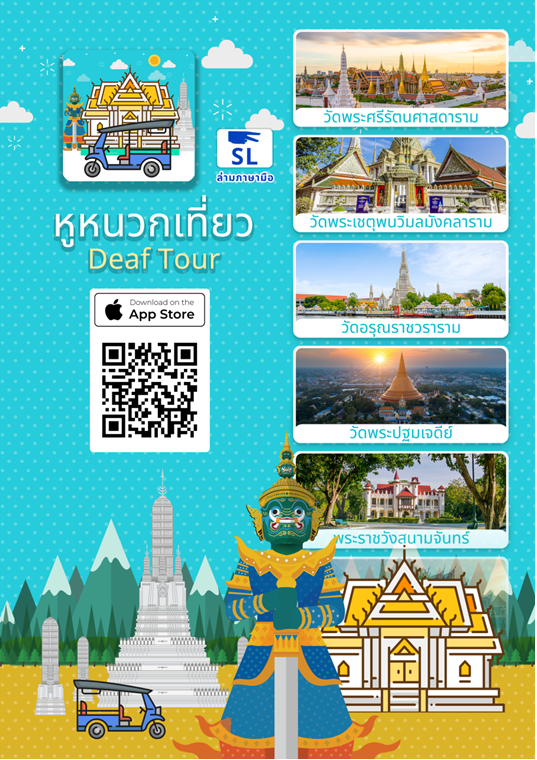
The Development of Historical Tourist Attractions Application for Children with Hearing Impairment in Primary School
DOI:
https://doi.org/10.14456/rc-sdj.2025.09Keywords:
hearing impairment, learning support application, video-based media, historical tourist attractionAbstract
Background: The limitation in accessing historical learning information, which is not designed to suit the perceptual characteristics of students with hearing impairments, prompted the research team to develop and evaluate a learning support application. The objective was to enable hearing-impaired students to access information and learn equally alongside all groups of learners.
Methods: A research and development methodology was employed to design a video-based application that includes visuals, sign language interpreters, and subtitles as a substitute for sound. The target group was selected through purposive sampling and consisted of 40 sixth-grade students from schools for the hearing impaired in Bangkok and its vicinity. Data were collected using surveys, questionnaires, and pre-, during-, and post-learning tests to assess needs and the application's effectiveness. Descriptive statistics were used to analyze percentages, means, and standard deviations.
Results: Hearing-impaired primary school students expressed a need for a video-based application with visuals, sign language interpreters, and subtitles to support learning and access through teachers, parents, and peers. They showed particular interest in Phra Pathom Chedi Ratcha Wora Maha Wihan, a historical tourist site, primarily because they had never visited it, wished to gain knowledge, and wanted to see the site in person. The developed video application, incorporating visuals, subtitles, and sign language interpretation, was found to be appropriate for the perceptual systems of hearing-impaired students. Post-learning test results showed higher learning performance compared to pre- and during-learning phases.
Conclusions: An application developed with consideration of the perceptual characteristics of hearing-impaired learners can effectively enhance historical learning and information access. Especially when appropriate media is used to match the specific needs of the target group, the learning experience is significantly improved. Furthermore, the study highlights the essential role of surrounding individuals as learning mediators in conjunction with technology.
References
Alit, N. A., Ellias, M. S., & Ahmad, A. D. (2025). Technology Application In Teaching And Learning For Hearing Impaired Students: A Recent Systematic Review. International Journal of Education, Psychology and Counseling, 10 (58), 541-561. https://doi.org/10.35631/IJEPC.1058036
Announcement of the National Broadcasting and Telecommunications Commission On the promotion and protection of the rights of disabled persons to access, be aware of and utilize television programs (No. 7). (2017, December 27). Royal Thai Government Gazette. Volume 134, Special Issue 322 Ng. Pages 27-32.
Arena, F., Collotta, M., Pau, G., & Termine, F. (2022). An overview of augmented reality. Computers, 11(2), 28. https://doi.org/10.3390/computers11020028
Ayomsari, S. W., & Azizah, N. (2024). A Case Study on the Implementation of Inclusive Education for Hearing-Impaired Students in Primary Schools. Jurnal Ilmiah Sekolah Dasar, 8(4), 728-738. https://doi.org/10.23887/jisd.v8i4.86785
Boonchai, C., & Kaewpetch, R. (2013). Study to develop economic potential from historical tourism in the upper central region provinces: a case study of Nakhon Nayok and Prachin Buri provinces. Office of the Higher Education Commission (OHEC).
Boonchuea, T., & Boonchuea, K. (2018). Disabled people and access to communication technology in broadcasting and television for improving quality of life: an analytical, critical and methodological study. Journalism, 9(2), 210-213.
Chaiwatthanakunwanich, S. (2020). Assessment of Standards for Performance Sign Language Interpreters 2018 (2561). Journal of Ratchasuda Institute for Research and Development of Persons with Disabilities, 16(2), 18-35.
Chwaja, K., Chwaja, B., Marczak, I., & Kruczek, Z. (2025). Accessibility of Tourist Attractions for Individuals with Disabilities as a Factor in the Development of Inclusive Tourism: Example of the Świętokrzyskie Region—Poland. Sustainability, 17(9), 3853. https://doi.org/10.3390/su17093853
Domínguez Vila, T., Rubio-Escuderos, L., & Alén González, E. (2024). Accessible tourism: using technology to increase social equality for people with disabilities. Tourism Review, 80(9), 1614-1634. https://doi.org/10.1108/TR-11-2023-0812
Ebbes, P., & Netzer, O. (2022). Using social network activity data to identify and target job seekers. Management Science, 68(4), 3026-3046. https://doi.org/10.1287/mnsc.2021.3995
Ertzgaard, S. I., Kristin, N., Sofie, T., Sindberg, H. G., Bang, H. T., Cosmas, M., Vedul, T. T., & Jon, Ø. (2020). Prevalence of hearing impairment among primary school children in the Kilimanjaro region within Tanzania. International Journal of Pediatric Otorhinolaryngology, 130, 109797. https://doi.org/10.1016/j.ijporl.2019.109797
Evans, R. J. (2002). Prologue: What is history?—now. In What is history now? (pp. 1-18). Palgrave Macmillan UK.
Gall, M. D., Borg, W. R., & Gall, J. P. (1996). Educational research: An introduction. Longman.
Gento, S., Ferrádiz, I., & Orden, J. (2011). Physical education for addressing diversity. UNED.
Hanpachern, R., & Chatkaewnapanon, Y. (2013). Understanding a tourist destination: a tourism history approach. International Journal of asian social science, 3(12), 2399-2408.
Hussain, B. (2021). Perceived Applicability of Educational Management Information System [EMIS] in Secondary Schools using the TOE Framework. Pakistan Social Sciences Review, 5, 581-596.
Kloieiam, S. (2018). Study of the effectiveness of health care demonstration video clips for students with hearing impairments. Office of the Committee of Qualified Persons.
Krajnik, I., & Demeter, R. (2024, May). QR Code Applications Digital Literacy Skills in Today's Technology-Driven World in the Field of Education. In 2024 IEEE 18th International Symposium on Applied Computational Intelligence and Informatics (SACI) (pp. 000211-000216). IEEE.
Meechamnan, S. (2012). Development of multimedia computer lessons on Phimai Historical Park for students of the Youth Volunteer Tourist Assistance Project, Phimai Witthaya School [Master’s thesis]. Central Library, Srinakharinwirot University. https://ir.swu.ac.th/handle/123456789/585
Mumba, D. (2022). Perceptions of teachers and pupils on factors affecting academic performance of pupils with hearing impairement in selected special schools in Muchinga and Northern provinces, Zambia [Doctoral dissertation, The University of Zambia].
Office of Special Education Administration. (n.d.). Special schools for the disabled, under the group of educational institutions under the Office of Special Education Administration, Group 1. [Unpublished manuscript].
Orak, C., & Turan, Z. (2024). Using artificial intelligence in digital video production: A systematic review study. Journal of Educational Technology and Online Learning, 7(3), 286-307. https://doi.org/10.31681/jetol.1459434
Patel, P., Pampaniya, S., Ghosh, A., Raj, R., Karuppaih, D., & Kandasamy, S. (2025). Enhancing accessibility through machine learning: A review on visual and hearing impairment technologies. IEEE Access, 13, 33286-33307. https://doi.org/10.1109/ACCESS.2025.3539081
Pérez-Navarro, A., García, V., & Conesa, J. (2020). Students perception of videos in introductory physics courses of engineering in face-to-face and online environments. Multimedia Tools and Applications, 80, 1009-1028. https://doi.org/10.1007/s11042-020-09665-0
Phromwong, C. (2013). Testing the effectiveness of media or teaching materials. Journal of Silpakorn University Educational Research, 5,(1), 7-20.
Pinla, W. (2017). Techniques for teaching history for social studies teachers in the 21st century. Parichart Journal, 30(2), 1-19.
Rathore, A. A., Sultana, N., Zareen, S. J., & Ahmed, A. (2023). Artificial Intelligence and Curriculum Prospects for Elementary School. Pakistan Journal of Humanities and Social Sciences, 11(4), 4635–4644. https://doi.org/10.52131/pjhss.2023.v11i4.1909
Rodríguez, M., & Arroyo, M. J. (2014). ICTs for inclusive education. Digital Education Review, 25, 108-126.
Saenboonsong, S., Emrat, N., & Jantrasi, S. (2018). The Development of Multimedia for Learning on Search Engine of Seventh Grade Students at Wat Phrakhao School, Phranakhon Si Ayutthaya. Journal of Education and Learning Innovation, 4(2), 1-15.
Siri, K., Suwansri, P., & Manoruang, S. (2018). Complete research report: Using information technology to promote ecotourism at historical learning sites in Chiang Mai. Chiang Mai Royal University.
Songkram, N. (2010). Multimedia Design and Development for Learning (2nd ed.). Chulalongkorn University Press.
Srirattakul, P. (2014). Accessibility of information for self-reliance of the hearing impaired: A case study of Chonburi Province. Journal of Political Science Review, Kasetsart University, 1(1), 130-152.
Srisa-art, B. (2017). Preliminary research (10th ed.). Suwiriyasan.
Uengpetch, J. (2020). The development of package learning through by historical method local bongti prathomsuksa 5 students. Journal of Education Silpakorn University, 17(2), 90-103.
Vuković, B., Ristić, I., & Ćalasan, S. (2024). Inclusion in education and hearing impairment. Education and upbringing, 19(21), 79-95. https://doi.org/10.5937/obrvas19-51414
Walan, S. (2024). Primary school students’ perceptions of artificial intelligence-for good or bad. International Journal of Technology and Design Education, 1–16. https://doi.org/10.1007/s10798-024-09898-2
Williams, A. M. (2010). Mass tourism, culture and the historic city: Theoretical perspectives. Rivista di Scienze del Turismo-Ambiente Cultura Diritto Economia, 1(2), 9-29.
Wongkorm, K., Hongngam, K., Vinitastitkun, P., & Maneerat, S. (2023). The Development of Digital Technology for Deaf to Promote Access to Information of Archaeological Sites and Tourist Attractions. Research Community and Social Development Journal, 17(3), 57–70. https://doi.org/10.14456/nrru-rdi.2023.35
Zhao, X., Ren, Y., & Cheah, K. S. (2023). Leading virtual reality (VR) and augmented reality (AR) in education: bibliometric and content analysis from the web of science (2018–2022). Sage Open, 13(3), 21582440231190821. https://doi.org/10.1177/21582440231190821