An Analysis of Chinese Business Investment Patterns and Their Impacts on the Livelihoods of People in the Thai-Lao Border Area
DOI:
https://doi.org/10.14456/rc-sdj.2025.10Keywords:
Chinese business investment patterns, livelihood impacts, Thai–Lao border areaAbstract
Background: Chinese investment in the Thai–Lao border area, driven by socio-economic mechanisms such as economic development projects, railway systems, and special economic zones, has influenced local economies, lifestyles, and people’s livelihoods. Therefore, this study aims to analyze the patterns of Chinese business investment and to examine its economic, social, and educational impacts on residents in the border region.
Methods: This study employed a mixed-methods approach using purposive sampling. The samples included 366 respondents, 26 target participants, and 14 key informants. Field data were collected with written informed consent from all participants through structured interviews and observation checklists, which demonstrated content validity indices ranging from 0.67 to 1.00. The questionnaire achieved an overall reliability coefficient of 0.86. Data were analyzed through interpretive and conceptual analysis, descriptive statistics (frequency and percentage), and inferential statistics, including correlation analysis and two-group logistic regression.
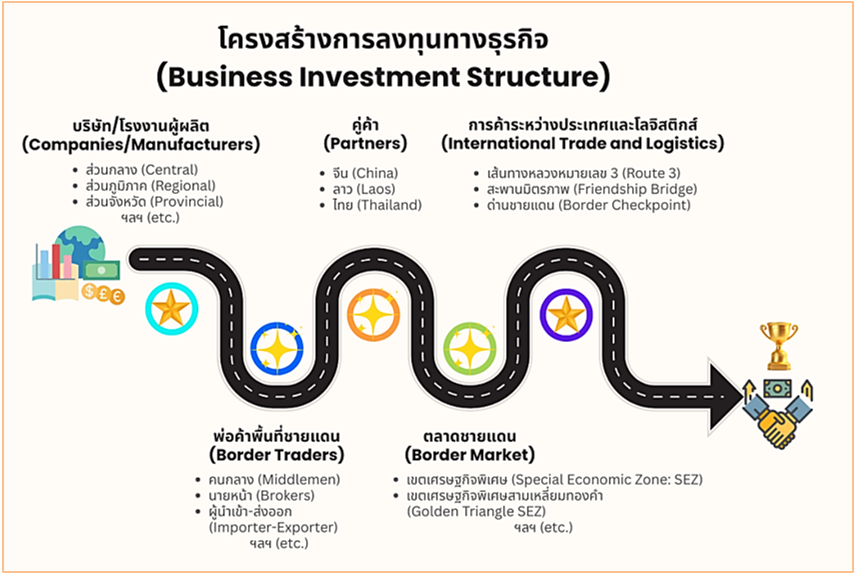
Results: The structure of Chinese business investment comprised manufacturers or factories, border traders, border market partners, and international trade and logistics enterprises, thereby reflecting the patterns of Chinese business investment in the Thai–Lao border area. Perceptions of impacts on living conditions and livelihoods were reported highest for education (57.10%) and lowest for economic aspects (49.90%). Personal, socioeconomic, and environmental factors showed a low level of impact on the economy (19.10%) and a moderate level of impact on society (24.90%). Education level was found to show a significant positive influence on both economic impacts (B=0.097, p=0.004) and social impacts (B=0.086, p=0.007) at the 0.05 significance level.
Conclusions: Enhancing education is a critical factor in improving economic and social quality of life. Increased local residency (Thai–Lao), agricultural land use, and household environments tended to reduce economic impacts, while environmental factors continued to contribute positively to social well-being. Strengthening Chinese trade activities, procurement and export patterns, infrastructure development, special economic zones, business expansion, and regulatory cooperation are essential for achieving sustainable and balanced development in the Thai–Lao border area.
References
Adhikari, O. (2018). Sustainable development and its challenges in developing countries. International Young Nature Friends.
Allen, S., & Girei, E. (2024). Developing decolonial reflexivity: Decolonizing management education by confronting white skin, white identities, and whiteness. Academy of Management Learning & Education, 23(2), 246-264. https://doi.org/10.5465/amle.2022.0387
Benbourenane, O. H. (2024). Thailand’s Journey With China’s Belt and Road: a Nine-year Odyssey Under General Prayut’s Leadership (2014-2023). Asian Affairs, 55(2), 289-316. https://doi.org/10.1080/03068374.2024.2384642
Bengana, I., Mili, K., Soliman, Y., Hassan, E. A. A. E., & Mehaouat, L. H. (2025). Population models, theories, and policies. Pakistan Journal of Life and Social Sciences (PJLSS), 23(1), 4895-4907. https://doi.org/10.57239/PJLSS-2025-23.1.00389
Boonchai, K., Maneepong, C., & Panyong, P. (2020). Assessment of damage, impact and adaptation of local communities to the COVID-19 pandemic. King Prajadhipok's Institute.
Buerkle, A., O'Dell, A., Matharu, H., Buerkle, L., & Ferreira, P. (2023). Recommendations to align higher education teaching with the UN sustainability goals–A scoping survey. International Journal of Educational Research Open, 5, 100280. https://doi.org/10.1016/j.ijedro.2023.100280
Cardon, M. S., Glauser, M., & Murnieks, C. Y. (2017). Passion for what? Expanding the domains of entrepreneurial passion. Journal of Business Venturing Insights, 8, 24–32. https://doi.org/10.1016/j.jbvi.2017.05.004
Cebrián, g., Junyent, M., & Mulà, i. (2020). Competencies in education for sustainable development: emerging teach-ing and research developments. Sustainability, 12(2), 579. https://doi.org/10.3390/su12020579
Charoensri, N. (2023). Civil Society and Regional Connectivity: Governing the Transforming Connectivity at Thai-Laos Border. In Governance in Transitional Societies in East and Southeast Asia (pp. 77-89). Springer. https://doi.org/10.1007/978-981-99-5306-6_4
Chiang, M. H., & de Micheaux, E. L. (2022). China's outward foreign direct investment in Southeast Asia: Analyzing the Chinese state's strategies and potential influence. Thunderbird International Business Review, 64(6), 581-593. https://doi.org/10.1002/tie.22311
Cronbach, L. J. (1990). Essentials of Psychological Testing (5th ed.). Harper.
Erjavec, E. (2020). Reinforcement of Social Sustainability through Education and Public Intangible Capital. In Challenges on the Path Toward Sustainability in Europe (pp. 253-270). Emerald Publishing Limited.
Isgren, e., & Longo, S. B. (2024). Social sustainability: More confusion than clarity. Journal of Environmental Studies and Sciences, 14(4), 820–825. https://doi.org/10.1007/s13412-024-00978-2
Kaes, M., Kruse, S., Maus, C., Krieweth, C., & Brettel, M. (2025). Entrepreneurs can create a better tomorrow: The relationship between entrepreneurial grit, nonfinancial success, and societal impact. Journal of Small Business Management, 63(2), 653-685. https://doi.org/10.1080/00472778.2024.2342839
Khecharanan, N. (2005). Management. SE-Education.
Kim, A. (2025). Harambee! A triadic perspective on social impact: Organizations, evaluators, and target beneficiaries in Kenya. Administrative Science Quarterly, 70(1), 246-291. https://doi.org/10.1177/0001839224130358
Kokkhangplu, A., Koodsela, W., & Onlamai, W. (2024). The innovative Belt and Road Initiative driving economic corridors between China and Thailand. International Journal of Science and Innovative Technology, 7(2), 21-34.
Liu, S., He, Q., Lin, Z., O'Regan, N., & Zhong, Z. (2025). When Do Environmental Regulations Lead to Green Practices? The Role of Resource Commitment and Corporate Entrepreneurship. Business Strategy and the Environment, 1-16. https://doi.org/10.1002/bse.70106
Mickwitz, P., Melanen, M., Rosenström, U., & Seppälä, J. (2006). Regional eco-efficiency indicators a participatory approach. Journal of Cleaner Production, 14(18), 1603-1611. https://doi.org/10.1016/j.jclepro.2005.05.025
Office of the National Security Council. (2023). Border Management Action Plan (2023-2027). https://www.nsc.go.th/wp-content/uploads/2023/04/Action-Plan-on-Border-Security-Management-66-70.pdf
Oryani, B., Moridian, A., Rezania, S., Vasseghian, Y., Bagheri, M., & Shahzad, K. (2022). Asymmetric impacts of economic uncertainties and energy consumption on the ecological Footprint: Implications apropos structural transformation in South Korea. Fuel, 322, 124180. https://doi.org/10.1016/j.fuel.2022.124180
Phonsaram, P., Malison, T., & Sitthileot, T. (2014). Western Land Trade. International Institute for Trade and Development.
Phophiraksanan, N. (2017). Research methodology. Principles and concepts. Techniques for writing research reports (8th ed.). Active Print.
Photisita, C. (2009). Science and art of qualitative research (4th ed.). Amarin Printing and Publishing.
Prasitratsin, S. (2005). Multivariate analysis techniques for social and behavioral science research: principles, methods and applications (5th ed.). Samlada.
Rovinelli R. J., & Hambleton R. K. (1977). On the use of content specialists in the assessment of criterion-referenced test item validity. Dutch Journal for Educational Research, 2, 49–60.
Schaltegger, S., & Synnestvedt, T. (2002). The link between ‘green’ and economic success: environmental management as the crucial trigger between environmental and economic performance. Journal of Environmental Management, 65(4), 339-346.
Schmitz, M. A., Cordova, M., Cankar, T., & Marko-Wieser, L. (2024). Exploring the sustainability mindset for management education with a focus on social sustainability. In The Palgrave Handbook of Social Sustainability in Business Education (pp. 423-441). Springer Nature Switzerland.
Shashi, M. (2022). The sustainability strategies in the Pharmaceutical Supply Chain: A Qualitative research. International Journal of Engineering and Advanced Technology, 11, 90-95.
Strategy and Planning Division, Office of the Permanent Secretary. (2024). Annual Operational Plan 2025 of the Ministry of Commerce. Ministry of Commerce. https://www.moc.go.th/th/file/get/file/202412199eef149ea8eb 531472053ecaba87181a101556.pdf
United Nations Conference on Trade and Development (UNCTAD). (2023). World Investment Report 2023. United Nations.
Wanichbancha, K. (2018). Statistics for research (12th ed.). Samlada.
Zaerens, K., & Tuukkanen, V. (2025). Conceptual model for determining societal impact of innovation. Innovative Business Development and Sustainability, 84-94.