การวิเคราะห์รูปแบบการลงทุนทางธุรกิจของจีนและผลกระทบต่อความเป็นอยู่ของประชาชนในพื้นที่ชายแดนไทย-ลาว
DOI:
https://doi.org/10.14456/rc-sdj.2025.10คำสำคัญ:
รูปแบบการลงทุนทางธุรกิจของจีน, ผลกระทบต่อความเป็นอยู่, ประชาชนในพื้นที่ชายแดนไทย-ลาวบทคัดย่อ
ที่มา(ภูมิหลัง): การลงทุนของจีนในพื้นที่ชายแดนเติบโตผ่านโครงการเศรษฐกิจ รถไฟ และเขตพิเศษ ซึ่งมีผลต่อเศรษฐกิจท้องถิ่น วิถีชีวิต และประชาชน จึงจำเป็นต้องมีการวิจัยตามวัตถุประสงค์เพื่อวิเคราะห์รูปแบบการลงทุนทางธุรกิจการค้าของจีน ศึกษาผลกระทบทางเศรษฐกิจ สังคม และศึกษาจากการลงทุนของจีนต่อประชาชนในพื้นที่ชายแดนไทย-ลาว
วิธีการ: ระเบียบวิธีวิจัยเชิงผสมผสาน ใช้วิธีเลือกหน่วยตัวอย่างโดยไม่ใช้ความน่าจะเป็นด้วยการเลือกแบบเฉพาะเจาะจง กลุ่มตัวอย่าง 366 คน กลุ่มเป้าหมาย 26 คน และกลุ่มผู้ให้ข้อมูลสำคัญ 14 คน เก็บรวบรวมข้อมูลภาคสนาม ซึ่งได้รับความยินยอมเป็นลายลักษณ์อักษรจากหน่วยตัวอย่างทุกกลุ่มด้วยแบบสัมภาษณ์ชนิดมีโครงสร้างและแบบสังเกตการณ์ที่มีค่าความตรงเชิงเนื้อหาอยู่ระหว่าง 0.67-1.00 และแบบสอบถามมีค่าความเชื่อมั่นทั้งฉบับเท่ากับ 0.86 โดยทำการวิเคราะห์ข้อมูลโดยใช้วิธีการตีความร่วมกับการวิเคราะห์เชิงแนวคิด และใช้สถิติเชิงพรรณนาในการหาจำนวนและร้อยละ สำหรับการทดสอบสมมติฐาน โดยใช้สถิติเชิงอนุมานในการวิเคราะห์ความสัมพันธ์และวิเคราะห์การถดถอยโลจิสติกแบบ 2 กลุ่ม
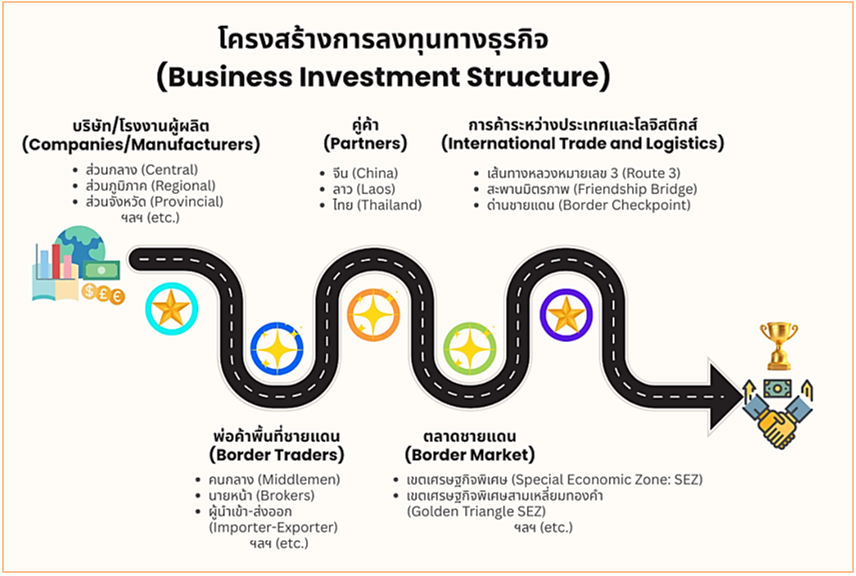
ผลลัพธ์: โครงสร้างการลงทุนทางธุรกิจ ประกอบด้วย บริษัทหรือโรงงานผู้ผลิต พ่อค้าในพื้นที่ชายแดน คู่ค้า ตลาดชายแดน และการค้าระหว่างประเทศและโลจิสติก แสดงให้เห็นรูปแบบการลงทุนทางธุรกิจการค้าของจีนในพื้นที่ตามแนวชายแดนไทย-ลาว โดยมีผลกระทบต่อความเป็นอยู่ส่วนใหญ่ คือ ด้านการศึกษา (ร้อยละ 57.10) และส่วนน้อย คือ ด้านเศรษฐกิจ (ร้อยละ 49.90) สำหรับปัจจัยส่วนบุคคล เศรษฐกิจสังคม และสิ่งแวดล้อม มีผลกระทบด้านเศรษฐกิจระดับน้อย (ร้อยละ 19.10) และด้านสังคมระดับปานกลาง (ร้อยละ 24.90) โดยปัจจัยด้านระดับการศึกษา มีอิทธิพลเชิงบวกต่อผลกระทบด้านเศรษฐกิจ (B=0.097, p=0.004) และด้านสังคม (B=0.086, p=0.007) อย่างมีนัยสำคัญทางสถิติที่ระดับ 0.05
บทสรุป: การยกระดับการศึกษาเป็นปัจจัยสำคัญที่ช่วยส่งเสริมคุณภาพชีวิตทางเศรษฐกิจและสังคมให้ดีขึ้น การเพิ่มขึ้นของภูมิลำเนา (ไทย–ลาว) การใช้ประโยชน์ที่ดินทำการเกษตร และสภาพแวดล้อมติดบ้านเรือน มีแนวโน้มที่จะเกิดผลกระทบด้านเศรษฐกิจลดลง ขณะเดียวกัน ความสำคัญของปัจจัยด้านสิ่งแวดล้อมเอื้อต่อคุณภาพชีวิตทางสังคมของประชาชน โดยบูรณาการความเชื่อมโยงบทบาทและกิจกรรมทางธุรกิจการค้าจีน รูปแบบการสั่งซื้อและส่งออกสินค้า การพัฒนาโครงสร้างพื้นฐานและโครงสร้างเขตเศรษฐกิจพิเศษ การขยายทางกิจกรรมการค้าและการลงทุนเชิงบวก ความร่วมมือและมาตรกำกับดูแล
เอกสารอ้างอิง
Adhikari, O. (2018). Sustainable development and its challenges in developing countries. International Young Nature Friends.
Allen, S., & Girei, E. (2024). Developing decolonial reflexivity: Decolonizing management education by confronting white skin, white identities, and whiteness. Academy of Management Learning & Education, 23(2), 246-264. https://doi.org/10.5465/amle.2022.0387
Benbourenane, O. H. (2024). Thailand’s Journey With China’s Belt and Road: a Nine-year Odyssey Under General Prayut’s Leadership (2014-2023). Asian Affairs, 55(2), 289-316. https://doi.org/10.1080/03068374.2024.2384642
Bengana, I., Mili, K., Soliman, Y., Hassan, E. A. A. E., & Mehaouat, L. H. (2025). Population models, theories, and policies. Pakistan Journal of Life and Social Sciences (PJLSS), 23(1), 4895-4907. https://doi.org/10.57239/PJLSS-2025-23.1.00389
Boonchai, K., Maneepong, C., & Panyong, P. (2020). Assessment of damage, impact and adaptation of local communities to the COVID-19 pandemic. King Prajadhipok's Institute.
Buerkle, A., O'Dell, A., Matharu, H., Buerkle, L., & Ferreira, P. (2023). Recommendations to align higher education teaching with the UN sustainability goals–A scoping survey. International Journal of Educational Research Open, 5, 100280. https://doi.org/10.1016/j.ijedro.2023.100280
Cardon, M. S., Glauser, M., & Murnieks, C. Y. (2017). Passion for what? Expanding the domains of entrepreneurial passion. Journal of Business Venturing Insights, 8, 24–32. https://doi.org/10.1016/j.jbvi.2017.05.004
Cebrián, g., Junyent, M., & Mulà, i. (2020). Competencies in education for sustainable development: emerging teach-ing and research developments. Sustainability, 12(2), 579. https://doi.org/10.3390/su12020579
Charoensri, N. (2023). Civil Society and Regional Connectivity: Governing the Transforming Connectivity at Thai-Laos Border. In Governance in Transitional Societies in East and Southeast Asia (pp. 77-89). Springer. https://doi.org/10.1007/978-981-99-5306-6_4
Chiang, M. H., & de Micheaux, E. L. (2022). China's outward foreign direct investment in Southeast Asia: Analyzing the Chinese state's strategies and potential influence. Thunderbird International Business Review, 64(6), 581-593. https://doi.org/10.1002/tie.22311
Cronbach, L. J. (1990). Essentials of Psychological Testing (5th ed.). Harper.
Erjavec, E. (2020). Reinforcement of Social Sustainability through Education and Public Intangible Capital. In Challenges on the Path Toward Sustainability in Europe (pp. 253-270). Emerald Publishing Limited.
Isgren, e., & Longo, S. B. (2024). Social sustainability: More confusion than clarity. Journal of Environmental Studies and Sciences, 14(4), 820–825. https://doi.org/10.1007/s13412-024-00978-2
Kaes, M., Kruse, S., Maus, C., Krieweth, C., & Brettel, M. (2025). Entrepreneurs can create a better tomorrow: The relationship between entrepreneurial grit, nonfinancial success, and societal impact. Journal of Small Business Management, 63(2), 653-685. https://doi.org/10.1080/00472778.2024.2342839
Khecharanan, N. (2005). Management. SE-Education.
Kim, A. (2025). Harambee! A triadic perspective on social impact: Organizations, evaluators, and target beneficiaries in Kenya. Administrative Science Quarterly, 70(1), 246-291. https://doi.org/10.1177/0001839224130358
Kokkhangplu, A., Koodsela, W., & Onlamai, W. (2024). The innovative Belt and Road Initiative driving economic corridors between China and Thailand. International Journal of Science and Innovative Technology, 7(2), 21-34.
Liu, S., He, Q., Lin, Z., O'Regan, N., & Zhong, Z. (2025). When Do Environmental Regulations Lead to Green Practices? The Role of Resource Commitment and Corporate Entrepreneurship. Business Strategy and the Environment, 1-16. https://doi.org/10.1002/bse.70106
Mickwitz, P., Melanen, M., Rosenström, U., & Seppälä, J. (2006). Regional eco-efficiency indicators a participatory approach. Journal of Cleaner Production, 14(18), 1603-1611. https://doi.org/10.1016/j.jclepro.2005.05.025
Office of the National Security Council. (2023). Border Management Action Plan (2023-2027). https://www.nsc.go.th/wp-content/uploads/2023/04/Action-Plan-on-Border-Security-Management-66-70.pdf
Oryani, B., Moridian, A., Rezania, S., Vasseghian, Y., Bagheri, M., & Shahzad, K. (2022). Asymmetric impacts of economic uncertainties and energy consumption on the ecological Footprint: Implications apropos structural transformation in South Korea. Fuel, 322, 124180. https://doi.org/10.1016/j.fuel.2022.124180
Phonsaram, P., Malison, T., & Sitthileot, T. (2014). Western Land Trade. International Institute for Trade and Development.
Phophiraksanan, N. (2017). Research methodology. Principles and concepts. Techniques for writing research reports (8th ed.). Active Print.
Photisita, C. (2009). Science and art of qualitative research (4th ed.). Amarin Printing and Publishing.
Prasitratsin, S. (2005). Multivariate analysis techniques for social and behavioral science research: principles, methods and applications (5th ed.). Samlada.
Rovinelli R. J., & Hambleton R. K. (1977). On the use of content specialists in the assessment of criterion-referenced test item validity. Dutch Journal for Educational Research, 2, 49–60.
Schaltegger, S., & Synnestvedt, T. (2002). The link between ‘green’ and economic success: environmental management as the crucial trigger between environmental and economic performance. Journal of Environmental Management, 65(4), 339-346.
Schmitz, M. A., Cordova, M., Cankar, T., & Marko-Wieser, L. (2024). Exploring the sustainability mindset for management education with a focus on social sustainability. In The Palgrave Handbook of Social Sustainability in Business Education (pp. 423-441). Springer Nature Switzerland.
Shashi, M. (2022). The sustainability strategies in the Pharmaceutical Supply Chain: A Qualitative research. International Journal of Engineering and Advanced Technology, 11, 90-95.
Strategy and Planning Division, Office of the Permanent Secretary. (2024). Annual Operational Plan 2025 of the Ministry of Commerce. Ministry of Commerce. https://www.moc.go.th/th/file/get/file/202412199eef149ea8eb 531472053ecaba87181a101556.pdf
United Nations Conference on Trade and Development (UNCTAD). (2023). World Investment Report 2023. United Nations.
Wanichbancha, K. (2018). Statistics for research (12th ed.). Samlada.
Zaerens, K., & Tuukkanen, V. (2025). Conceptual model for determining societal impact of innovation. Innovative Business Development and Sustainability, 84-94.