Development of a Learning Experience Model, the PEDRA Model, On the Topic of "The Essence of Colors," To Enhance Hand-Eye Coordination for Young Children Aged 3-5 Years
DOI:
https://doi.org/10.14456/rc-sdj.2025.13Keywords:
PEDRA model, the essence of colors, hand-eye coordination, early childhoodAbstract
Background: The conceptual basis and necessity of organizing experiences that connect interests, practice, and develop skills of early childhood learners. The objectives are to study basic information, create and evaluate the effectiveness of the experience format, and assess its impact on promoting hand-eye coordination in young children aged 3-5 years.
Methods: Research and development, including early childhood parents, teachers, personnel, experts, and young children, and senior experts. The target group of 75 was selected using purposive sampling. The study used an opinion assessment form, a literature review, an effectiveness assessment form, and a one-group pre-post quasi-experimental design. The tools, which include content validation, data collection through field surveys, focus groups, and interviews, organizing activities, experiments, and evaluations, have been tested. Data through field surveys, focus groups, interviews, activities, experiments, and estimates. The data were analyzed using mean and standard deviation, the 80/80 calculation, paired t-test, and content analysis.
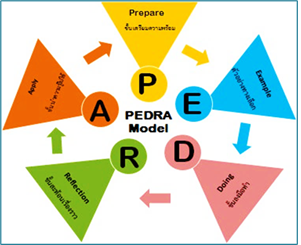
Results: Young children aged 3-5 years receive moderate learning experiences. Developed the PEDRA model for preparation, examples, hands-on practice, reflection, and application of knowledge. And the experience plan, according to the format, is most appropriate. The process and outcome efficiency met the 80/80 criteria, and the post-learning achievement was higher than before learning. Lastly, after the experience, coordination of hand and eye muscles was higher than before, resulting in the most satisfying and effective.
Conclusions: The development of the PEDRA model on the essence of color is appropriate and highly effective for young children aged 3-5 years. Key findings from the implementation include: Young children who received learning experiences showed increased achievement. Improvements were in hand-eye coordination skills. Participants were the learning experience. The model's success is appropriate for this age group and the effective delivery of the topic.
References
Ajat, A., & Amaliani, R. (2025). Evaluation of Blended Learning Model of HighScope and Montessori at TK Early Step Kebagusan South Jakarta. Journal of Scientific Research, Education, and Technology (JSRET), 4(2), 1179–1189. https://doi.org/10.58526/jsret.v4i2.773
Davis, K., Christodoulou, J., Seider, S., & Gardner, H. (2011). The theory of multiple intelligences. In R. J. Sternberg & S.B. Kaufman (Eds.), Cambridge Handbook of Intelligence (pp. 485-503). Cambridge University Press.
Department of Academic Affairs. (2002). Thai language learning management manual. The Transport and Parcel Organization Printing House.
Early Childhood Development Act B.E. 2019. (2019, April 30). Royal Gazette. Volume 136, Chapter 56 A, pp. 1-28.
Fisher, J., & Terry, A. (1977). Children’s Language and the Language Arts. McGraw-Hill.
Gesell, A. (1947). The First Five Years of Life: A guide to the Study of the Preschool Child. Harper.
Hohmann, M., Weikart, D. P., & Epstein, A. S. (1995). Educating young children: Active learning practices for preschool and child care programs. High/Scope Press.
Jamroennao, W. (2025). The development of basic mathematical thinking skills in preschool children using a teaching method. High Scope students at the Ban Khao Chong Khab Child Development Center in Sa Kaeo. Wisdom Journal of Humanities and Social Science, 2(4), 1-10.
Kaemmanee, T. (2008). 14 Teaching Methods for Professional Teachers. Chulalongkorn University Press.
Kaemmanee, T. (2019). Teaching Science: Knowledge for Organizing Effective Learning Processes (23rd ed.). Chulalongkorn University Press.
Kanchanawasi, S. (2013). Traditional teaching theory (7th ed.). Chulalongkorn University Press.
Kittakarn, P. (2001). Effectiveness Index. Faculty of Education, Maha Sarakham University.
Klichaya, P. (2021). Integrated Communication Design. Chulalongkorn University Press.
Krogh, S. L., & Morehouse, P. (2020). The Early Childhood Curriculum: Inquiry Learning Through Integration (3rd ed.). Routledge. https://doi.org/10.4324/9780429280764
Malijan, J., Assapaporn, N., & Swathanan, S. (2025). Organizing Creative Art Activities Based on the HighScope Approach to Develop Fine Motor Skills and Executive Function in Early Childhood. Journal of Curriculum and Instruction, Chiang Mai University, 4(1), 63-79.
Ministry of Education. (2017). Early Childhood Education Curriculum 2017. Agricultural Cooperative Printing House.
Office of Educational Standards. (2025). Early Childhood Education Curriculum Guide 2025 for Children Aged 3-6 Years. Office of the Basic Education Commission.
Prachakun, W., & Nuengchalem, P. (2011). Teaching and learning model (2nd ed.). Maha Sarakham University Press.
Solomon, M. R. (2017). Consumer Behavior A Strategic Approach (2nd ed.). Routledge.
Srisa-at, B. (2010). Research for Teachers (8th ed.). Suwiriyasarn.
Srisa-at, B. (2017). Preliminary research (10th ed.). Suwiriyasarn.
Tantiphalachiwa, K. (2008). Organizing learning activities for early childhood. Brain-Base.
Thaewthaisong, T., & Chiwakumnuan, P. (2025). Organizing a High-scope Learning Experience with a Set of Hand Gesture Art Practice to Promote the Development of Fine Motor in Early Childhood. Rajabhat Rambhai Barni Research Journal, 19(2), 53-61.
Wenner, L. A. (1985). The Nature of Gratifications. In Media Gratifications Research: Current Perspective (pp. 171-193). Sage.