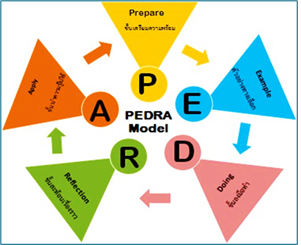
การพัฒนารูปแบบการจัดประสบการณ์ PEDRA model เรื่อง สาระแห่งสีสัน เพื่อส่งเสริมความสามารถในการใช้กล้ามเนื้อมือและตาให้ประสานสัมพันธ์กันสำหรับเด็กเล็กอายุ 3-5 ปี
DOI:
https://doi.org/10.14456/rc-sdj.2025.13คำสำคัญ:
รูปแบบจัดประสบการณ์เรียนรู้, กิจกรรมเรียนรู้สาระแห่งสีสัน, การใช้มือและตา, เด็กปฐมวัยบทคัดย่อ
ที่มา(ภูมิหลัง): ฐานความคิดและความจำเป็นในการจัดประสบการณ์ที่เชื่อมโยงความสนใจ การลงมือปฏิบัติ และพัฒนาทักษะจริงของผู้เรียนระดับปฐมวัย นำมาสู่การวิจัยที่มีวัตถุประสงค์เพื่อศึกษาข้อมูลพื้นฐาน ทำการสร้างและประเมินประสิทธิภาพ ศึกษาผลการใช้และประเมินรูปแบบการจัดประสบการณ์เพื่อส่งเสริมความสามารถการใช้กล้ามเนื้อมือและตาให้ประสานสัมพันธ์กันสําหรับเด็กเล็กอายุ 3-5 ปี
วิธีการ: การวิจัยและพัฒนา กำหนดกลุ่มเป้าหมาย 75 คน ได้แก่ ผู้ปกครองเด็กปฐมวัย ครูและบุคลากร ผู้เชี่ยวชาญ เด็กเล็ก และผู้ทรงคุณวุฒิ ด้วยวิธีการเลือกแบบเจาะจง โดยใช้แบบประเมินความคิดเห็น การทบทวนวรรณกรรม แบบประเมินประสิทธิผล รูปแบบกึ่งทดลองก่อนและหลังแบบกลุ่มเดียว แบบประเมินความพึงใจ และแบบประเมินประสิทธิภาพ ที่ผ่านการตรวจสอบความตรงเชิงเนื้อหาในการเก็บรวบรวมข้อมูลด้วยการลงพื้นที่สำรวจ สนทนากลุ่มและสัมภาษณ์ จัดกิจกรรม ทดลอง และประเมินผล โดยข้อมูลที่ได้นำมาวิเคราะห์ด้วยสถิติเพื่อหาค่าเฉลี่ย ส่วนเบี่ยงเบนมาตรฐาน วิธีการคำนวณตามเกณฑ์ 80/80 การใช้สถิติทดสอบความแตกต่าง และการวิเคราะห์เนื้อหา
ผลลัพธ์: เด็กเล็ก 3-5 ปี ได้รับการจัดประสบการณ์เรียนรู้ปานกลาง โดยรูปแบบการจัดประสบการณ์ PEDRA model เรื่อง สาระแห่งสีสัน ที่สร้างและพัฒนาขึ้น ประกอบด้วย การเตรียมความพร้อม การดูตัวอย่าง การลงมือทำ การสะท้อนเรื่องราว และการนำความรู้ไปใช้ และแผนการจัดประสบการณ์ตามรูปแบบมีความเหมาะสมมากที่สุด ประสิทธิภาพด้านกระบวนการและด้านผลลัพธ์เป็นไปตามเกณฑ์ 80/80 และผลสัมฤทธิ์หลังเรียนสูงกว่าก่อนเรียน ซึ่งภายหลังการจัดประสบการใช้กล้ามเนื้อมือและตาให้ประสานสัมพันธ์กันสูงกว่าก่อนการจัดประสบการณ์ ส่งผลให้เกิดความพึงพอใจมากที่สุด และรูปแบบมีประสิทธิภาพมากที่สุด
บทสรุป: การพัฒนารูปแบบ PEDRA model เรื่อง สาระแห่งสีสัน ที่มีความเหมาะสม มีประสิทธิภาพสูง ส่งผลให้เด็กเล็กอายุ 3-5 ปีที่ได้รับประสบการณ์เรียนรู้มีผลสัมฤทธิ์และทักษะการใช้มือและตาประสานสัมพันธ์กันเพิ่มมากขึ้นและเกิดความพึงพอใจมากที่สุด
เอกสารอ้างอิง
Ajat, A., & Amaliani, R. (2025). Evaluation of Blended Learning Model of HighScope and Montessori at TK Early Step Kebagusan South Jakarta. Journal of Scientific Research, Education, and Technology (JSRET), 4(2), 1179–1189. https://doi.org/10.58526/jsret.v4i2.773
Davis, K., Christodoulou, J., Seider, S., & Gardner, H. (2011). The theory of multiple intelligences. In R. J. Sternberg & S.B. Kaufman (Eds.), Cambridge Handbook of Intelligence (pp. 485-503). Cambridge University Press.
Department of Academic Affairs. (2002). Thai language learning management manual. The Transport and Parcel Organization Printing House.
Early Childhood Development Act B.E. 2019. (2019, April 30). Royal Gazette. Volume 136, Chapter 56 A, pp. 1-28.
Fisher, J., & Terry, A. (1977). Children’s Language and the Language Arts. McGraw-Hill.
Gesell, A. (1947). The First Five Years of Life: A guide to the Study of the Preschool Child. Harper.
Hohmann, M., Weikart, D. P., & Epstein, A. S. (1995). Educating young children: Active learning practices for preschool and child care programs. High/Scope Press.
Jamroennao, W. (2025). The development of basic mathematical thinking skills in preschool children using a teaching method. High Scope students at the Ban Khao Chong Khab Child Development Center in Sa Kaeo. Wisdom Journal of Humanities and Social Science, 2(4), 1-10.
Kaemmanee, T. (2008). 14 Teaching Methods for Professional Teachers. Chulalongkorn University Press.
Kaemmanee, T. (2019). Teaching Science: Knowledge for Organizing Effective Learning Processes (23rd ed.). Chulalongkorn University Press.
Kanchanawasi, S. (2013). Traditional teaching theory (7th ed.). Chulalongkorn University Press.
Kittakarn, P. (2001). Effectiveness Index. Faculty of Education, Maha Sarakham University.
Klichaya, P. (2021). Integrated Communication Design. Chulalongkorn University Press.
Krogh, S. L., & Morehouse, P. (2020). The Early Childhood Curriculum: Inquiry Learning Through Integration (3rd ed.). Routledge. https://doi.org/10.4324/9780429280764
Malijan, J., Assapaporn, N., & Swathanan, S. (2025). Organizing Creative Art Activities Based on the HighScope Approach to Develop Fine Motor Skills and Executive Function in Early Childhood. Journal of Curriculum and Instruction, Chiang Mai University, 4(1), 63-79.
Ministry of Education. (2017). Early Childhood Education Curriculum 2017. Agricultural Cooperative Printing House.
Office of Educational Standards. (2025). Early Childhood Education Curriculum Guide 2025 for Children Aged 3-6 Years. Office of the Basic Education Commission.
Prachakun, W., & Nuengchalem, P. (2011). Teaching and learning model (2nd ed.). Maha Sarakham University Press.
Solomon, M. R. (2017). Consumer Behavior A Strategic Approach (2nd ed.). Routledge.
Srisa-at, B. (2010). Research for Teachers (8th ed.). Suwiriyasarn.
Srisa-at, B. (2017). Preliminary research (10th ed.). Suwiriyasarn.
Tantiphalachiwa, K. (2008). Organizing learning activities for early childhood. Brain-Base.
Thaewthaisong, T., & Chiwakumnuan, P. (2025). Organizing a High-scope Learning Experience with a Set of Hand Gesture Art Practice to Promote the Development of Fine Motor in Early Childhood. Rajabhat Rambhai Barni Research Journal, 19(2), 53-61.
Wenner, L. A. (1985). The Nature of Gratifications. In Media Gratifications Research: Current Perspective (pp. 171-193). Sage.