Modeling the Impact of Perceived Frustration on Challenge-Seeking Behavior through Motivation, Effort, and Resilience: Evidence from Chinese Hyper-Casual Game Players
DOI:
https://doi.org/10.14456/rc-sdj.2026.9Keywords:
perceived frustration, player resilience, player effort, challenge-seeking behavior, hyper-casual gamesAbstract
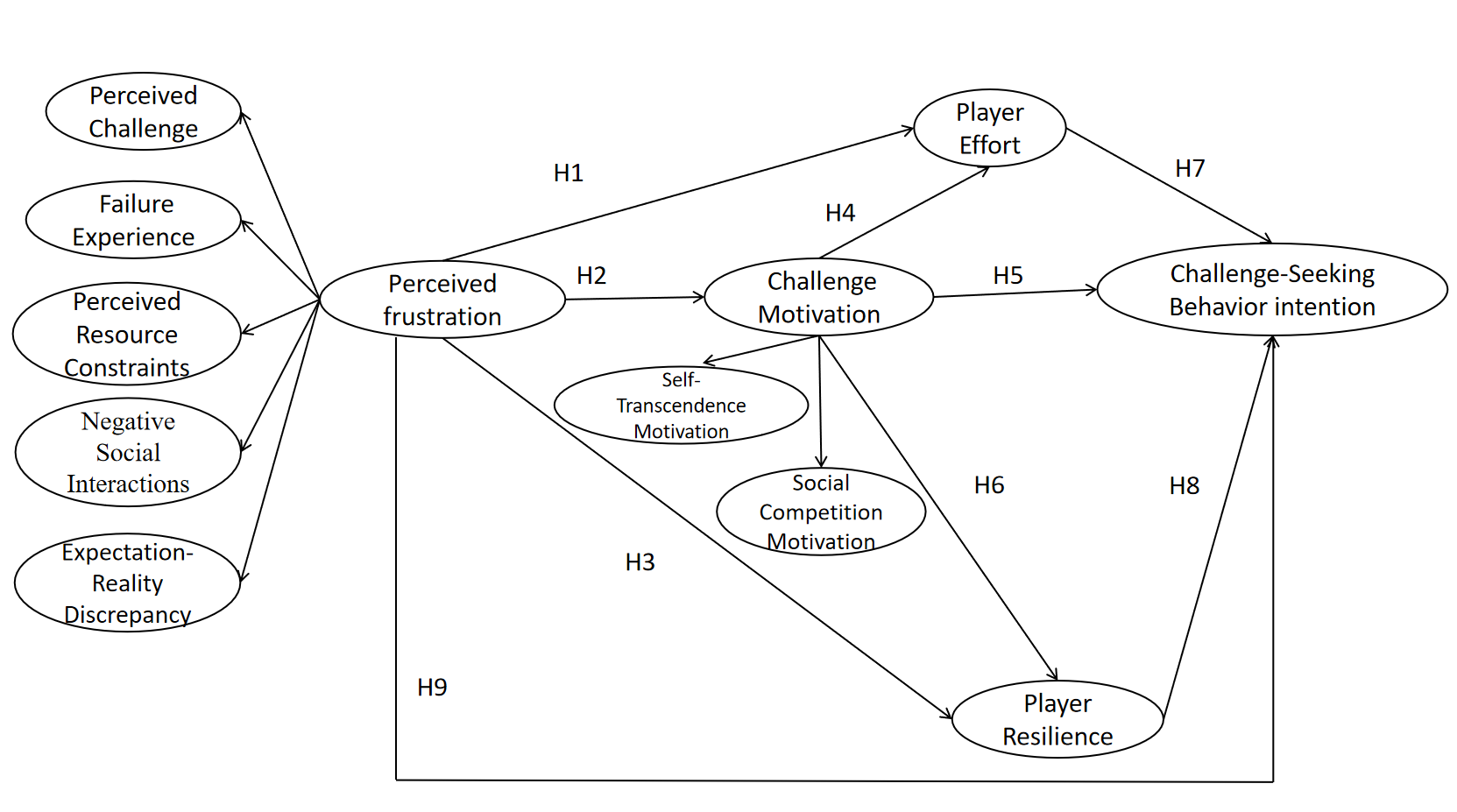
Background and Objective: The hyper-casual games industry in China has rapidly expanded, offering simple gameplay yet highly competitive engagement patterns. However, many players experience frustration due to repetitive challenges and limited rewards, which can influence their motivation and persistence. This study aimed to construct and test a structural model explaining how perceived frustration affects players’ challenge-seeking behavior intention through the mediating roles of challenge motivation, player effort, and player resilience. The objective was to deepen understanding of player psychological dynamics and propose strategies for sustaining engagement in the hyper-casual gaming sector.
Methodology: The study employed a quantitative approach using a survey design. Data were collected from 553 Chinese players of hyper-casual games through an online questionnaire containing 10 constructs measured by 30 indicators on a seven-point Likert scale. The data were analyzed using Partial Least Squares Structural Equation Modeling (PLS-SEM) to examine both direct and indirect relationships among variables. Reliability, convergent validity, and discriminant validity were established before hypothesis testing.
Results: The findings confirmed that perceived frustration significantly influenced challenge motivation, player effort, and resilience. All three mediators positively predicted challenge-seeking behavior intention. Moreover, the indirect effects of perceived frustration on challenge-seeking behavior intention through challenge motivation, player effort, and resilience were significant, with challenge motivation showing the strongest mediating effect. The model explained 72% of the variance in challenge-seeking behavior intention, indicating strong predictive power and model fit.
Discussion and Suggestion: The results highlight that frustration, when perceived as manageable and meaningful, can enhance motivation and resilience rather than discourage players. Game developers are encouraged to design adaptive challenges that balance difficulty and reward to foster positive motivational states. Future studies may explore cultural or genre-specific factors influencing frustration tolerance and player engagement across different gaming contexts.
References
Agrawal, S., & Dalvi, G. (2023). From interviews to experience sampling: Understanding player motivations. Proceedings of the 2023 CHI Conference on Human Factors in Computing Systems, 1–15. https://dl.acm.org/doi/10.1145/3573382.3616094
Amabile, T. M., Hill, K. G., Hennessey, B. A., & Tighe, E. M. (1994). The Work Preference Inventory: Assessing intrinsic and extrinsic motivational orientations. Journal of Personality and Social Psychology, 66(5), 950–967. https://doi.org/10.1037/0022-3514.66.5.950
Amsel, A. (1992). Frustration theory: An analysis of dispositional learning and memory. Cambridge University Press. https://doi.org/10.1017/CBO9780511665561
Atkinson, J. W. (1957). Motivational determinants of risk-taking behavior. Psychological Review, 64(6, Pt. 1), 359–372. https://doi.org/10.1037/h0043445
Bäcklund, C., Elbe, P., Gavelin, H. M., Sörman, D., & Ljungberg, J. (2022). Gaming motivations and gaming disorder symptoms: A systematic review and meta-analysis. Journal of Behavioral Addictions, 11(4), 667–688. https://doi.org/10.1556/2006.2022.00053
Bagozzi, R. P., & Yi, Y. (1988). On the evaluation of structural equation models. Journal of the Academy of Marketing Science, 16, 74–94. https://doi.org/10.1007/BF02723327
Berkowitz, L. (1989). Frustration-aggression hypothesis: Examination and reformulation. Psychological Bulletin,106(1), 59–73. https://doi.org/10.1037/0033-2909.106.1.59
Bessière, K., Seay, A. F., & Kiesler, S. (2007). The ideal elf: Identity exploration in World of Warcraft. Games and Culture, 1(4), 318–340. https://doi.org/10.1089/cpb.2007.9994
Bowman, N. D., Keene, J. R., & Najera, C. J. (2021). Flow encourages task focus, but frustration drives task engagement: How players engage with difficult tasks in video games. Journal of Media Psychology: Theories, Methods, and Applications, 33(3), 131–142. https://doi.org/10.1145/3411764.3445678
Brakus, J. J., Schmitt, B. H., & Zarantonello, L. (2009). Brand experience: What is it? How is it measured? Does it affect loyalty? Journal of Marketing, 73(3), 52–68. https://doi.org/10.1509/jmkg.73.3.52
Brandse, M., & Tomimatsu, K. (2014). Challenge design and categorization in video game design. In A. Marcus (Ed.), Design, user experience, and usability: User experience design for diverse interaction platforms and environments, (pp. 669–677). Springer. https://doi.org/10.1007/978-3-319-07626-3_63
Cacciata, M. C., Stromberg, A., Klompstra, L., Jaarsma, T., Kuriakose, M., Lee, J. A., Lombardo, D., & Evangelista, L. (2022). Facilitators and challenges to exergaming. The Journal of Cardiovascular Nursing, 37(3), 281–288. https://doi.org/10.1097/JCN.0000000000000825
Chamarro, A., Oberst, U., Cladellas, R., & Fuster, H. (2020). Effect of the frustration of psychological needs on addictive behaviors in mobile videogamers—the mediating role of use expectancies and time spent gaming. International Journal of Environmental Research and Public Health, 17(17), 6429. https://doi.org/10.3390/ijerph17176429
Chin, W. W. (1998). Commentary: Issues and opinion on structural equation modeling. MIS Quarterly, 22(1), 12–16. https://doi.org/10.2307/249674
Csikszentmihalyi, M. (1990). Flow: The psychology of optimal experience. Harper & Row.
Deci, E. L., & Ryan, R. M. (2000). The “what” and “why” of goal pursuits: Human needs and the self-determination of behavior. Psychological Inquiry, 11(4), 227–268. https://doi.org/10.1207/S15327965PLI1104_01
Deci, E. L., & Ryan, R. M. (2013). Intrinsic motivation and self-determination in human behavior. Springer Science & Business Media. https://doi.org/10.1007/978-1-4899-2271-7
Demetrovics, Z., Urbán, R., Nagygyörgy, K., Farkas, J., Zilahy, D., Mervó, B., & Harmath, E. (2011). Why do you play? The development of the motives for online gaming questionnaire (MOGQ). Behavior Research Methods, 43(3), 814–825. https://doi.org/10.3758/s13428-011-0091-y
Deterding, S., Dixon, D., Khaled, R., & Nacke, L. (2011). From game design elements to gamefulness: Defining “Gamification.” Proceedings of the 15th International Academic MindTrek Conference: Envisioning Future Media Environments, 9–15. https://doi.org/10.1145/2181037.2181040
DiMenichi, B. C., & Tricomi, E. (2015). The power of competition: Effects of social motivation on effort-based learning and attention. Frontiers in Psychology, 6, 1282. https://doi.org/10.3389/fpsyg.2015.01282
Dollard, J., Doob, L. W., Miller, N. E., Mowrer, O. H., & Sears, R. R. (1939). Frustration and aggression. Yale University Press. https://doi.org/10.1037/10022-000
Dweck, C. S., & Leggett, E. L. (1988). A social-cognitive approach to motivation and personality.
Psychological Review, 95(2), 256–273. https://doi.org/10.1037/0033-295X.95.2.256
Fishbein, M., & Ajzen, I. (1977). Belief, attitude, intention, and behavior: An introduction to theory and research. Addison-Wesley. https://doi.org/10.1037/0033-2909.84.5.888
Flanagan, M., & Nissenbaum, H. (2014). Values at play in digital games. MIT Press.
https://doi.org/10.7551/mitpress/9016.001.0001
Fornell, C., & Larcker, D. F. (1981). Evaluating structural equation models with unobservable variables and measurement error. Journal of Marketing Research, 18(1), 39–50. https://doi.org/10.2307/3151312
Fuster, H., Chamarro, A., Carbonell, X., & Vallerand, R. J. (2014). Relationship between passion and motivation for gaming in players of massively multiplayer online role-playing games. Cyberpsychology, Behavior, and Social Networking, 17(5), 292–297. https://doi.org/10.1089/cyber.2013.0349
Guo, K., Wang, Z., Zhang, L., & Li, C. (2023). Self-transcendence values influence meaningful sports consumption behavior: The chain mediator of team identification and eudaimonic motivation. Sustainability, 15(14), 10938. https://doi.org/10.3390/su151410938
Hair, J. F., Hult, G. T. M., Ringle, C. M., & Sarstedt, M. (2014). A primer on partial least squares structural equation modeling (PLS-SEM). Sage Publications. https://doi.org/10.54055/ejtr.v6i2.134
Hair, J. F., Risher, J. J., Sarstedt, M., & Ringle, C. M. (2019). When to use and how to report the results of PLS-SEM. European Business Review, 31(1), 2–24. https://doi.org/10.1108/EBR-11-2018-0203
Hair, J. F., Sarstedt, M., Ringle, C. M., & Gudergan, S. P. (2023). Advanced issues in partial least squares structural equation modeling. Sage Publications. https://doi.org/10.3926/oss.37
He, W., Fang, Y., & Wei, K. K. (2009). The role of trust in promoting organizational knowledge seeking using knowledge management systems: An empirical investigation. Journal of the American Society for Information Science and Technology, 60(3), 526–537. https://doi.org/10.1002/asi.21006
Higgins, E. T. (1987). Self-discrepancy: A theory relating self and affect. Psychological Review, 94(3), 319–340. https://doi.org/10.1037/0033-295X.94.3.319
Hobfoll, S. E. (1989). Conservation of resources: A new attempt at conceptualizing stress. American Psychologist, 44(3), 513–524. https://doi.org/10.1037/0003-066X.44.3.513
Hoffman, D. L., Paek, S., Zhou, Z., & Türkay, S. (2022). Motivation outcomes in math-related video games. Technology, Knowledge and Learning, 26(4), 637–659.
Hulland, J. (1999). Use of partial least squares (PLS) in strategic management research: A review of four recent studies. Strategic Management Journal, 20(2), 195–204.
Juul, J. (2013). The art of failure: An essay on the pain of playing video games. MIT Press.
Kosa, M., & Uysal, A. (2022). Need frustration in online video games. Behaviour & Information Technology, 41(11), 2251–2262.
Kissane, D. W., Wein, S., Love, A., Lee, X. Q., Kee, P. L., & Clarke, D. M. (2004). The Demoralization Scale: A report of its development and preliminary validation. Journal of Palliative Care, 20(4), 269–276.
Lalla, A., & Sheldon, S. (2021). The effects of emotional valence and perceived life stress on recalling personal experiences and envisioning future events. Emotion, 21(7), 1392–1401.
Larche, C. J., & Dixon, M. (2020). The relationship between the skill-challenge balance, game expertise, flow, and the urge to keep playing complex mobile games. Journal of Behavioral Addictions, 9(2), 606–616.
Lazarus, R. S., & Folkman, S. (1984). Stress, appraisal, and coping. Springer.
Lee, Y. H., Chang, W. Y., & Li, S. (2025). How does competition enable social comparison? A comparison of behavior in competitive internet-based games. Information Technology and Management, 26(2), 185–204.
Liao, G. Y., Huang, H. C., & Teng, C. I. (2016). When does frustration not reduce continuance intention of online gamers? The expectancy disconfirmation perspective. Journal of Electronic Commerce Research, 17(1), 65-76.
Masten, A. S. (2001). Ordinary magic: Resilience processes in development. American Psychologist, 56(3), 227–238.
McClelland, D. C., Atkinson, J. W., Clark, R. A., & Lowell, E. L. (1953). The achievement motive.
Appleton-Century-Crofts.
Mills, D. J., Milyavskaya, M., Heath, N. L., & Derevensky, J. L. (2018). Gaming motivation and problematic video gaming: The role of needs frustration. European Journal of Social Psychology, 48(4), 551-559.
Petter, S., Straub, D., & Rai, A. (2007). Specifying formative constructs in information systems research. MIS Quarterly, 31(4), 623–656.
Przybylski, A. K., Rigby, C. S., & Ryan, R. M. (2010). A motivational model of video game engagement. Review of General Psychology, 14(2), 154–166.
Riediger, M., & Freund, A. M. (2004). Interference and facilitation among personal goals: Differentialassociations with subjective well-being and persistent goal pursuit. Personality and Social Psychology Bulletin, 30(12), 1511–1523.
Ryan, R. M., & Deci, E. L. (2000). Intrinsic and extrinsic motivations: Classic definitions and new directions. Contemporary Educational Psychology, 25(1), 54–67.
Ryan, R. M., Rigby, C. S., & Przybylski, A. (2006). The motivational pull of video games: A self-determination theory approach. Motivation and Emotion, 30(4), 344–360.
Smith, B. W., Dalen, J., Wiggins, K., Tooley, E., Christopher, P., & Bernard, J. (2008). The brief resilience scale: Assessing the ability to bounce back. International Journal of Behavioral Medicine, 15(3), 194–200.
Yee, N. (2006). Motivations for play in online games. CyberPsychology & Behavior, 9(6), 772–775.
Yu, S., Mao, S., & Wu, A. M. (2018). The interplay among stress, frustration tolerance, mindfulness, and social support in internet gaming disorder symptoms among Chinese working adults. Asia-Pacific Psychiatry, 10(4), e12319.