A DEVELOPMENT OF A TEACHER TO PROMOTE IDEOLOGY ASSISTANT TEACHERS IN BASIC SCHOOLS UNDER KAMPHAENGPHET PRIMARY EDUCATION SERVICE AREA OFFICE 1 AND 2
DOI:
https://doi.org/10.14456/nrru-rdi.2022.76Keywords:
Teachership, An ideology of teachership, Assistant teacherAbstract
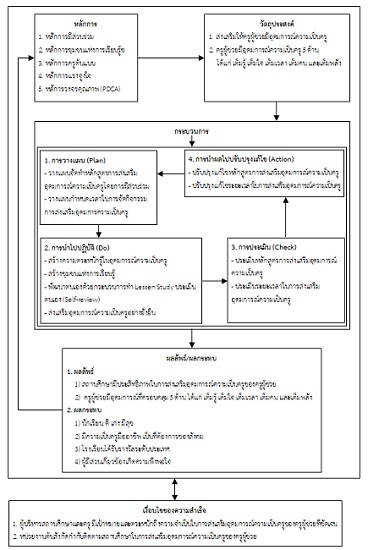
Development of a teacher to promote the ideology of assistant teachers in basic schools under Kamphaengphet primary education service area offices 1 and 2 was aimed to 1) investigate the ideology of teachership, 2) to study the context of and problems in promoting the ideology of teachership, and 3) to develop and assess a model of the ideology of teachership. Total samples of 344 persons were drawn using Krejcie and Morgan’s table and stratified randomization. Sixty-five key informants were selectively obtained from the purposive sampling method. Research tools were recording and analyzing documents, a structured questionnaire, a drafted model of the ideology of teachership, an auditing form, and an evaluation form that were endorsed by the supervisor. The questionnaire had a reliability of 0.97. Data were drawn from individual interviews, group discussions, workshops, and seminars. Data were analyzed using content analysis, percentage, mean, and standard deviation. Results showed that there were 5 aspects of the ideology of teachership with a full-time promotion process in accordance with the quality cycle. The first-priority problem is full-time and full-person. The model in promoting the ideology of teachership eventually had 5 principles and 1 condition of success, which were suitable, possible, and useful at the highest levels in all items.
References
Abacioglu, C. S., Fisscher, A. H., & Volman, M. (2022). Professional development in multicultural education: What can we learn from the Australian context?. Teching and Teacher Education, 114, 1-15. https://doi.org/10.1016/j.tate.2022.103701
Cronbach, L. J. (1990). Esentials of psychological testing (5th ed.). New York : Harper Collins.
Emerick, M. R. (2022). Diversity Ideology and School Leadership: Obscuring Inequities for Emergent Bilingual Students in Career and Technical Education. ResearchGate, 1-14. DOI: 10.1177/0013161X211052510
Futemwong, N., Piyanonthasin, W., Prasonsuk, K., & Promsuwicha, S. (2021). Foreign teacher preparation context: The lesson is capable to apply to Thai education system. The Journal of Pacific Institute of Management Science (Humanities and Social Sciences), 7(2), 46-57. (In Thai)
Government Gazette. (2019). Teachers Council Regulations on Professional Standards (No. 4) B. E. 2562. Volum 136, special chapter 68 ng, page 18-20. 20 March 2019. (In Thai)
Kamphaeng Phet Primary Educational Service Area District Office 1. (2020). Basic Education Development Plan 2018-2021, (2020-2022 review). Kamphaeng Phet : Kamphaeng Phet Primary Educational Service Area District Office 1. (In Thai)
Kamphaeng Phet Primary Educational Service Area District Office 1. (2021). Manpower rate of government teachers and educational personnel. (Mimeographed) (In Thai)
Kamphaeng Phet Primary Educational Service Area District Office 2. (2021). Manpower rate of government teachers and educational personnel. (Mimeographed) (In Thai)
Kamphaeng Phet Provincial Education Office. (2020). Educational Development Plan (2020-2022), Kamphaeng Phet Province. Kamphaeng Phet : Kamphaeng Phet Provincial Education Office. (In Thai)
Khamanee, T. (2011). Pedagogical Science : Knowledge for effective learning process management (14th ed., additional edition). Bangkok : Chulalongkorn University Press. (In Thai)
Krejcie, R. V., & Morgan, D. W. (1970). Determining Sample Size for Research Activities. Education and Psychological Measurement, 30(3), 607-610.
Likert, R. (1967). Foundations of Behavioral Research. New York : Halt, Rinehart and Winston.
Melnyk, S. A., & Denzler, D. A. (1996). Operations management: A value-driven approach. Boston : Irwin/McGraw-Hill.
Ministry of Education. (2009). Civil Service Teacher Pracitce Manual. Bangkok : Office of the Basic Education Commission, Ministry of Education. (In Thai)
Ministry of Education. (2022). A collection of important works of the Ministry of Education in the past 1 year (March 2021-2022). Bangkok : Ministry of Education. (In Thai)
Nadler, L. (1980). Corporate Human Resource Development. New York : Van. Nostrand Reinhold.
Office of the Basic Education Commission. (2019). Manual of self-development through online system and operating meetings: Enhance the capacity of assistant teachers to become professional teachers. Bangkok : Office of the Basic Education Commisionm, Ministry of Education. (In Thai)
Otaboeivch, K. M. (2022). Legal Fundamentals of Developing Ideological and Ideological Competence in Students. World Bulletin of Social Sciences (WBSS), 8, 96-100.
PhraPhompiriya Thavaro (Malairak). (2022). Professional teachers and Thai education in the New Normal era. In Report from the 7th National Academic Conference “ Buddhist Ways, Community Ways, Foundations of Lanna Social Bioviews in a New Way Society ”. February 28, 2021 (pp. 1-11). Lamphun : Lamphun Monastic College, Mahachulalongkornrajavidyalaya University. (In Thai)
Phuwittayaphan, A. (2007). Strategies for Management and Development of Star Employees. Bangkok : HR Center. (In Thai)
Srisa-ard, B. (2017). Preliminary research (10th ed.). Bangkok : Suwiriyasan. (In Thai)
The Secondary Educational Service Area Office Lampang Lamphun. (2022). Basic Education Development Plan 2020-2022 (2022 review). Lampang : The Secondary Educational Service Area Office Lampang Lamphun. (In Thai)
Thirathanachadilok, T. (2015). Total Quality Management. Bangkok : Odeon Store. (In Thai)
Wattana, A. (2018). The Model of Administration for Excellence of Schools under the Provincial Administrative Organization. Dissertation, Doctor of Education Program in Educational Administration, Nakhon Sawan Rajabhat University, Nakhon Sawan. (In Thai)
Yuenyao, P. (2019). Professional teacher in the 21st century. Nakhon Pathom : Faculty of Education, Nakhon Pathom Rajabhat University. (In Thai)
Yun, G., Ravi, R. V., & Jumani, A. K. (2022). Analysis of the teaching quality on deep learning-based innovative ideological political education plathform. Springer-Verlag GmbH Germany, part of Springer Nature 2022. https://doi.org/10.1007/s13748-021-00272-0
Downloads
Published
How to Cite
Issue
Section
License

This work is licensed under a Creative Commons Attribution-NonCommercial-NoDerivatives 4.0 International License.