การประยุกต์ใช้เทคโนโลยีบล็อกเชนเพื่อยกระดับความปลอดภัยและความโปร่งใสในธุรกิจแพลตฟอร์มดิจิทัล
DOI:
https://doi.org/10.14456/nrru-rdi.2024.40คำสำคัญ:
เทคโนโลยีบล็อกเชน, ความปลอดภัย, ความโปร่งใส, ผลกระทบทางประสิทธิภาพ, ธุรกิจแพลตฟอร์มดิจิทัลบทคัดย่อ
ที่มาและวัตถุประสงค์การวิจัย: ความท้าทายในการดำเนินธุรกิจบนฐานเทคโนโลยีดิจิทัลนำมาสู่ผลกระทบต่อความกังวลใจสำหรับผู้ใช้และผู้ให้บริการอย่างต่อเนื่อง ดังนั้น งานวิจัยนี้จึงกำหนดวัตถุประสงค์เพื่อศึกษาการประยุกต์ใช้เทคโนโลยีบล็อกเชนเพื่อยกระดับความปลอดภัยและความโปร่งใสในธุรกิจแพลตฟอร์มดิจิทัล
ระเบียบวิธีวิจัย (วิธีดำเนินการวิจัย): ระเบียบวิธีวิจัยเชิงประยุกต์ ได้กำหนดข้อมูลสารสนเทศแบบเฉพาะเจาะจงด้วยการคัดเลือกบทความวิชาการ 48 บทความ เนื้อหาเว็บไซต์ 100 เว็บไซต์ และธุรกิจแพลตฟอร์มดิจิทัล 15 กรณีศึกษา โดยใช้แบบบันทึกข้อมูลคุณสมบัติและผลกระทบทางศักยภาพที่ปรับปรุงจากการทบทวนวรรณกรรมและสอดคล้องกับวัตถุประสงค์การวิจัยในการเก็บข้อมูลด้วยการใช้คำค้นหลักซึ่งเป็นไปตามวิธีการจำลองแบบมนุษย์ในวงจรร่วมกับโปรแกรมการเพิ่มประสิทธิภาพในการค้นหา “Google Keyword Planner” เพื่อดึงข้อมูลจากเว็บไซต์ และใช้โปรแกรม Beautiful Soup เพื่อวิเคราะห์และประมวลผลข้อมูลที่เชื่อมโยงเทคนิคการเคลื่อนไหวเพื่อแยกแยะและจัดระเบียบข้อมูล
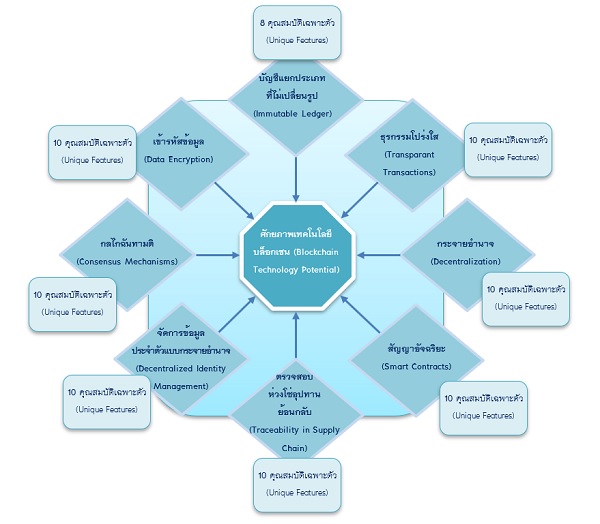
ผลการวิจัย: ศักยภาพเทคโนโลยีบล็อกเชนผ่านคุณสมบัติเฉพาะตัวที่ช่วยยกระดับการเพิ่มความปลอดภัยและความโปร่งใสในธุรกิจแพลตฟอร์มดิจิทัล 8 ส่วน ประกอบด้วย 1) บัญชีแยกประเภทที่ไม่เปลี่ยนรูป 4 ประการ 2) การทำธุรกรรมที่โปร่งใส 6 ประการ 3) การกระจายอำนาจ 2 ประการ 4) สัญญาอัจฉริยะ 5 ประการ 5) การตรวจสอบห่วงโซ่อุปทานย้อนกลับ 6 ประการ 6) การจัดการข้อมูลประจำตัวแบบกระจายอำนาจ 3 ประการ 7) กลไกฉันทามติ 5 ประการ และ 8) การเข้ารหัสข้อมูล 2 ประการ สำหรับศักยภาพผ่านคุณสมบัติเฉพาะที่ไม่มีผลกระทบทางประสิทธิภาพในส่วนของ 1) กระจายอำนาจ คือ บัญชีแยกประเภทที่ไม่เปลี่ยนรูป 2) สัญญาอัจฉริยะ คือ ดำเนินการป้องกันการงัดแงะ 3) กลไกฉันทามติ คือ ปรับกฎให้สอดคล้องกับแพลตฟอร์ม และ 4) การเข้ารหัสข้อมูล คือ พื้นที่เก็บข้อมูลปลอดภัย
อภิปรายผล: คุณสมบัติเฉพาะตัวของศักยภาพเทคโนโลยีบล็อกเชนแสดงถึงผลกระทบทางด้านประสิทธิภาพในการช่วยยกระดับความปลอดภัยและความโปร่งใสสำหรับธุรกิจแพลตฟอร์มดิจิทัลได้เกิดความเชื่อมั่นและไว้วางใจต่อการนำไปประยุกต์ใช้ดำเนินการและบริหารจัดการองค์กรต่อไป
ข้อเสนอแนะ: ควรมีการพัฒนาแนวทางการบูรณาการความสัมพันธ์ของเทคโนโลยีบล็อกเชนที่ยังมีความซ้ำซ้อนในแต่ละด้าน เพื่อเป็นการเพิ่มประสิทธิภาพการทำงานและลดต้นทุนการดำเนินงาน
เอกสารอ้างอิง
Aggarwal, B. K., Gupta, A., Goyal, D., Gupta, P., Bansal, B., & Barak, D. D. (2022). A review on investigating the role of block-chain in cyber security. Materials Today Proceedings, 56, 3312-3316.
Avirutha, A. (2021). ASEAN in Digital Economy: Opportunities and Challenges. Journal of ASEAN PLUS+ Studies, 2(1), 17-25.
Barmuta, K. A., Akhmetshin, E. M., Andryushchenko, I. Y., Tagibova, A. A., Meshkova, G. V., & Zekiy, A. O. (2020). Problems of business processes transformation in the context of building digital economy. Entrepreneurship and Sustainability Issues, 8(1), 945.
Bartczak, K. (2024). Business Models and Digital Technology Platforms: Implementation and Complexities for Digital Business. Taylor & Francis.
Bashir, I. (2020). Mastering Blockchain: A deep dive into distributed ledgers, consensus protocols, smart contracts, DApps, cryptocurrencies, Ethereum, and more. Packt Publishing.
Bashir, I. (2023). Mastering Blockchain: Inner workings of blockchain, from cryptography and decentralized identities, to DeFi, NFTs and Web3. Packt Publishing.
Bonina, C., Koskinen, K., Eaton, B., & Gawer, A. (2021). Digital platforms for development: Foundations and research agenda. Information Systems Journal, 31(6), 869-902.
Caulfield, M. (2019, 19 June). SIFT (The Four Moves). HAPGOOD. https://hapgood.us/2019/06/19/sift-the-four-moves/
Cavaliere, L. P., Sargunam, S. S., Sharma, D. K., Ramana, Y. V., Ramachandran, K. K., Gohatre, U. B., & Vinayagam, N. (2024). Leveraging Blockchain and Distributed Systems for Improved Supply Chain Traceability and Transparency. Meta Heuristic Algorithms for Advanced Distributed Systems, 359-374.
Creswell, J. W., & Creswell, J. D. (2017). Research design: Qualitative, quantitative, and mixed methods approaches. Sage publications.
Dave, C. (2024). Security Challenges with Blockchain: Navigate Blockchain Security Challenges, Unveil Vulnerabilities, and Gain Practical Strategies for Secure Application Development (English Edition). Orange Education Pvt Ltd.
De Sordi, J. O. (2024). Software-Technique in Support of Qualitative Analyses. In Qualitative Research Methods In Business (pp. 107-118). Palgrave Macmillan. https://doi.org/10.1007/978-3-031-50323-8_8
Doshi, S., Jangir, S., & Gohil, P. (2024). Role of Blockchain Technology in Enhancing Supplychain Traceability, Transparency and Efficiency. Journal of Experimental Agriculture International, 46(5), 636-653.
Ferdous, M. S., Cali, U., Halden, U., & Prinz, W. (2023). Leveraging self-sovereign identity & distributed ledger technology in renewable energy certificate ecosystems. Journal of cleaner production, 422, 138355.
Ghelani, D., Hua, T. K., & Koduru, S. K. R. (2022). Cyber Security Threats, Vulnerabilities, and Security Solutions Models in Banking. Authorea Preprints.
Gruner, A., Muhle, A., Lockenvitz, N., & Meinel, C. (2023). Analyzing and comparing the security of self-sovereign identity management systems through threat modeling. International Journal of Information Security, 22(5), 1231-1248.
Han, Z., Wood, S., Coe, N. M., & Alexander, A. (2024). Platform Business Groups and the Omni‐Channel Transformation of Food Retailing in China. Tijdschrift voor economische en sociale geografie.
Hart, A. (2024). Unlock the Power of Web Data Extraction with: Python Web Scraping with Beautiful Soup. Independently published.
Hossain, E. (2024). Machine Learning Crash Course for Engineers. Springer.
Kardas, M. (2016). Concepts and types of business models. in K. Klincewicz (ed.), Management, organization and organizing – a review of theoretical perspectives (pp. 298-318). Scientific Publishing House of the Faculty of Management of the University of Warsaw.
Kshetri, N. (2021). Blockchain and supply chain management. Elsevier.
Lantz, L., & Cawrey, D. (2020). Mastering blockchain. O'Reilly Media.
Laurence, T. (2023). Blockchain for dummies. John Wiley & Sons.
Li, W., He, M., & Haiquan, S. (2021, June). An overview of blockchain technology: applications, challenges and future trends. In 2021 IEEE 11th International Conference on Electronics Information and Emergency Communication (ICEIEC) 2021 IEEE 11th International Conference on Electronics Information and Emergency Communication (ICEIEC) (pp. 31-39). IEEE.
Liang, W., Yang, Y., Yang, C., Hu, Y., Xie, S., Li, K.-C., & Cao, J. (2022). PDPChain: A consortium blockchain-based privacy protection scheme for personal data. IEEE Transactions on Reliability, 72(2), 586-598.
Lipton, A., & Treccani, A. (2021). Blockchain and distributed ledgers: Mathematics, technology, and economics. World Scientific Publishing.
Liu, Y., Liu, C., Li, J., & Sun, Y. (2023, August). Research on the security reinforcement method of Industrial Internet Identification data based on blockchain technology. In 2023 IEEE International Conference on Smart Internet of Things (SmartIoT) (pp. 315-320). IEEE.
Ma, X., & Wang, Z. (2024). Computer security technology in E-commerce platform business model construction. Heliyon, 10(7), e28571.
Mansell, R. (2024). Realigning incentives through formal media, communications and platform governance. In Handbook of Media and Communication Governance (pp. 201-217). Edward Elgar Publishing. https://doi.org/10.4337/9781800887206.00026
Metcalfe, W. (2020). Ethereum, smart contracts, DApps. Blockchain and Crypt Currency, 77, 77-93.
Namasudra, S., & Deka, G. C. (Eds.). (2021). Applications of blockchain in healthcare (Vol. 83). Springer.
Oppliger, R. (2023). SSL and TLS Theory and Practice. Artech House.
Parker, G. G. (2016). Platform revolution: How networked markets are transforming the economy and how to make them work for you. WW Norton & Company.
Ramamurthy, B. (2020). Blockchain in action. Manning Publications.
Ravani, A., Edupuganti, S., Pugh, J., & Sushama, S. (2024). Applications of Blockchain Technology: An Industry Focus. CRC Press.
Razumov, P., Cherckesova, L., Revyakina, E., Morozov, S., Medvedev, D., & Lobodenko, A. (2023). Ensuring the security of web applications operating on the basis of the SSL/TLS protocol. In E3S Web of Conferences (Vol. 402, p. 03028). EDP Sciences.
Rothrock, L., & Narayanan, S. (Eds.). (2011). Human-in-the-Loop Simulations, Methods and Practice. Springer Nature Switzerland AG.
Sharma, A., Sarishma, Tomar, R., Chilamkurti, N., & Kim, B.-G. (2020). Blockchain based smart contracts for internet of medical things in e-healthcare. Electronics, 9(10), 1609.
Szczesniak, A. (2011). Innovative business models. In Bak, A., Kulawczuk, P., & Szczesniak, A. (eds.), Business models of enterprises created on the basis of higher education institutions (pp. 25-36). Institute for Research on Private Enterprise and Democracy.
Tanwar, S. (2022). Blockchain Technology. Springer.
Weiss, M. (2020). Websites, Search Engine Optimization, and Online Consultation. In Grow Your Eye Care Practice (pp. 79-103). CRC Press.
Xiao, Y., Zhang, N., Lou, W., & Hou, Y. T. (2020). A survey of distributed consensus protocols for blockchain networks. IEEE Communications Surveys & Tutorials, 22(2), 1432-1465.
Xu, P., Lee, J., Barth, J. R., & Richey, R. G. (2021). Blockchain as supply chain technology: considering transparency and security. International Journal of Physical Distribution & Logistics Management, 51(3), 305-324.
ดาวน์โหลด
เผยแพร่แล้ว
รูปแบบการอ้างอิง
ฉบับ
ประเภทบทความ
สัญญาอนุญาต
ลิขสิทธิ์ (c) 2024 สถาบันวิจัยและพัฒนา มหาวิทยาลัยราชภัฏนครราชสีมา

อนุญาตภายใต้เงื่อนไข Creative Commons Attribution-NonCommercial-NoDerivatives 4.0 International License.