
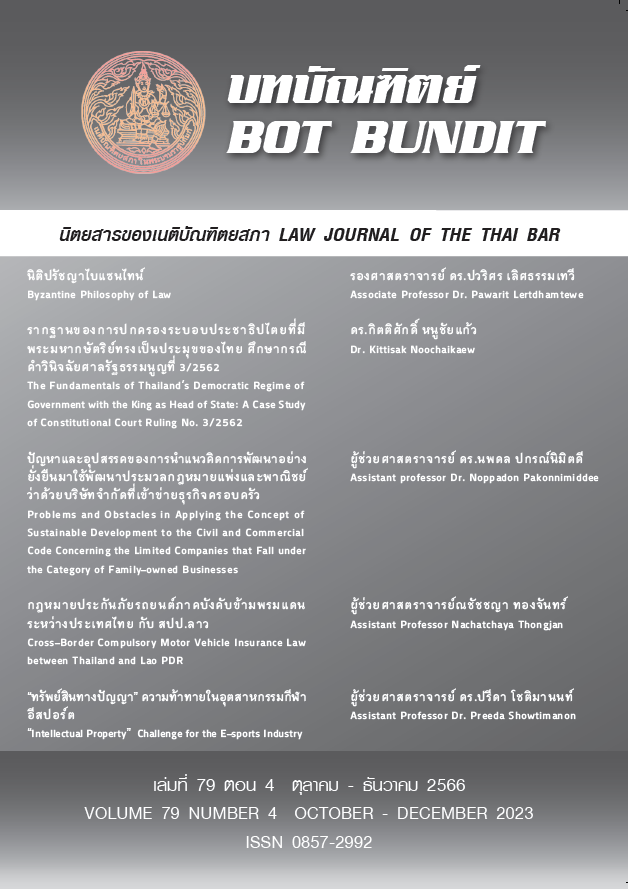
The Fundamentals of Thailand’s Democratic Regime of Government with the King as Head of State: A Case Study of Constitutional Court Ruling No. 3/2562
Article Sidebar
Main Article Content
Abstract
This article aims to investigate the fundamental constitutional principles of Thailand’s democratic regime of government with the King as head of state as enunciated in Constitutional Court Ruling No. 3/2562 for the purpose of contributing to the comprehensiveness of academic knowledge on the subject.
According to the findings, the fundamentals of Thailand’s democratic regime of government with the King as head of the state as found in Constitutional Court Rulings No. 3/2562 consist of three main principles: first, the principle of defining the unique identity of Thailand’s democratic regime of government with the King as head of state; second, the fundamental principle that the Royal Institution remains above politics and is politically neutral, which applies not only to the King but also to members of the royal family; and third, the principle of setting norms with which to define the concept of “traditional governance of Thailand as a democratic regime of government with the King as head of state”, which stands to fill the gaps in instances where there are no prescribed provision of the Constitution and is also considered to be a general constitutional principle and fundamental to the Thai Constitution.
The article recommends that as Thailand has a written constitution, the fundamentals of democratic governance with the King as head of state that are not prescribed in writing by Constitutional Court Ruling No. 3/2562 should be explicitly prescribed in the provisions of the Constitution for clarity in constitutional enforcement and in accordance with the intent of the fundamental principles of Thai governance.
Article Details

This work is licensed under a Creative Commons Attribution-NonCommercial-NoDerivatives 4.0 International License.
References
ภาษาไทย
กิตติศักดิ์ หนูชัยแก้ว, ‘การใช้จารีตประเพณีการปกครองในระบอบประชาธิปไตยตามบทบัญญัติรัฐธรรมนูญ ศึกษากรณีการเข้าสู่ตำแหน่งนายกรัฐมนตรี’ (วิทยานิพนธ์ นิติศาสตรมหาบัณฑิต สถาบันบัณฑิตพัฒนบริหารศาสตร์ 2560).
คำวินิจฉัยศาลรัฐธรรมนูญที่ 3/2562.
บวรศักดิ์ อุวรรณโณ, กฎหมายมหาชน เล่ม 2 การแบ่งแยกกฎหมายมหาชน-เอกชนและพัฒนาการกฎหมายมหาชนในประเทศไทย (พิมพ์ครั้งที่ 5, สำนักพิมพ์จุฬาลงกรณ์มหาวิทยาลัย 2550).
บุญศรี มีวงศ์อุโฆษ, กฎหมายรัฐธรรมนูญ (พิมพ์ครั้งที่ 10, โครงการตำราและเอกสารประกอบการสอน คณะนิติศาสตร์ มหาวิทยาลัยธรรมศาสตร์ 2563).
ประกาศสถาบันพระมหากษัตริย์ตามรัฐธรรมนูญแห่งราชอาณาจักรไทย (ราชกิจจานุเบกษา เล่ม 136 ตอนพิเศษ 37 ง).
วิษณุ เครืองาม, กฎหมายรัฐธรรมนูญ (สำนักพิมพ์นิติบรรณการ 2530).
ภาษาอังกฤษ
Al-Monitor Staff, ‘Bahrain appoints crown prince as new prime minister’ (Al-Monitor, 12 November 2020)<https://www.al-monitor.com/originals/2020/11/bahrain-prime-minister-sheikh-salman-bin-hamad-al-khalifa.html> สืบค้นเมื่อ 10 สิงหาคม 2565.
Alfred Stepan, Juan J. Linz and Juli F. Minoves, ‘Democratic Parliamentary Monarchies’ (2014) 2 Journal of Democracy 35.
Andrew Mills, ‘Qatar’s emir names top diplomat as premier, reappoints energy and finance ministers’ (Reuters, 7 March 2023) <https://www.reuters.com/world/middle-east/qatars-emir-names-new-pm-reappoints-energy-finance-ministers-cabinet-reshuffle-2023-03-07/> สืบค้นเมื่อวันที่ 12 มีนาคม 2566.
The Constitution of the Kingdom of Bahrain (Issued in 2002) and its amendments <https://www.nihr.org.bh/en/MediaHandler/GenericHandler/documents/download/1%20Constitution%20of%20the%20Kingdom%20of%20Bahrain.pdf> สืบค้นเมื่อ 10 สิงหาคม 2565.
TheConstitutionofQatar <https://www.gco.gov.qa/wp-content/uploads/2016/09/GCO-Constitution-English.pdf> สืบค้นเมื่อ 12 มีนาคม 2566.
