
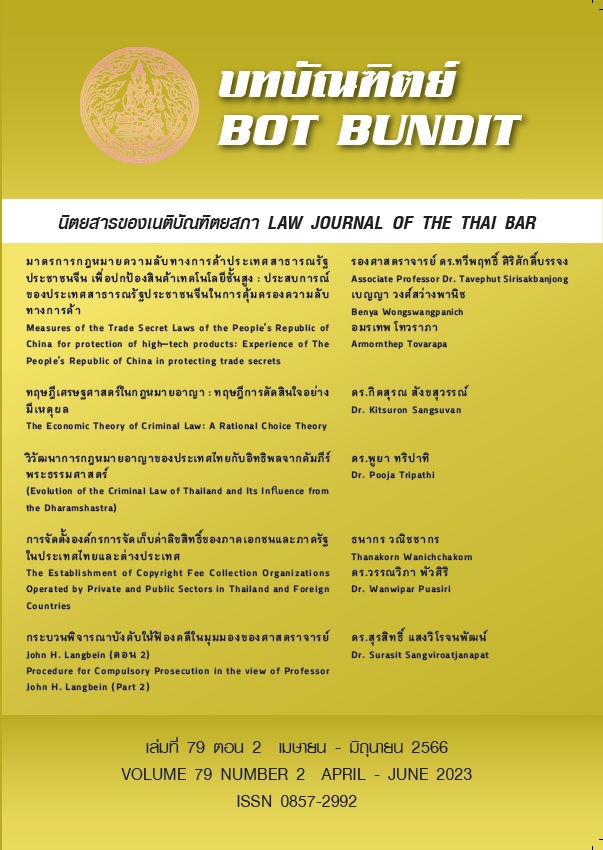
กระบวนพิจารณาบังคับให้ฟ้องคดีในมุมมองของศาสตราจารย์ John H. Langbein (ตอน 2)
Article Sidebar
Main Article Content
บทคัดย่อ
กระบวนพิจารณาบังคับให้ฟ้องคดีจะถูกนำมาใช้เฉพาะกับความผิดอาญาร้ายแรงเท่านั้น และเป็นไปตามหลักการฟ้องคดีตามกฎหมาย โดยไม่นำมาใช้กับกรณีของความผิดอาญาเล็กน้อย หรือความผิดอาญาธรรมดา ที่นำหลักการฟ้องคดีตามดุลพินิจมาปรับใช้เป็นกรณี ๆ ไปตามที่บัญญัติไว้ในประมวลกฎหมายวิธีพิจารณาความอาญาเยอรมัน ซึ่งต่างจากกฎหมายอเมริกัน ที่ไม่ได้มีการบัญญัติหลักเกณฑ์ดังกล่าวไว้อย่างชัดแจ้งเหมือนกฎหมายเยอรมัน นอกจากนี้ กระบวนพิจารณาบังคับให้ฟ้องคดียังไม่นำมาใช้กับกระบวนพิจารณาคดีพิเศษอีกลักษณะหนึ่งตามกฎหมายเยอรมัน กล่าวคือคำสั่งให้ลงโทษทางอาญา ซึ่งเป็นกรณีที่จำเลยให้การรับสารภาพ ซึ่งกระบวนพิจารณาคดีดังกล่าวเป็นไปในทำนองเดียวกันกับกรณีที่จำเลยให้การรับสารภาพตามกฎหมายอเมริกัน อย่างไรก็ตาม ก่อนผู้เสียหายจะใช้กระบวนพิจารณาบังคับให้ฟ้องคดี ผู้เสียหายจะต้องยื่นคำคัดค้านต่อหัวหน้าพนักงานอัยการที่มีคำสั่งไม่ฟ้องคดีเสียก่อน เมื่อหัวหน้าพนักงานอัยการเห็นด้วยกับคำสั่งไม่ฟ้องคดีของพนักงานอัยการแล้ว ผู้เสียหายจึงจะมีสิทธินำคดีมาฟ้องยังศาลยุติธรรม การเรียนรู้จากบทความดังกล่าวของศาสตราจารย์ Langbein จะช่วยให้เราสามารถวิเคราะห์ปัญหาข้อกฎหมายบางประการ ไม่ว่าจะเป็นปัญหาเดิม ๆ ที่นักกฎหมายไทยเคยมีความเห็นไว้ หรือปัญหาใหม่ ๆ ที่นักกฎหมายไทยคงจะต้องเผชิญเมื่อกฎหมายใหม่ดังกล่าวมีผลใช้บังคับ
Article Details

อนุญาตภายใต้เงื่อนไข Creative Commons Attribution-NonCommercial-NoDerivatives 4.0 International License.
เอกสารอ้างอิง
ภาษาไทย
กรรภิรมย์ โกมลารชุน, ‘วัตถุแห่งคดีในคดีอาญาคืออะไร? What is the object of criminal proceedings?’ (2557) 2 วารสารกระบวนการยุติธรรม 1.
เข็มชัย ชุติวงศ์, ‘หลักนิติธรรมกับการสั่งคดีของพนักงานอัยการ’ (รายงานส่วนบุคคล หลักสูตรนิติธรรมเพื่อประชาธิปไตย รุ่นที่ 5 วิทยาลัยรัฐธรรมนูญ สำนักงานศาลรัฐธรรมนูญ 2560) <https://www.constitutionalcourt.or.th/occ_web/ewt_dl_link.php?nid=9674> สืบค้นเมื่อ 5 พฤษภาคม 2566.
คณิต ณ นคร, กฎหมายวิธีพิจารณาความอาญา (พิมพ์ครั้งที่ 9 แก้ไขเพิ่มเติม, สำนักพิมพ์วิญญูชน 2561).
ณรงค์ ใจหาญ, หลักกฎหมายวิธีพิจารณาความอาญา เล่ม 1 (พิมพ์ครั้งที่ 12, สำนักพิมพ์วิญญูชน 2556).
สรรพัชญ รัชตะวรรณ, ‘การสั่งไม่ฟ้องคดีอาญาของพนักงานอัยการด้วยเหตุคดีไม่เป็นประโยชน์ต่อสาธารณะ : ศึกษาเปรียบเทียบกับประเทศอังกฤษ’ (2564) 1 ดุลพาห 150.
สุรศักดิ์ ลิขสิทธิ์วัฒนกุล, ประมวลกฎหมายวิธีพิจารณาความอาญา ฉบับอ้างอิง, (พิมพ์ครั้งที่ 19, สำนักพิมพ์วิญญูชน 2562).
สุรสิทธิ์ แสงวิโรจนพัฒน์, ‘การชะลอการฟ้องโดยมีเงื่อนไขตามมาตรา 153 a ประมวลกฎหมายวิธีพิจารณาความอาญาเยอรมัน’ (2546) 2 บทบัณฑิตย์ 16.
สุรสิทธิ์ แสงวิโรจนพัฒน์, ‘การเจรจาต่อรองในคดีอาญา (Absprachen im Strafprozess) ตามกฎหมายวิธีพิจารณาความอาญาเยอรมัน’ (2546) 3 บทบัณฑิตย์ 1.
สุรสิทธิ์ แสงวิโรจนพัฒน์, ‘การมีส่วนร่วมของผู้เสียหายในกระบวนพิจารณาคดีอาญาตามกฎหมายวิธีพิจารณาความอาญาเยอรมัน’ (2558) 2 ดุลพาห 90.
สุรสิทธิ์ แสงวิโรจนพัฒน์, ‘กระบวนพิจารณาบังคับให้ฟ้องคดี (Klageerzwingungsverfahren) ตามกฎหมายวิธีพิจารณาความอาญาเยอรมัน’ (2563) 3 บทบัณฑิตย์ 151.
สุรสิทธิ์ แสงวิโรจนพัฒน์, ‘ความผิดอาญาเล็กน้อย’ (2565) 2 บทบัณฑิตย์ 110.
หยุด แสงอุทัย, ประมวลกฎหมายวิธีพิจารณาความอาญา : ศึกษาทางคำพิพากษาฎีกา (สำนักพิมพ์แม่บ้านการเรือน 2507).
ภาษาต่างประเทศ
Claus Roxin, Strafprozessordnung (50th edn, C.H. Beck Verlag 2014).
Claus Roxin and Bernd Schuenemann, Strafverfahrensrecht (29th edn, C.H. BECK Verlag 2017).
Eike Duckwitz, ‘Die Verwertbarkeit von nach §§ 154, 154a StPO ausgeschiedenem Prozessstoff bei der Beweiswürdigung und Strafzumessung im Strafverfahren’ (Göttingen University Press 2017) <https://www.univerlag.uni-goettingen.de/bitstream/handle/3/isbn-978-3-86395-219-8/GSK28_duckwitz.pdf;jsessionid=866E222C168DF36CBE18973EB35096A7?sequence=1> สืบค้นเมื่อ 5 พฤษภาคม 2566.
Floriaan H. Went, ‘Das Opportunitaetsprinzip im niederlaendischen und schweizerischen Strafverfahren’ (dissertation, University of Zurich and Erasmus University Rotterdam 2012).
Joachim Bohnert and Jens Buelte, Ordnungswidrigkeitenrecht (5th edn, C.H. BECK Verlag 2016).
Volker Erb, ‘Legalitaets- und Opportunitaetsgrundsatz als normative Prinzipien’ in Claudius Geisler (ed) Das Ermittlungsverhalten der Polizei und die Einstellungspraxis der Staatsanwaltschaften (Duncker & Humblot 1999).
