
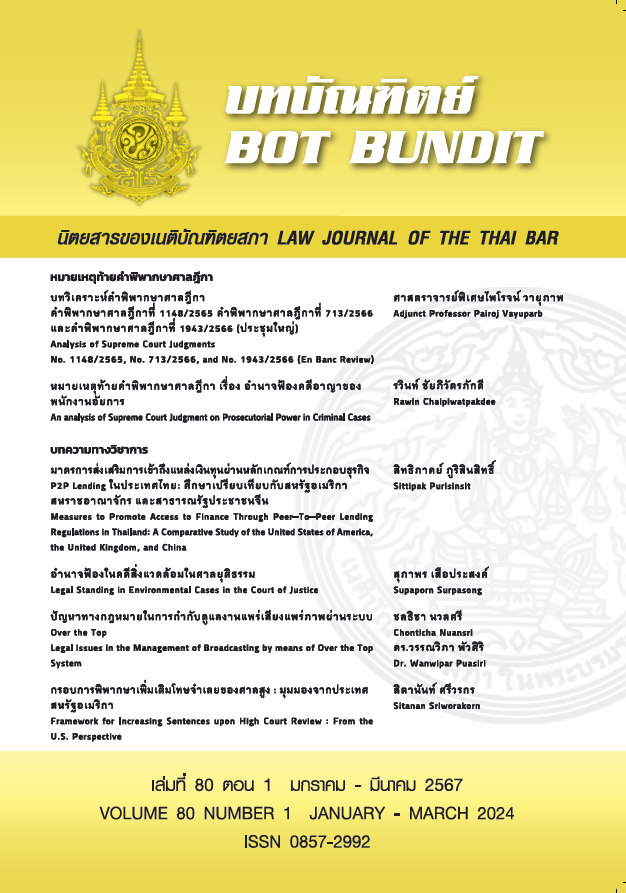
Analysis of Supreme Court Judgments No. 1148/2565, No. 713/2566, and No. 1943/2566 (En Banc Review)
Article Sidebar
Main Article Content
Abstract
This article aims to study and analyze the principles of law according to the Civil Procedure Code and Criminal Procedure Code as appears in Supreme Court Judgments No. 1148/2565, Supreme Court Judgment No. 713/2566, and Supreme Court Judgment No. 1943/2566 (en banc review).
In Supreme Court Judgment No. 1148/2565, where a party to a compromise agreement sued the other party for compliance, the Court raised the issues of jurisdiction and standing to dismiss the case. The author offers an analysis regarding the application of the relevant rules.
In Supreme Court Judgment No. 713/2566, the Court considered the issue of duplicative litigation and ruled that where the plaintiff in both initial and subsequent cases sued the two defendants in their capacities as executors of an estate and requested the division of inheritance assets, there did not exist duplicative litigation because the assets in each case were distinct from each other. The article thus considers the relevant points made in the Supreme Court’s opinion in order to analyze Section 173 Paragraph Two (1) of the Civil Procedure Code, which prohibits a plaintiff from filing multiple complaints with the same subject matter.
Supreme Court Judgment No. 1943/2566 (En Banc Review) ruled on the issue of a motion to request compensation in criminal cases according to Section 44/1 of the Criminal Procedure Code, which states that, in cases where the public prosecutor is a plaintiff, if the victim is entitled to claim compensation for death, bodily injury, mental injury or loss of physical freedom, reputation, or property damage arising from wrongdoing by the defendant, the victim may file a motion with the criminal court to require that the defendant pay compensation. However, Section 44/1 does not specify the scope of the motion for compensation as to whether it must be based on offenses charged by the prosecutor. On this issue, the Court established principles in Supreme Court Judgment No. 1943/2023 (en banc review) in accordance with the principles of interpretation according to Section 4 Paragraph One of the Civil and Commercial Code. This should likely be a judgment that lawyers can use as a guideline in the future.
Article Details

This work is licensed under a Creative Commons Attribution-NonCommercial-NoDerivatives 4.0 International License.
