
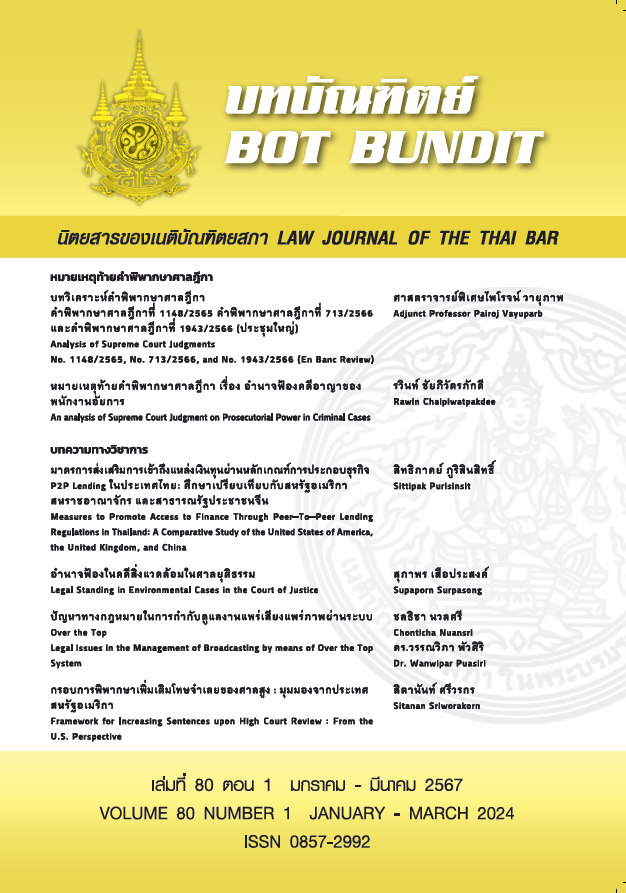
Framework for Increasing Sentences upon High Court Review : From the U.S. Perspective
Article Sidebar
Main Article Content
Abstract
The Criminal Procedure Code provides “In a case in which the defendant appeals against a judgment of conviction, the Appellate court shall not render a sentence to increase the punishment, unless the plaintiff’s appeal requests the same.” Section 212 of the Criminal Procedure Code is a provision that aims to protect defendants from having to face harsher punishment if the plaintiff does not appeal to increase the defendant’s sentence. However, the interpretation of this provision in the context of criminal proceedings in Thailand is dependent upon the decisions of the Supreme Court. In some cases where a plaintiff does not request the court to activate suspended sentences previously handed down nor request the court to count all the sentences consecutively in the appeal, the High Court is yet able to do so. Such a decision would not be deemed to be an increase in the defendant’s punishment.
Article Details

This work is licensed under a Creative Commons Attribution-NonCommercial-NoDerivatives 4.0 International License.
References
ภาษาไทย
กรองทิพย์ คำยะรัตน์, ‘สิทธิที่จะได้รับความช่วยเหลือในทางคดีอาญาจากทนายความ : ศึกษาปัญหาระบบทนายความขอแรงและการใช้ระบบ Public Defender’ (2558) 2 ดุลพาห 168, 168-199 <https://dunlaphaha.coj.go.th/upload/2558/2/2558_2_a8.pdf> สืบค้นเมื่อ 25 กุมภาพันธ์ 2567.
คณะกรรมการนักนิติศาสตร์สากล, ‘คู่มือสังเกตการณ์กระบวนการยุติธรรมทางอาญา แนวทางเพื่อการปฏิบัติ ลำดับที่ 5’ (ICJ, 2554) <https://www.icj.org/wp-content/uploads/2015/06/trial-observation-manual-Human-Rights-Rule-of-Law-series-2009-thai.pdf> สืบค้นเมื่อ 25 กุมภาพันธ์ 2567.
คำพิพากษาศาลฎีกาที่ 2651/2517 (ประชุมใหญ่).
คำพิพากษาศาลฎีกาที่ 3656/2527.
คำพิพากษาศาลฎีกาที่ 147/2538.
คำพิพากษาศาลฎีกาที่ 5129/2538.
คำพิพากษาศาลฎีกาที่ 822/2540.
คำพิพากษาศาลฎีกาที่ 3741/2540.
คำพิพากษาศาลฎีกาที่ 6397/2540.
คำพิพากษาศาลฎีกาที่ 1020/2541.
คำพิพากษาศาลฎีกาที่ 571/2542.
คำพิพากษาศาลฎีกาที่ 714/2542.
คำพิพากษาศาลฎีกาที่ 8682/2543.
คำพิพากษาศาลฎีกาที่ 1081/2544.
คำพิพากษาศาลฎีกาที่ 1983/2544.
คำพิพากษาศาลฎีกาที่ 1715/2545.
คำพิพากษาศาลฎีกาที่ 6247/2545.
คำพิพากษาศาลฎีกาที่ 2114/2547.
คำพิพากษาศาลฎีกาที่ 2115/2547.
คำพิพากษาศาลฎีกาที่ 2226/2547.
คำพิพากษาศาลฎีกาที่ 6712/2547.
คำพิพากษาศาลฎีกาที่ 7586/2547.
คำพิพากษาศาลฎีกาที่ 2695/2548.
คำพิพากษาศาลฎีกาที่ 3366/2548.
คำพิพากษาศาลฎีกาที่ 4534/2548.
คำพิพากษาศาลฎีกาที่ 6121/2548.
คำพิพากษาศาลฎีกาที่ 6855/2550.
คำพิพากษาศาลฎีกาที่ 398/2551.
คำพิพากษาศาลฎีกาที่ 1439/2551.
คำพิพากษาศาลฎีกาที่ 263/2553.
คำพิพากษาศาลฎีกาที่ 6368/2557.
คำพิพากษาศาลฎีกาที่ 4790/2562
คำพิพากษาศาลฎีกาที่ 1346/2563.
วิเชียร ดิเรกอุดมศักดิ์, กฎหมาย วิ.อาญาพิสดาร เล่ม 2 (ฉบับปรับปรุงใหม่ ปี 2566) ประมวลกฎหมายวิธีพิจารณาความอาญา หลักกฎหมายและแนวคำพิพากษาศาลฎีกา ตาม ป.วิ.อ. ภาค 3 และ ภาค 4 (หจก. แสงจันทร์การพิมพ์ 2565) 405.
สำนักการต่างประเทศ สำนักงานศาลยุติธรรม, ‘รอบรู้ศาลยุติธรรม ตอน การดำเนินคดีอาญา Getting to Know the Court of Justice: The Criminal Procedure’ (COJ, สิงหาคม 2559) <https://oia.coj.go.th/th/content/category/detail/id/8/cid/11205/iid/275227> สืบค้นเมื่อ 25 กุมภาพันธ์ 2567.
วิสาร พันธุนะ, ‘วิธีพิจารณาความอาญาในสหรัฐอเมริกา’ (2521) 5 ดุลพาห 39.
ภาษาอังกฤษ
Alabama v. Shelton, 535 U.S. 654, 662, 122 S.Ct. 1764, 152 L.Ed.2d 888 (2002).
Deal v. United States, 508 U.S. 129, 113 S. Ct. 1993, 124 L. Ed. 2d 44 (1993).
Greenlaw v. United States, 554 U.S. 237, 128 S. Ct. 2559, 171 L. Ed. 2d 399 (2008).
Pepper v. United States, 562 U.S. 476, 131 S. Ct. 1229, 179 L. Ed. 2d 196 (2011).
United States Federal Rules of Criminal Procedure.
United States Crimes and Criminal Procedure (18 United States Code Annotated (U.S.C.A.)).
United States Supreme Court Actions 01-18-2008 U.S. Sup. Ct. Actions 13.
United States v. Aquart, 92 F.4th 77 (2d Cir. 2024).
United States v. Gajdik, 292 F.3d 555, 557 (7th Cir. 2002)
United States v. Henry, 1 F.4th 1315 (11th Cir. 2021).
United States v. Perez–Macias, 335 F.3d 421, 426 (5th Cir.2003).
United States v. Stuart, 1 F.4th 326 (4th Cir. 2021).
