
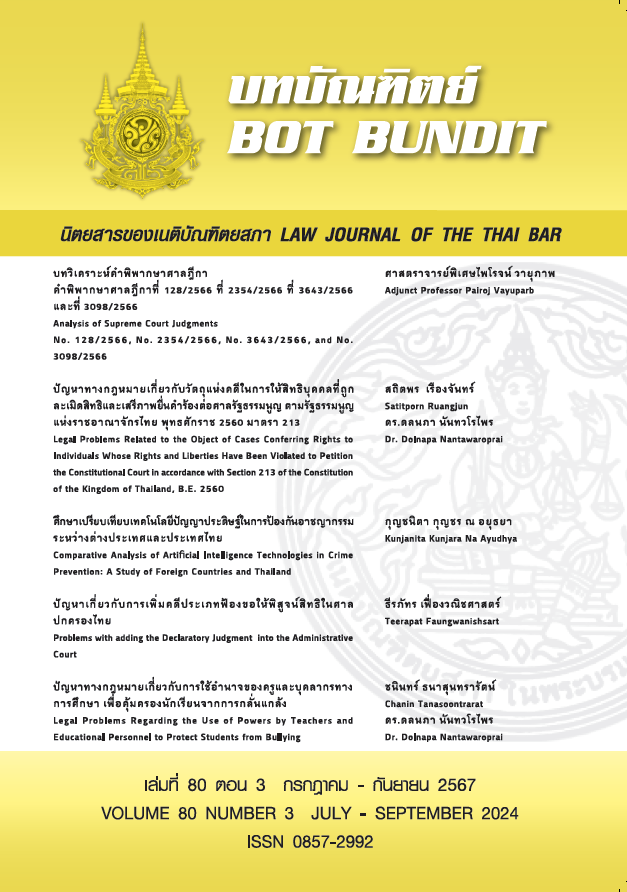
Legal Problems Regarding the Use of Powers by Teachers and Educational Personnel to Protect Students from Bullying
Article Sidebar
Main Article Content
Abstract
The study sought to investigate legal barriers to the exercise of power by teachers and educational professionals to protect students from bullying. It focused on examining and comparing legal provisions governing the use of such powers in different countries, including Thailand. The study additionally explored legal concepts and theories from scholar sources to identify legal impediments and offered resolutions appropriate for the current circumstances.
The study revealed that Thailand does not currently have any specific law governing the exercise of powers by teachers and educational personnel to protect students from bullying. The existing Thai laws present several obstacles to teachers and educational personnel in exercising their powers. These obstacles arise from the unclear and inconclusive definition of “bullying,” as well as the limited penalties and inappropriate decisions regarding punishment. Additionally, there is a lack of procedures for investigating incidents involving bullying before imposing punishment, and there are no initial protective measures for bullied students before punishing the bullies. Moreover, the supervision of use of disciplinary powers by teachers and educational personnel is unclear.
Article Details

This work is licensed under a Creative Commons Attribution-NonCommercial-NoDerivatives 4.0 International License.
References
ภาษาไทย
กระปุก.คอม, ‘ลั่นเอาผิด รุ่นพี่ ม.5 ลงโทษรุ่นน้องสุดยี้ แช่บ่อเกรอะ ราดน้ำขี้ – ครูยังอ้าง สมัครใจทำเอง’ (Kapook Hilight, 20 กุมภาพันธ์ 2566) <https://hilight.kapook.com/view/231102> สืบค้นเมื่อ 2 กุมภาพันธ์ 2567.
จิราวัฒน์ แช่มชัยพร, ‘การคุ้มครองสิทธิเด็กโดยหลักประโยชน์สูงสุดของเด็ก ตามมาตรา 3 (1) แห่งอนุสัญญาว่าด้วยสิทธิเด็ก ค.ศ. 1989’ (วิทยานิพนธ์ นิติศาสตร์มหาบัณฑิต มหาวิทยาลัยธรรมศาสตร์ 2551).
ไทยรัฐ, ‘นักเรียนชั้น ม.3 ตกตึกชั้น 4 แม่ติดใจเชื่อลูกถูกแกล้ง โดนเพื่อนบูลลี่เป็นประจำ’ (ไทยรัฐ ออนไลน์, 15 กุมภาพันธ์ 2566) <https://www.thairath.co.th/news/local/south/2630426> สืบค้นเมื่อ 28 ธันวาคม 2566.
ธานี วรภัทร์, หลักกฎหมายว่าด้วยการบังคับโทษจำคุก (พิมพ์ครั้งที่ 3, วิญญูชน 2558).
นครินทร์ เมฆไตรรัตน์, วสันต์ เหลืองประภัสร์ และปานรัตน์ นิ่มตลุง, ‘การปรับเปลี่ยนกลไกเชิงสถาบันเพื่อเสริมสร้างสมรรถนะในการทำงานด้านเด็กขององค์กรปกครองส่วนท้องถิ่น’ (รายงานผลการวิจัยเสนอต่อกองทุนเพื่อเด็กแห่งสหประชาชาติ 2553).
บรรเจิด สิงคะเนติ, หลักกฎหมายเกี่ยวกับการควบคุมฝ่ายปกครอง (พิมพ์ครั้งที่ 6, วิญญูชน 2561).
ผู้จัดการออนไลน์, ‘ครม.ทราบข้อเสนอส่งเสริมคุ้มครองสิทธิมนุษยชน กรณีถอนข้อสงวนข้อ 22 ของอนุสัญญาว่าด้วยสิทธิเด็ก’ (MGR Online, 9 มกราคม 2567) <https://mgronline.com/politics/detail/9670000002345> สืบค้นเมื่อ 25 เมษายน 2567.
พชรพร พงษ์อาภา, ‘อำนาจของครูในการลงโทษนักเรียนและการใช้กำลังทางกายภาพในสถานศึกษา’ (วิทยานิพนธ์ นิติศาสตรมหาบัณฑิต จุฬาลงกรณ์มหาวิทยาลัย 2561).
ภาณุกฤษฏิ์ พิศิษฎ์สกุลชัย, เสกสัณ เครือขำ และโสรัตน์ กลับวิลา ‘รูปแบบการลงโทษนักเรียนและแนวทางในการควบคุมให้เกิดการลงโทษนักเรียนที่เหมาะสมในสถานศึกษา’ (2565) 8(1) วารสารวิชาการวิทยาลัยสันตพล 131.
ยุวดี งามวิทย์โรจน์, ‘บทบาทของบุคลิกภาพแบบใช้อำนาจ ประสบการณ์การถูกลงโทษในวัยเด็กและสภาพของครูในการทำนายเจตคติต่อและพฤติกรรมการลงโทษทางร่างกายและจิตใจในโรงเรียน’ (วิทยานิพนธ์ วิทยาศาสตรมหาบัณฑิต สาขาวิชาจิตวิทยาสังคม จุฬาลงกรณ์มหาวิทยาลัย 2552).
โรงเรียนเตรียมอุดมศึกษา, คู่มือนักเรียน ครู และผู้ปกครอง โรงเรียนเตรียมอุดมศึกษา ปีการศึกษา 2564 (โรงเรียนเตรียมอุดมศึกษา 2564) <https://www.triamudom.ac.th/website/images/64/DOC/014-m-std2564.pdf> สืบค้นเมื่อวันที่ 18 ธันวาคม 2566.
โรงเรียนอัสสัมชัญ, คู่มือผู้ปกครองและนักเรียน (โรงเรียนอัสสัมชัญ 2560) <https://www.assumption.ac.th/assets/pdf/journal/handbook/handbook.pdf> สืบค้นเมื่อ วันที่ 18 ธันวาคม 2566.
วรเจตน์ ภาคีรัตน์, กฎหมายปกครอง ภาคทั่วไป (นิติราษฎร์ 2554).
วรพจน์ วิศรุตพิชญ์, ข้อความคิดและหลักการพื้นฐานบางประการของกฎหมายปกครอง (พิมพ์ครั้งที่ 3, วิญญูชน 2562).
สภาผู้แทนราษฎร, กระทู้ถามที่ 042 ในราชกิจจานุเบกษา เล่มที่ 125 ตอนพิเศษ 120 ง วันที่ 23 กรกฎาคม 2551.
สมโภชน์ เอี่ยมสุภาษิต, ทฤษฎีและเทคนิคการปรับพฤติกรรม (พิมพ์ครั้งที่ 9, จุฬาลงกรณ์มหาวิทยาลัย 2562).
อรวรรณ ด่านวราวิจิตร, ‘การปกป้องสิทธิมนุษยชนตามกฎหมายของนักเรียนต่อการถูกลงโทษจากโรงเรียน’ (2566) 5(2) Lawarath Social E-Journal 91.
อนันต์ ลิขิตธนสมบัติ, ‘มาตรการการลงโทษทางอาญาแก่ผู้กระทำความผิดในคดีสิ่งแวดล้อม’ (รายงานส่วนบุคคล หลักสูตรฝึกอบรมผู้พิพากษาผู้บริหารในศาลชั้นต้น รุ่นที่ 13 สถาบันพัฒนาข้าราชการฝ่ายตุลาการศาลยุติธรรม สำนักงานศาลยุติธรรม 2557).
อัจฉรียา ชูตินันทน์, อาชญาวิทยาและทัณฑวิทยา (พิมพ์ครั้งที่ 5, นิติธรรม 2566).
อุทิศ สุภาพ, ‘ปรัชญาอาชญาวิทยาในการลงโทษ: การปฏิบัติหน้าที่ของผู้พิพากษา’ (2560) 64(2) ดุลพาห 146.
ภาษาอังกฤษ
United Nations, ‘harassment’ (United Nations, no publication date) <https://unterm.un.org/unterm2/en/view/3a4dfe2b-d34c-46bc-96d0-fbfce121be7e> สืบค้น เมื่อ 9 กุมภาพันธ์ 2567.
Dan Olweus, Bullying at School: What We Know and What We Can Do (Wiley- Blackwell 1993).
Simon C. Hunter, James M. E. Boyle and David Warden, ‘Perceptions and Correlates of Peer-victimization and Bullying’ (2007) 77(4) British Journal of Educational Psychology 797.
Supa Pengpid and Karl Peltzer, ‘Bullying and Its Associated Factors among School- Aged Adolescents in Thailand’ (2013) Scientific World Journal 1.
UN Committee on the Rights of the Child (CRC) ‘General comment No. 14 on the right of the child to have his or her best interests taken as a primary consideration (art. 3, para. 1)’ (2013) UN Doc CRC/C/GC/14 <https://www.refworld.org/legal/general/crc/2013/en/95780> สืบค้นเมื่อ 3 กุมภาพันธ์ 2567.
UNESCO, Behind the Numbers: Ending School Violence and Bullying (UNESCO 2019) <https://unesdoc.unesco.org/ark:/48223/pf0000366483> สืบค้นเมื่อ 23 กุมภาพันธ์ 2567.
