
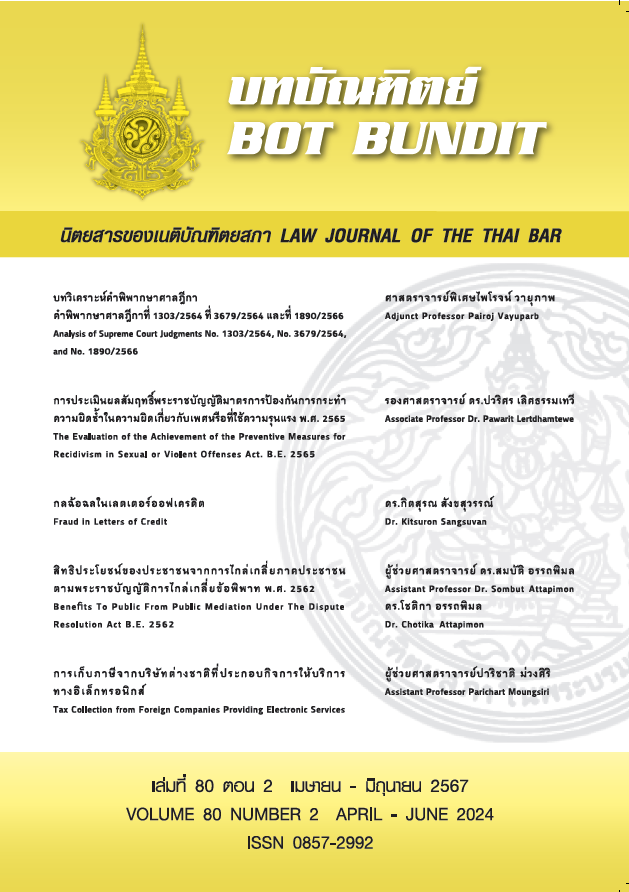
Analysis of Supreme Court Judgments No. 1303/2564, No. 3679/2564, and No. 1890/2566
Article Sidebar
Main Article Content
Abstract
This article aims to study and analyze the principles of law according to the Civil and Commercial Code and Criminal Code as appear in Supreme Court Judgments No. 1303/2564, No. 3679/2564, and No. 1890/2566.
Do the legal rights, duties and liabilities pursuant to a contract of suretyship between a guarantor and a creditor bind only the contracting parties in such a way that the successors of the guarantor would not be bound? If not, to what extent are the successors held liable? The author offers an analysis of Supreme Court Judgment No. 1303/2564 regarding the application of the relevant rules to these legal issues.
In Supreme Court Judgment No. 3679/2564, the Court ruled on the issue of an annulment of a fraudulent transfer of real property. In this case, the debtor’s ex-husband transferred to a third party land and structures located thereon, which were community property, causing the debtor’s creditor to be at a disadvantage in collecting an outstanding loan. The author employs the rule application from the judgment to analyze Section 237 of the Civil and Commercial Code.
Supreme Court Judgment No. 1890/2566 analyzed the distinction between attempted larceny and a successfully completed crime by applying the criterion of “taking property,” according to the Criminal Code, Section 334. However, the author has an observation regarding the use of that particular criterion; had the Court considered the facts as to the manner in which ownership was deprived, the outcome of the case may well have been different.
Article Details

This work is licensed under a Creative Commons Attribution-NonCommercial-NoDerivatives 4.0 International License.
