
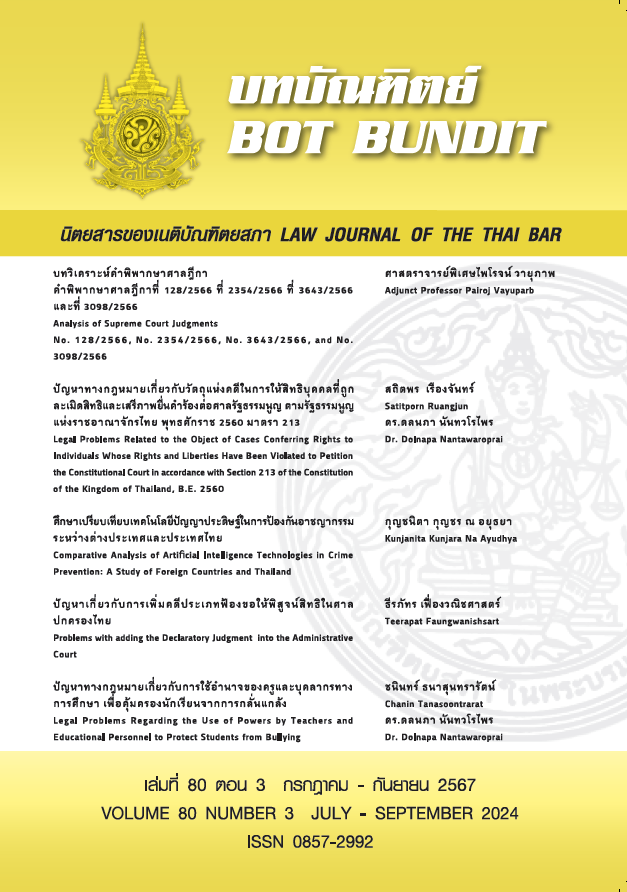
Analysis of Supreme Court Judgments No. 128/2566, No. 2354/2566, No. 3643/2566, and No. 3098/2566
Article Sidebar
Main Article Content
Abstract
This article aims to study and analyze the principles of law according to the Civil and Commercial Code as appear in Supreme Court Judgment No. 128/2566, the Civil Procedure Code as appear in Supreme Court Judgment No. 2354/2566, and the Criminal Code as appear in the Supreme Court’s judgments No. 3643/2566 and No. 3098/2566.
The plaintiff entered into a settlement agreement with the first defendant to settle a dispute in court. Will the agreement cause the original loan agreement to be terminated? And will the second defendant, who is the guarantor's estate executor, be entitled to raise a defense based on the settlement agreement between the plaintiff and the first defendant? The author offers an analysis on the application of the Civil and Commercial Code on this issue according to Supreme Court judgment No. 128/2566.
The court dismissed the original case because the plaintiff sent a notice to the defendant, who was the guarantor, exceeding the sixty-day period from the date of default. Later, the plaintiff notified the defendant and filed a new lawsuit against the same defendant. Will the second lawsuit be considered as duplicative litigation according to the Civil Procedure Code Section 148? The author offers a perspective on the reasoning stated in the Supreme Court judgment No. 2354/2566.
Does the term "any object" stated in the first paragraph of Criminal Code Section 22 mean only that the object that caused the fire must belong to the person who caused the fire? The author employs an analysis of the decision in Supreme Court judgment No. 3643/2566.
The investigation officer ordered the defendant, who was a suspect in a minor offense, to take fingerprints for a criminal record check, but the defendant did not comply with the order. Is the defendant’s noncompliance considered as an offense under Section 368 of the Criminal Code? The author offers an interesting analysis that differs from the decision in Supreme Court judgment No. 3098/2566.
Article Details

This work is licensed under a Creative Commons Attribution-NonCommercial-NoDerivatives 4.0 International License.
