
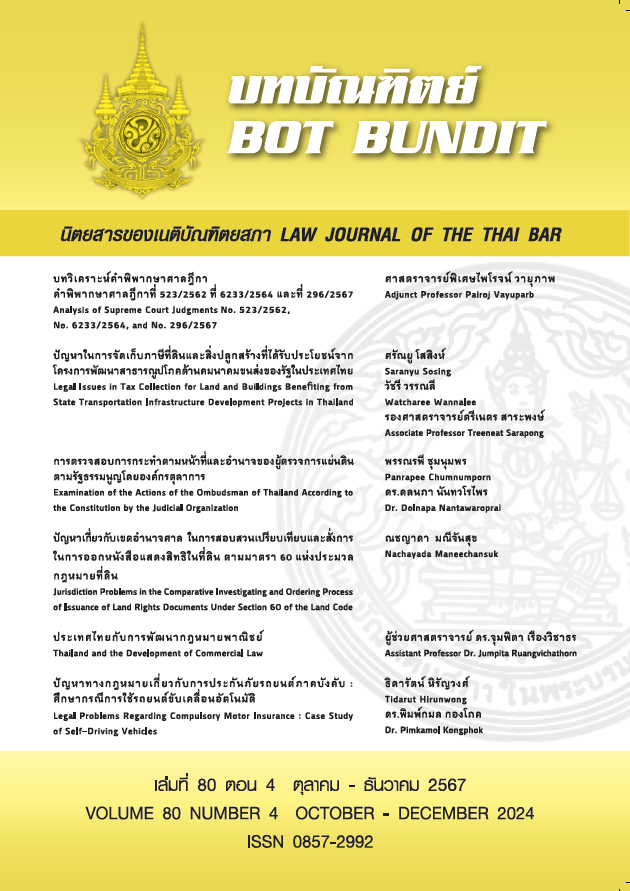
Analysis of Supreme Court Judgments No. 523/2562, No. 6233/2564, and No. 296/2567
Article Sidebar
Main Article Content
Abstract
This article aims to study and analyze the principles of law according to the Civil and Commercial Code and Criminal Code and the Civil Procedure Code as appeared in Supreme Court Judgments No. 523/2562 and No. 6233/2564 and principles of law according to the Criminal Code as appeared in Supreme Court Judgment No. 296/2567.
The plaintiff entered into a land lease agreement with the State Railway of Thailand, with a contract stipulating that the lessee must have the duty and responsibility to evict the intruder or the original operator, demolish the building, and the lessee must be responsible for taking action and making corrections, at the lessee’s own expense. After signing the contract, the plaintiff was unable to occupy and use some of the land because the defendant had already occupied it. Does the plaintiff have the right to sue to evict the defendant directly? The Supreme Court has ruled in the Supreme Court Judgment No. 523/2562, in which the author has a different opinion, as detailed in the note at the end of the judgment.
The plaintiff deposited money with the defendant, which is a commercial bank and a service provider for using or transferring money via mobile phones and computers. Later, the money in the plaintiff’s deposit account was transferred to another person’s deposit account, which was the same account or the same account name, multiple times in a row at the same time at night. This is considered an unusual financial transaction behavior. Does the defendant have a duty to have measures to prevent the transfer of money or the making of improper electronic transactions to prevent damage? To what extent? The Supreme Court has ruled in the Supreme Court Judgment No. 6233/2564, which the author has noted in the note at the end of the judgment. The term “fraudulently” according to the definition in the Criminal Code, Section 1 (1), which is an element of the crime of theft, will have a meaning covering the circumstances in which the defendant honestly believed that the defendant could do so in such circumstances or not? To what extent? The Supreme Court has ruled in the Supreme Court Judgment No. 296/2567, which the author has noted in the note at the end of the judgment.
Article Details

This work is licensed under a Creative Commons Attribution-NonCommercial-NoDerivatives 4.0 International License.
