
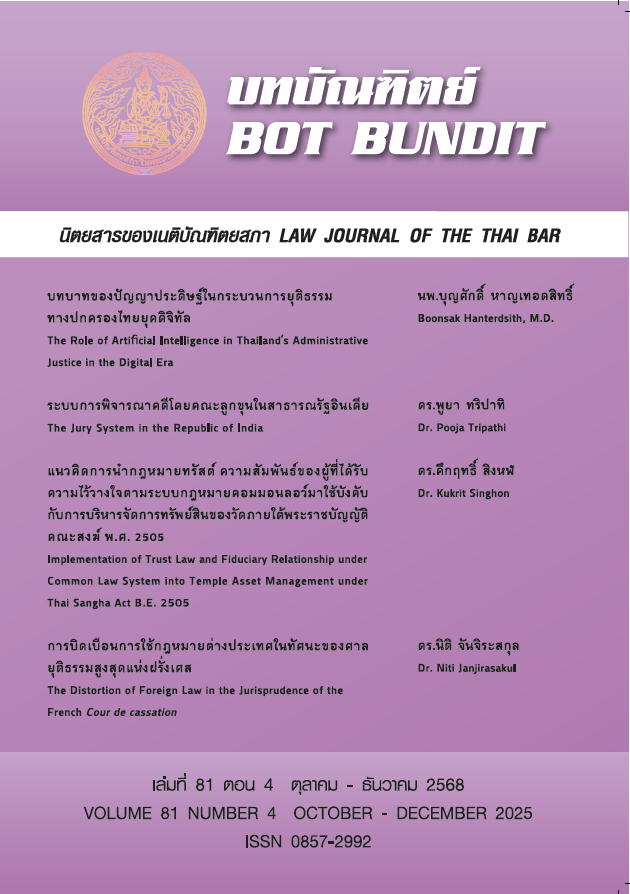
The The Role of Artificial Intelligence in Thailand’s Administrative
Article Sidebar
Main Article Content
Abstract
court system (e-Admincourt). However, it still lacks automation and decision support systems—key components of digital transformation in the judiciary. The integration of artificial intelligence (AI) in administrative justice could help minimize errors in administrative discretion, enhance transparency, and reduce the number of cases brought before the courts. Additionally, AI has the potential to shorten litigation time and lower procedural costs, improving access to justice for the public. Nonetheless, several challenges remain, including data completeness, the risks associated with over-reliance on technology, high development costs, and liability concerns in case of AI-related errors. This article examines the role of AI in Thailand’s administrative justice system by analyzing the development of the Administrative Court and the application of digital technology to improve decision-making processes for administrative officials and judges. The study highlights the necessity of developing legal and technological infrastructure alongside appropriate regulatory oversight to ensure that AI serves as an effective tool for promoting justice, reducing judicial burdens, and safeguarding citizens’ rights in the future.
Article Details

This work is licensed under a Creative Commons Attribution-NonCommercial-NoDerivatives 4.0 International License.
References
ภาษาไทย
ครองธรรม ธรรมรัฐ, ‘คดีบริหารงานบุคคล (จาดุร - พีรพล - ถวิล) คําตัดสินบนหลักการเดียวกัน’ (บทความทางวิชาการเกี่ยวกับคำพิพากษาของศาลปกครองที่น่าสนใจ, สำนักงานเลขาธิการสภาผู้แทนราษฎร) <https://www.parliament.go.th/ewtadmin/ewt/parliament_parcy/download/admincourt_journal/everyorganization/12.pdf> สืบค้นเมื่อ 2 มิถุนายน 2567.
นันทวัฒน์ บรมานันท์, กฎหมายปกครอง (พิมพ์ครั้งที่ 4, วิญญูชน 2557).
นันทวัฒน์ บรมานันท์, ‘หลักความชอบด้วยกฎหมายของการกระทำทางปกครอง’ ใน กฎหมายปกครอง (พิมพ์ครั้งที่ 4, วิญญูชน 2557) 310–18; ศูนย์ปฏิบัติการต่อต้านการทุจริต กระทรวงสาธารณสุข, ‘แนวปฏิบัติของสำนักงานปลัดกระทรวงสาธารณสุข ราชการบริหารส่วนกลาง ในการตรวจสอบการใช้ดุลพินิจในการปฏิบัติงาน’ (2562).
นิรัญ อินดร, ‘การใช้ดุลพินิจออกคําสั่งย้ายข้าราชการ ... กรณีมีสาเหตุจากการร้องเรียน’ (บทความทางวิชาการเกี่ยวกับคำพิพากษาของศาลปกครองที่น่าสนใจ, สำนักงานเลขาธิการสภาผู้แทนราษฎร, 2555) <https://www.parliament.go.th/ewtadmin/ewt/parliament_parcy/download/admincourt_journal/everyorganization/5.pdf> สืบค้นเมื่อ 31 ธันวาคม 2567.
บัญชา แสงจันทร์, ‘การเข้าถึงกระบวนการยุติธรรมทางปกครองของประชาชน: ศึกษากรณี ปัญหาและอุปสรรคที่เกิดจากระบบศาลและวิธีพิจารณาคดีปกครอง’ (สถาบันบัณฑิตพัฒนบริหารศาสตร์, 2559) <https://repository.nida.ac.th/server/api/core/bitstreams/57539a75-8067-477b-9b72-8fa09c49b84d/content>.
บุญศักดิ์ หาญเทอดสิทธิ์, ‘มาตรฐานทางกฎหมายวิธีปฏิบัติราชการทางปกครอง ในการวัดและประเมินผลระดับอุดมศึกษายุคไทยแลนด์ 4.0’ (2560) 3 บทบัณฑิตย์ 38.
พัชรี อยู่ประเสริฐ, ‘ปัญหาความล่าช้าของกระบวนวิธีพิจารณาคดีของศาลปกครองในคดีบริหารงานบุคคล’ (มหาวิทยาลัยสุโขทัยธรรมาธิราช, 2562) <https://ir.stou.ac.th/handle/123456789/3951?mode=full> สืบค้นเมื่อ 31 ธันวาคม 2567.
พีรพัฒ โชคสุวัฒนสกุล และ อรรถพล ธำรงรัตนฤทธิ์, ‘การวิเคราะห์คดีละเมิดด้วยปัญญาประดิษฐ์’ (ตุลาคม 2563) <https://www.khonthai4-0.net/content_detail.php?id=115> สืบค้นเมื่อ 31 ธันวาคม 2567.
วรเจตน์ ภาคีรัตน์, ‘ความถูกต้องของการใช้ดุลพินิจ’ ใน กฎหมายวิธีปฏิบัติราชการทางปกครอง (สถาบันพระปกเกล้า 2554).
ศักดิ์ เสกขุนทด, ‘การใช้ดุลพินิจของเจ้าหน้าที่ภาครัฐจะถูกทดแทนด้วย AI ในอนาคต’ (e-Government, 22 กรกฎาคม 2560) <https://www.dga.or.th/document-sharing/article/36063/> สืบค้นเมื่อ 31 ธันวาคม 2567.
ศาลปกครองและสำนักงานศาลปกครอง, ‘สถิติคดีปกครอง’ (สำนักบริหารยุทธศาสตร์ สำนักงานศาลปกครอง) <https://www.admincourt.go.th/admincourt/site/03casedata.html> สืบค้นเมื่อ 28 พฤษภาคม 2568.
ศูนย์ปฏิบัติการต่อต้านการทุจริต, แนวปฏิบัติของสำนักงานปลัดกระทรวงสาธารณสุข ราชการบริหารส่วนกลาง ในการตรวจสอบการใช้ดุลพินิจในการปฏิบัติงาน (กระทรวงสาธารณสุข 2562).
ศูนย์วิเคราะห์ข้อมูล สายยุทธศาสตร์ สำนักงานพัฒนาธุรกรรมทางอิเล็กทรอนิกส์, ‘ปัญญาประดิษฐ์ในการให้บริการของภาครัฐ (AI in Government Services)’ (23 พฤษภาคม 2564) <https://www.etda.or.th/getattachment/bb938d1a-6dd4-4407-bd87-d026773eda89/AI-in-Government-Services.aspx> สืบค้นเมื่อ 31 ธันวาคม 2567.
สถาบันเพื่อการยุติธรรมแห่งประเทศไทย (องค์การมหาชน), ‘Open Data และ AI เครื่องมือสู่ความยุติธรรม TIJ ยกระดับธรรมาภิบาลแบบมีส่วนร่วม’ (2561) <https://www.tijthailand.org/th/highlight/detail/detail/7> สืบค้นเมื่อ 31 ธันวาคม 2567.
สมชัย เลิศสุทธิวงค์, ‘หลักนิติธรรม กับ ดุลพินิจในการออกคําสั่งทางปกครอง’ (การอบรมหลักสูตรหลักนิติธรรมเพื่อประชาธิปไตย รุ่นที่ 5 วิทยาลัยศาลรัฐธรรมนูญ สํานักงานศาลรัฐธรรมนูญ, สํานักงานศาลรัฐธรรมนูญ, มปป.).
สำนักงานคณะกรรมการกฤษฎีกา, ‘การใช้ระบบปัญญาประดิษฐ์ในการแก้ต่างคดี’ (21 สิงหาคม 2563) <https://lawforasean.krisdika.go.th/Content/View?Id=852&Type=1> สืบค้นเมื่อ 31 ธันวาคม 2567.
สำนักงานคณะกรรมการกฤษฎีกา, ‘ความเบื้องต้นเกี่ยวกับการใช้ดุลพินิจของเจ้าหน้าที่ของรัฐ’ <https://www.lawreform.go.th/uploads/files/1593488899-2md2a-80h4b.pdf> สืบค้นเมื่อ 31 ธันวาคม 2567;
สำนักงานราชบัณฑิตยสภา, ‘พจนานุกรม ฉบับราชบัณฑิตยสถาน พ.ศ. 2554’ <https://dictionary.orst.go.th/> สืบค้นเมื่อ 21 เมษายน 2567.
อรญา วิริยะธนาวุฒิวงษ์, ‘ปัญญาประดิษฐ์ (Artificial Intelligence) และการบริหารราชการแผ่นดิน’ ใน วารสารกฎหมายปกครอง (พิมพ์ครั้งที่ 35, ฉบับที่ 4, 2566) 59–78 <https://krisdika.ocs.go.th/data/outsitedata16/file/magazine_no.35-4.pdf> สืบค้นเมื่อ 31 ธันวาคม 2567.
ภาษาต่างประเทศ
Cary Coglianese and David Lehr, ‘Regulating by robot: Administrative decision making in the Machine-learning era’ (2017) Georgetown Law Journal.
Digital Freedom Fund, ‘The ‘SyRI’ Welfare Fraud Risk-Scoring Algorithm’ (2020) <https://digitalfreedomfund.org/the-syri-welfare-fraud-risk-scoring-algorithm/> สืบค้นเมื่อ 31 ธันวาคม 2567.
Dovile Baryse and Roee Sarel, ‘Algorithms in the Court: Does It Matter Which Part of the Judicial Decision-Making Is Automated?’ (2024) Artificial Intelligence and Law 32, no. 1 <https://doi.org/10.1007/s10506-022-09343-6> สืบค้นเมื่อ 31 ธันวาคม 2567.
Ivo Pilving, and Monika Mikiver, ‘A Kratt as an Administrative Body: Algorithmic Decisions and Principles of Administrative Law’ Juridica International 29 (31 December 2020) <https://doi.org/10.12697/ji.2020.29.05>.
Jennifer M. Logg, ‘Using Algorithms to Understand the Biases in Your Organization’ (2019) Harvard business review (9 August 2019) <https://hbr.org/2019/08/using-algorithms-to-understand-the-biases-in-your-organization> สืบค้นเมื่อ 31 ธันวาคม 2567.
Johan Wolswinkel, ‘Artificial intelligence and administrative law’ (December 2022) <https://coe.int/documents/22298481/0/CDCJ%282022%2931E+-+FINAL+6.pdf/4cb20e4b-3da9-d4d4-2da0-65c11cd16116?t=1670943260563> สืบค้นเมื่อ 31 ธันวาคม 2567.
Johan Wolswinkel, ‘Comparative Study on Administrative Law and the Use of Artificial Intelligence and Other Algorithmic Systems in Administrative Decision-Making in the Member States of the Council of Europe’ (Council of Europe, December 2022) <https://coe.int/documents/22298481/0/CDCJ%282022%2931E+-+FINAL+6.pdf/4cb20e4b-3da9-d4d4-2da0-65c11cd16116?t=1670943260563> สืบค้นเมื่อ 31 ธันวาคม 2567.
Lori Perri, ‘What’s New in Artificial Intelligence from the 2023 Gartner Hype Cycle’ (Innovation technology insights, 17 August 2023) <https://www.gartner.com/en/articles/what-s-new-in-artificial-intelligence-from-the-2023-gartner-hype-cycle> สืบค้นเมื่อ 31 ธันวาคม 2567.
Microsoft, ‘What is artificial intelligence?’ <https://azure.microsoft.com/en-us/resources/cloud-computing-dictionary/what-is-artificial-intelligence/#self-driving-cars> สืบค้นเมื่อ 1 มิถุนายน 2567.
NATO Strategic Communications Centre of Excellence, ‘2007 cyber attacks on Estonia’ (2019) <https://stratcomcoe.org/cuploads/pfiles/cyber_attacks_estonia.pdf#:~:text=In%20April%20and%20May%202007%2C%20Estonia%20became%20the,predominantly%20by%20a%20Distributed%20Denial%20of%20Service%20%28DDoS%29> สืบค้นเมื่อ 31 ธันวาคม 2567.
Peter Parycek, Verena Schmid, and Anna Sophie Novak, ‘Artificial Intelligence (AI) and Automation in Administrative Procedures: Potentials, Limitations, and Framework Conditions’ (Journal of the Knowledge Economy, 2023) <https://doi.org/10.1007/s13132-023-01433-3>.
Privacy First, ‘SyRI Risk Profiling’ (20 February 2023) <https://privacyfirst.nl/en/court-cases/syri/> สืบค้นเมื่อ 31 ธันวาคม 2567.
Sanne Blauw, ‘An Algorithm Was Taken to Court – and It Lost’ (The Correspondent, 10 February 2020) <https://thecorrespondent.com/276/an-algorithm-was-taken-to-court-and-it-lost-which-is-great-news-for-the-welfare-state> สืบค้น เมื่อ 31 ธันวาคม 2567.
Supreme Court of Estonia, ‘Artificial Intelligence: A Substitute or Supporter of Judges?’ (2019) <https://aastaraamat.riigikohus.ee/en/artificial-intelligence-a-substitute-or-supporter-of-judges/> สืบค้นเมื่อ 31 ธันวาคม 2567.
Yasemin Zeisl, ‘Risks and Benefits of Artificial Intelligence in Courts’ (16 April 2019) <https://www.globalriskintel.com/insights/risks-and-benefits-artificial-intelligence-courts> สืบค้นเมื่อ 31 ธันวาคม 2567.
