
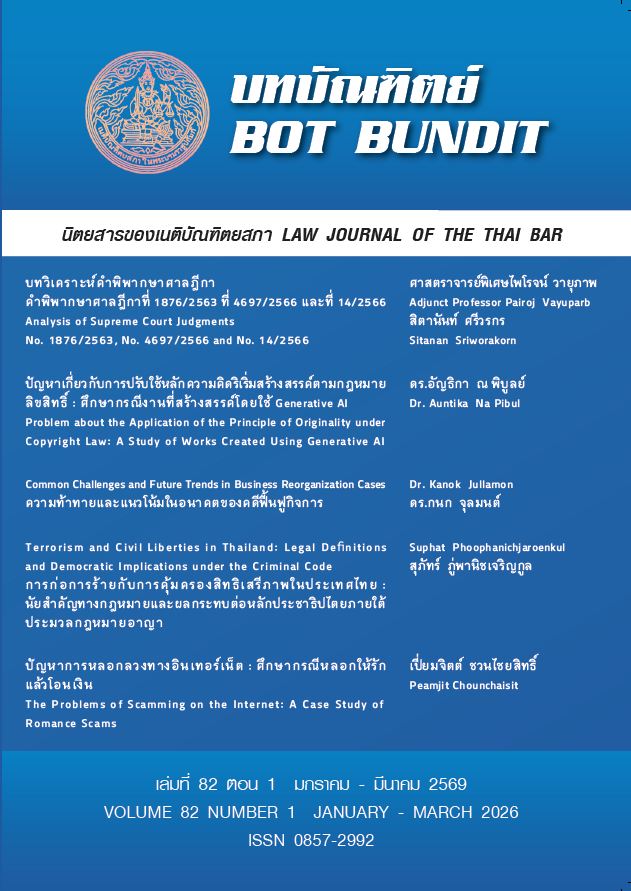
Analysis of Supreme Court Judgments No. 1876/2563, No. 4697/2566 and No. 14/2566
Article Sidebar
Main Article Content
Abstract
This article considers three cases; it aims to review and analyze the principles of law according to the Penal Code, as appears in Supreme Court Judgment No. 1876/2563 and principles of law according to the Criminal Procedure Code, as appears in Supreme Court Judgments No. 4697/2566 and No. 14/2566
First, the plaintiff and the defendant are full siblings. The defendant holds a lifelong right of residence in a house built on land owned solely by the plaintiff as is recorded in the deed. The issue is whether the defendant’s act of demolishing the existing house and constructing a new, improved structure for his own residence without the plaintiff’s consent constitutes the criminal offense of damage to property under Section 358 of the Thai Penal Code. The Supreme Court addressed this question in Supreme Court Judgment No. 1876/2563, on which the author provides additional commentary in the notes appended to the decision.
In a second case, where the defendant pleads guilty to an offense for which the law prescribes a minimum sentence of imprisonment of five years and the trial court hears the prosecution’s evidence to support the factual basis for a guilty plea and subsequently convicts the defendant, the question arises whether the defendant may later appeal on the ground that the prosecution’s evidence is insufficient to constitute the offense charged. The issues are whether such an appeal is inconsistent with the defendant’s guilty plea in the trial court and whether such an appeal constitutes an attempt to raise a factual issue that was not properly raised in the lower court and is, therefore, procedurally barred. The Supreme Court resolved these issues in Supreme Court Judgment No. 4697/2566, with the author’s observations included in the concluding notes to the decision.
In the third case, where the prosecution in a criminal case sets out the indictment without including any request concerning the seized property, questions arise as to the extent of the court’s authority to issue orders regarding such property. May the court order the disposition of the seized property? May the court order its return to the rightful owner? And if the court does order the return of the property to its owner, would this be considered a judgment or order exceeding the relief sought or addressing matters not included in the indictment? The Supreme Court addressed these issues in Supreme Court Judgment No. 14/2566, followed by the author’s observations in the notes appended to the decision.
Article Details

This work is licensed under a Creative Commons Attribution-NonCommercial-NoDerivatives 4.0 International License.
