
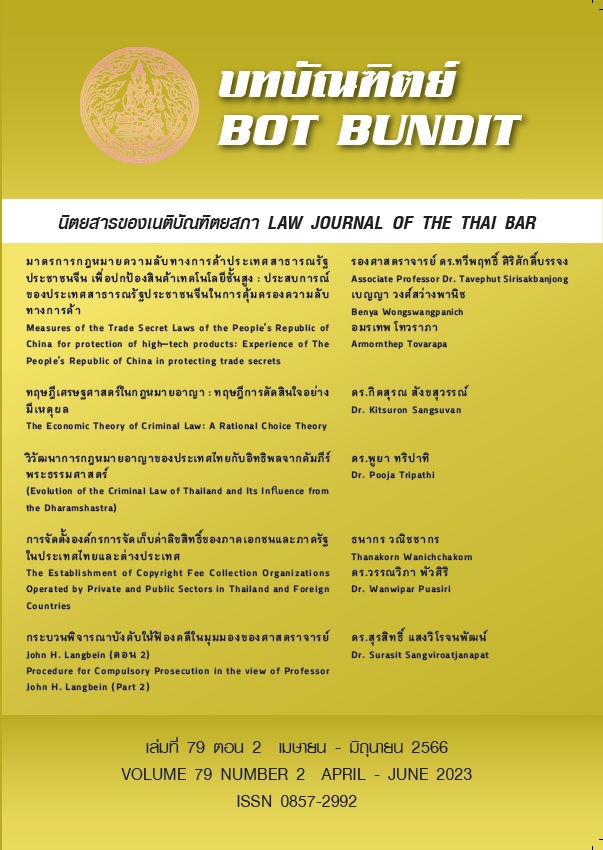
Evolution of the Criminal Law of Thailand and Its Influence from the Dharamshastra
Article Sidebar
Main Article Content
Abstract
The criminal legal system of Thailand has a long-standing evolution from the antecedent to the modern era. In the beginning, the written law was not in an existence, the customs based on Thai traditions were in force to regulate the society. Subsequently, in Sukhothai era the proof of written law was seen and during Ayutthaya period the written law was developed and strongly influenced from and skim off Dharamshastra taking into consideration of Thai traditions and cultures, with time to time, developed to the enactment and execution of the Law of Three Seals, the Penal Code of R.S. 127 and current Criminal Code B.E. 2499 respectively. The development has gradually been made in consonance with social, political, administrative and economic contexts in company with foreign influences. Altogether, these led to the criminal law keep abreast of the times. In particular, the court proceeding shall be judicious in accordance with the principle of criminal liability and punishment.
Article Details

This work is licensed under a Creative Commons Attribution-NonCommercial-NoDerivatives 4.0 International License.
References
ภาษาไทย
กลุ่มวิชาการทำหน้าที่กัลยาณมิตร, ‘ศาสนาพราหมณ์-ฮินดู คัมภีร์ในศาสนา’ (กัลยาณมิตร, 23 มิถุนายน 2559) <https://kalyanamitra.org/th/article_detail.php?i=12509> สืบค้นเมื่อ 13 ธันวาคม 2565.
คทาวุธ คเวสกธมฺโม, พระใบฏีกา (เพ็งที), ‘บทวิเคราะห์แนวคิดพหุนิยมกฎหมายของเมอรี่ มุมมองจากรากฐานทางพุทธศาสนากับสังคมวิทยาของประเทศไทย The analysis on the idea of Legal pluralism of Merry - The aspect from the roots of the Buddhism and sociology of Thailand’ (2563) 2 วารสารนิติศาสตร์และสังคมท้องถิ่น 189 <https://so04.tci-thaijo.org/index.php/llsj/article/download/244446/168713/870301> สืบค้นเมื่อ 13 ธันวาคม 2565> สืบค้นเมื่อ 13 ธันวาคม 2565.
ชมชื่น มัณยารมย์, ‘บทที่ 2 วิวัฒนาการของกฎหมาย’ (มหาวิทยาลัยธุรกิจบัณฑิตย์, 2542) <https://law.dpu.ac.th/upload/content/files/2.doc> สืบค้นเมื่อ 13 ธันวาคม 2565.
ดิเรก อุทรทวิการ ณ อยุธยา, ‘“พระธรรมสาตร” กับความเปลี่ยนแปลงโลกทัศน์ทางกฎหมายของชนชั้นนำไทย’ (2557) วารสารประวัติศาสตร์ 72 <https://ejournals.swu.ac.th/index.php/JOH/article/download/4691/4517/15201> สืบค้นเมื่อ 13 ธันวาคม 2565.
เดือน คำดี, ‘พระเวทในสายตาแห่งพุทธปรัชญา’ (2559) 2 วารสารราชบัณฑิตยสภา 41 <https://www.orst.go.th/FILEROOM/CABROYINWEB/DRAWER004/GENERAL/DATA0000/00000613.FLP/html/78/#zoom=z> สืบค้นเมื่อ 13 ธันวาคม 2565.
ปรามินทร์ เครือทอง, ‘บทลงโทษสุดโหด ในกฎหมายตราสามดวง ที่ความตายเรียก “พี่”’ (silpa-mag, 7 กุมภาพันธ์ 2565) <https://www.silpa-mag.com/history/article_34958> สืบค้นเมื่อ 13 ธันวาคม 2565.
ปิยฉัตร บุนนาค, สิริวรรณ นันทจันทูล และสุรีย์รัตน์ บำรุงสุข, ‘การสูญศัพท์ การเพิ่มศัพท์ และการเปลี่ยนแปลงทางความหมายของศัพท์ที่เป็นโทษทางอาญาในสมัยกรุงรัตนโกสินทร์ (Loss of Vocabularies, Adding Vocabularies and Meaning Change of Criminal Punishment Vocabularies in Rattanakosin Period)’ (2561) 3 วารสารมหาวิทยาลัยราชภัฏยะลา 436 <https://so04.tci-thaijo.org/index.php/yru_human/article/download/152119/111080/410763> สืบค้นเมื่อ 13 ธันวาคม 2565.
พงษ์ธร ธัญญสิริ, ‘ย้อนดูอดีต เพื่อก้าวสู่อนาคต กฎหมายอาญาไทย’ (2552) 2 วารสารกระบวนการยุติธรรม 133 <https://so04.tci-thaijo.org/index.php/JTJS/article/download/245569/166798/854543> สืบค้นเมื่อ 13 ธันวาคม 2565.
มานพ ถาวรวัฒน์สกุล, ‘การกำหนดอายุกฎหมายอยุธยาในกฎหมายตราสามดวง: บทวิเคราะห์เบื้องต้น’ (2543) 2 วารสารอักษรศาสตร์ มหาวิทยาลัยศิลปากร 171 <https://so04.tci-thaijo.org/index.php/jasu/article/download/250294/169912/> สืบค้นเมื่อ 13 ธันวาคม 2565.
วรภักดิ์พิบูลย์, พระ คำบรรยายประวัติศาสตร์กฎหมายไทย (โรงพิมพ์วิบูลกิจ, 2496).
ศรัณย์ จิระพงษ์สุวรรณ, ‘การรัฐประหารกับ “องค์อธิปัตย์” ในสังคมการเมืองไทย Coup d’Etat in Thai politics’ (2560) 2 วารสารศิลปศาสตร์ มหาวิทยาลัยอุบลราชธานี306 <https://so03.tci-thaijo.org/index.php/jla_ubu/article/download/242581/164542/> สืบค้นเมื่อ 13 ธันวาคม 2565.
ศูนย์ข้อมูลกฎหมายกลาง สํานักงานคณะกรรมการกฤษฎีกา, ‘200 ปี กฎหมายตราสามดวง’ (สํานักงานคณะกรรมการกฤษฎีกา, มปป) <http://web.krisdika.go.th/pdfPage.jsp?type=act&actCode=40> สืบค้นเมื่อ 13 ธันวาคม 2565.
สุเมฆ จีรชัยสิริ, ‘กฎหมายตราสามดวง’ (พิพิธภัณฑ์รัฐสภา, 1 สิงหาคม 2563) <https://parliamentmuseum.go.th/ar63-Law-enact.html> สืบค้นเมื่อ 13 ธันวาคม 2565.
ภาษาต่างประเทศ
A.S. Narayana Deekshitulu vs State Of Andhra Pradesh & Ors, 1996 AIR 1765, JT 1996 (3) 482.
The Editors of Encyclopaedia Britannica, ‘Dharma-shastra Hinduism’ (Encyclopaedia Britannica, 28 October 2018) <https://www.britannica.com/topic/Dharma-shastra> สืบค้นเมื่อ 13 ธันวาคม 2565.
M Rama Jois, Dharma The Global Ethic (Unknown Southasian Publishing, 1996) <https://www.vhp-america.org/wp-content/uploads/2018/09/DHARMA_Ram_Jois.pdf> สืบค้นเมื่อ 13 ธันวาคม 2565.
Madhulika Chebrol, ‘Dharma and Its Application in Ancient India’ (2022) <https://www.researchgate.net/publication/343510657_Dharma_and_its_Application_in_Ancient_India_Madhulika_Chebrol_Dharma_and_its_Application_in_Ancient_India> สืบค้นเมื่อ 13 ธันวาคม 2565.
Manu-Smriti – The Code of Manu’ (GlobalSecurity, no publication date) <https://www.globalsecurity.org/military/world/india/manu-smriti.htm> สืบค้นเมื่อ 13 ธันวาคม 2565.
Mark McClish, ‘From Law to Dharma: State Law and Sacred Duty in Ancient India’ (2019) 3 Journal of Law and Religion 284 <https://www.cambridge.org/core/journals/journal-of-law-and-religion/article/abs/from-law-to-dharma-state-law-and-sacred-duty-in-ancient-india/49D3C15A4CA35DBE7DD887079D37C065> สืบค้นเมื่อ 13 ธันวาคม 2565.
Mukund Sarda and Basim Akhtar, ‘Concept of Dharma, Justice, and Law: A Study’ (2017) 1 Bharati Law Review 179 <http://docs.manupatra.in/newsline/articles/Upload/50B727EC-6404-4C35-BB26-F6169BF31862.pdf> สืบค้นเมื่อ 13 ธันวาคม 2565.
