
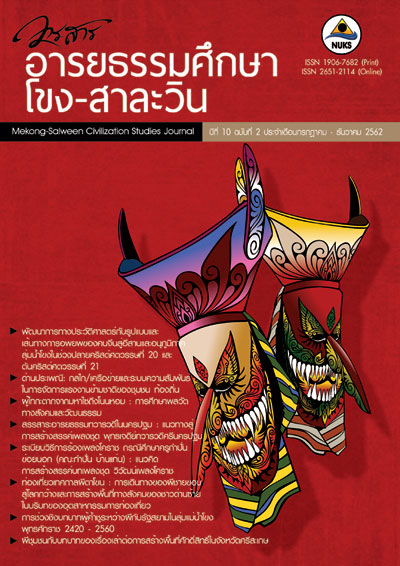
The Contestation of Patronage Role between Ghosts and the Siam State in the Mekong River Basin 1877 – 2017 The Contestation of Patronage Role between Ghosts and the Siam State in the Mekong River Basin 1877 – 2017
Article Sidebar
Main Article Content
Abstract
This article aims to study change of perception of Siam State to believe of northeastern people on spirits worship during 1877–2017. Historical methods used to study evident and tracks through written sources, both of primary and secondary sources. A result taken from this study was the meaning of ghost and holy thing of the Mekong river basin had changed over the time, depending on politics, economy and society in each period. In the early time, believes of local people based on ghost and super natural power. Later, ghosts were insulted as ignorant believe. In the present, ghosts are important, especially, economic value, Therefore, Thai state had changed its position from former adversary to be alliance of local ghosts.
Downloads
Article Details
References
Boonjaem, S. (1997). Dhammasroisaikam. Ubon Ratchathani: Isan
Heritage Publishing House.
Cripps, F. (2008) .Northeastern. Bangkok: Maekhamphang.
Kamboot, B. (1998). Past Remembrance, Bangkok: Namakson.
Limsiri, N. (1981). The Significance of the Isan Rebels. 2325-2445.
Thesis Master of Arts Department of History Silpakorn
University.
Office of the National Economics and Social Development Board.
(1961). National Economic Development Plan. Bangkok:
Office of the Prime Minister.
Pattha, P. (2007). Impact of US military bases on socio-economic
conditions of Udon Thani. Thesis Master of Arts Department
of History Silpakorn University.
Paemsombat, D. (2006). An Uprising in the Northeastern Region
(A.D.1901-1902) of Rebels Who Called Themselves. Thesis
Master of Arts Department of History Ramkhamhaeng
University.
Payutto, P. (2010). Development of Thai society. The knowledge
of the Tribhumi. Bangkok: Buddhism Publishing House.
Phonwattana, N. (2007). Social and Cultural Anthropology. Bangkok:
Exeter Network.
Pilawongs, K. (1967). Culture and tradition of Lao. Vientiane: Sang
Suwan Publishing House.
Pongsapich, A. (1995). Culture, Religion and Ethnic: Analyzes of
Thai Societies. Bangkok: Klangwitthaya.
Punnotok, T. (1991). Folk beliefs related to life style in Isan society.
Bangkok: Thai culture.
Prince Damrong Rajanubhab. (1955) Tales of Archeology. Bangkok:
The Fine Arts Department.
Prince Damrong Rajanubhab. (1961). Sasnasomdej. Bangkok: The
Trade Organization of the Teachers Council.
Royal Academy. (2013). Dictionary of Royal Academy 2554 Honor
the King on the occasion of His Majesty the King's 7th
Anniversary Celebration. December 5, 2554. Bangkok:
Royal Academy.
Subwattana, T. (2011). Concepts and Approaches of local history.
Bangkok: Inthanin.
Tapesrimuang, B. (2011). The Stone Star tells the story of Phaya Tan.
Bangkok: Health Mind.
Thai-Japanese Association. (1996). Speeches of the Representatives
on the Condition of Provinces. Bangkok : Amarin Printing
and Publishing.
Utraranakon, C. (1961). Traditions of Isan. Bangkok: Printing House.
Wipakpochanakij,T. (2003). History of Isan. Bangkok : Foundation for
the Promotion of Social Sciences and Humanities.
Weerawong, S. (1997). History of Laos. Bangkok: Matichon.
Wongthes, P. (2000). Society and Culture in Southeast Asia. Bangkok:
Ruankaew Printing.
Wongthes, S. (2006). The name of the city of Amnat Charoen.
Office of the National Culture Commission. Bangkok:
Ruankaew Printing.
