
Politics of Theorizing Food Security: A Survey Research on Defining Food Security in the Governmental, Private, and Civil Society Aspects in Thailand
Article Sidebar
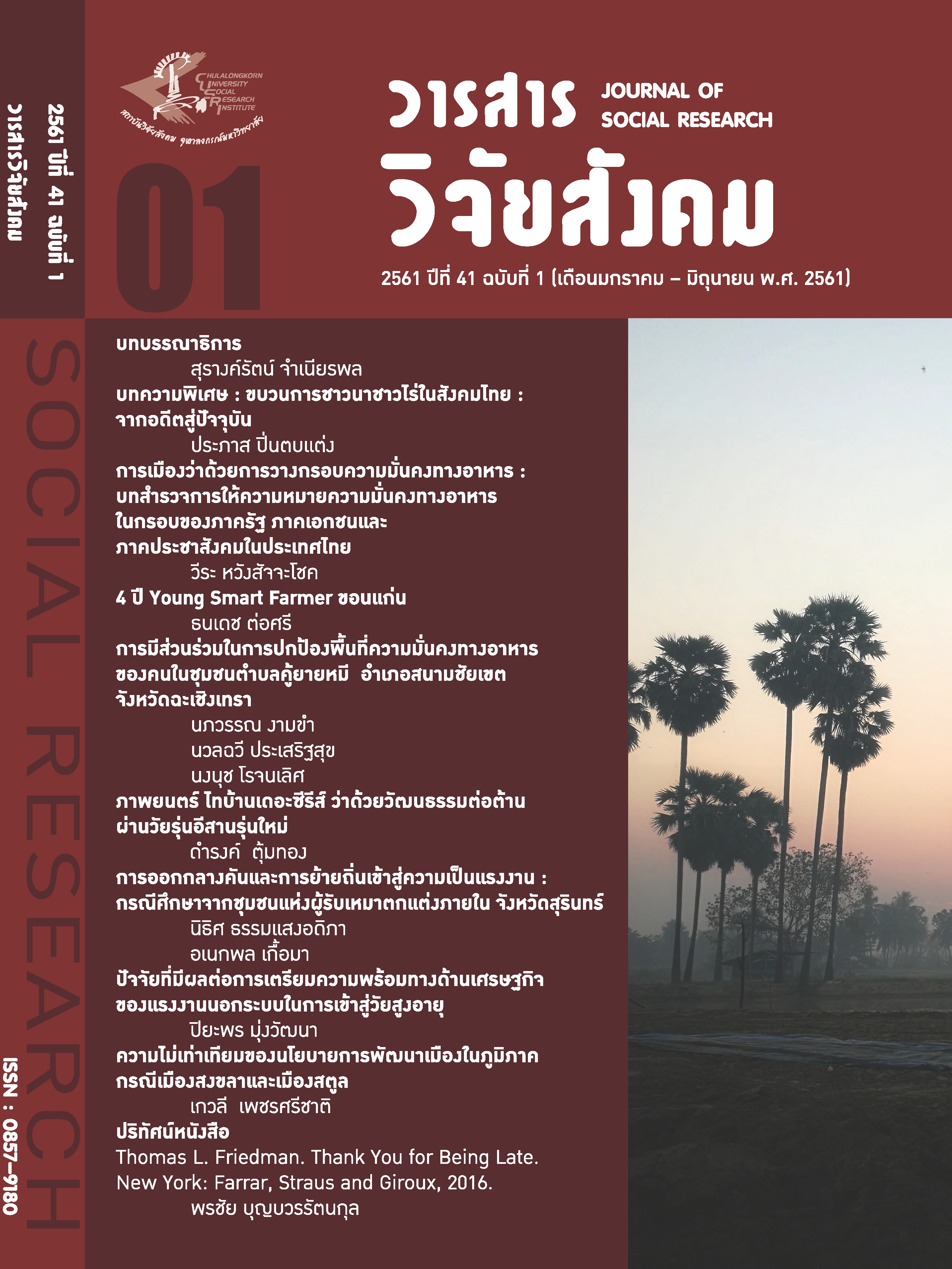
Main Article Content
Abstract
Food security is one of the most problematic concepts to define and frame because it has more than 200 definitions and 450 indicators. Food security hence becomes a strategic concept, which has been cited by every sector based on their purposes. These situations turned to research questions of this article. What were the different definitions of food security theorized by the Thai government, private, and civil society sectors? And how did they employ power relations to do so? The research used qualitative methods, including documentary research, in-depth interview, and critical discourse analysis to demonstrate politics and hegemonic power behind selected language and concept.
The finding showed that the politics of theorizing concept of food security relied on four issues: dimensions units of analysis, goals of each sector, and powers of positions they stand for. In the upshot, contributions of the research lead to an understanding that politics of theorizing the concepts of food security is undeniable. To reconcile every sector to solve issues of food security, the sectors should build practical cooperation, not ideological argumentation, in term of provincial and community-based organizations.
Article Details
- The copyright for this article belongs to the Social Research Institute at Chulalongkorn University. However, the views and content within are solely those of the authors.
- The views and opinions expressed in the articles published in the Journal of Social Research and Review, Social Research Institute, Chulalongkorn University, are the sole responsibility of the authors and do not reflect the views or responsibilities of the editorial board of the Journal of Social Research and Review, Social Research Institute, Chulalongkorn University. The editorial board does not reserve the rights to reproduction but requires proper citation for referencing.
References
1. คณะกรรมการอาหารแห่งชาติ. (2559). กรอบยุทธศาสตร์การจัดการด้านอาหารของประเทศไทย, เข้าถึงได้จาก: http://food.fda. moph.go.th/lgtfdapv/data/Strategy.pdf (วันที่เข้าถึง 12 มีนาคม 2560).
2. ซีพีเอฟ (2558) “รายงานความยั่งยืนประจำปี 2558” บริษัท เจริญโภคภัณฑ์อาหาร จำกัด (มหาชน), เข้าถึงได้จาก: http://www.cpfworldwide.com/th/sustainability/report, (วันที่เข้าถึง 13 มีนาคม 2560).
3. วีระ หวังสัจจะโชค. (2557). ความมั่นคงทางอาหารในอาเซียน: บทสำรวจร่วมสมัย, นนทบุรี: มูลนิธิเกษตรยั่งยืน (ประเทศไทย).
4. วีระ หวังสัจจะโชค. (2559). “ความมั่นคงทางอาหารและอธิปไตยทางอาหาร: การศึกษาการเมืองเรื่องอาหาร (Food Politics) ในศตวรรษที่ 21” วารสารรัฐศาสตร์มหาวิทยาลัยสุโขทัยธรรมา ธิราช. 2,2 (ก.ค.-ธ.ค.): 77-104.
ภาษาอังกฤษ
1. Agarwal, Bina. (2014). “Food Sovereignty, Food Security, and Democratic Choice: Critical Contradictions, Difficult Conciliations” The Journal of Peasant Studies. 41,6: 1247-1268.
2. Boyer, Jefferson. (2010). “Food Security, Food Sovereignty, and Local Challenges for Transnational Agrarian Movements: The Honduras Case” The Journal of Peasant Studies. 37, 2 : 319-351.
3. Chiengkul, Prapimhan. (2015). Hegemony and Counter-Hegemony in the Agri-food System in Thailand (1990-2014). Ph.D. thesis, University of Warwick.
4. Cox, Robert W. (1986) “Social Forces, States and World Orders: Beyond International Relation Theory”, in Robert O. Keohane (ed.) Neoliberalism and Its Critics. New York: Columbia University Press, pp. 204-254.
5. Fairbairn, Madeleine. (2010). “Framing Resistance: International Food Regime and the Roots of Food Sovereignty” in Hannah Wittman, Annette Desmarais and Nettie Wiebe (eds.) Food Sovereignty: Reconnecting Food, Nature, and Community. Oxford: Pambazuka Press. pp. 15-32.
6. Fairclough, Norman. (1995). Critical Discourse Analysis. London: Longman.
7. Fairclough, Norman and Ruth Wodak .(1997). “Critical Discourse Analysis” in Teun A. Van Dijk (ed.) Discourse as Social Interaction, Vol. 2, London: Sage, pp. 258-284.
8. FAO. (1983). World Food Security: A Reappraisal of the Concepts and Approaches. Director-General's Report. Rome.
9. Foucault, Michel. (1980). Power/Knowledge: Selected Interviews and Other Writings, 1972-1977, Colin Gordon, Leo Marshall, John Mepham, and Kate Soper (trans.). New York: Pantheon Books.
10. Friedmann, Harriet. (1982). “The Political Economy of Food: The Rise and Fall of the Postwar International Food Order” American Journal of Sociology, 88, Supplement: S248-S286.
11. Friedmann, Harriet. (1993). “The Political Economy of Food: A Global Crisis” New Left Review, 197: 29-57.
12. Friedmann, Harriet and Philip McMichael. (1989). “Agriculture and the State System: The Rise and Decline of National Agricultures, 1870 to the Present” Sociologia Ruralis, 29, 2 (August): 93-117.
13. Harvey, David. (2005). A Brief History of Neoliberalism. Oxford: Oxford University Press.
14. Hodge, Robert and Gunther Kress. (1993). Language as Ideology. London and New York: Routledge and Kegan Paul.
15. Holt- Giménez, Eric. (2006). Campesino a Campesino: Voices from Latin Maerica’s Farmer to Farmer Movement for Sustainable Agriculture. San Francisco: Food First Books.
16. Holt-Giménez, Eric and Loren Peabody. (2008). “From Food Rebellions to Food Sovereignty: Urgent Call to Fix a Broken Food System” Food First Backgrounder. 14, 1: 1-6.
17. Jarosz, Lucy. (2014). “Comparing Food Security and Food Sovereignty Discourses” Dialogues in Human Geography. 4, 2: 168-181.
18. Maxwell, Simon. (1996). “Food Security: A Post-Modern Perspective” Food Policy, 21,2 : 155-170.
19. McKeown, David. (2006). “Chapter One: Definition of Food Security” in Food Security: Implications for the Early Year. Available: http://www1.toronto.ca /city_of_toronto/torontopublic_health/healthy_public_policy/children/files/pdf/fsbp_ch_1.pdf, (Accessed July 11, 2017)
20. McMichael, Philip. (1992). “Tensions between National and International Control of the World Food Order: Contours of a New Food Regime”. Sociological Perspectives. 35,2 : 343-365.
21. McMichael, Philip. (2000). “Global Food Politics” in Fred Magdoff, John Bellamy Foster, and Frederick H. Buttel (eds.) Hungry for Profit: The Agribusiness Threat to Farmers, Food, and the Environment. New York: Monthly Review Press. pp.125-143.
22. McMichael, Philip. (2009). “A Food Regime Genealogy” Journal of Peasant Studies. 36,1: 139-170.
23. McMichael, Philip and Mindi Schneider. (2011). “Food Security Politics and the Millennium Development Goals”. Third World Quarterly. 32, 1: 119-139.
24. Patel, Raj. (2012). “The Long Green Revolution” The Journal of Peasant Studies. 40,1: 1-63.
25. Rosset, Peter. (2006). Food is Different: Why We Must Get the WTO Out of Agriculture. London and New York: Zed Book.
26. Staples, Amy L. S. (2006). The Birth of Development: How the World Bank, Food and Agriculture Organization and World Health Organization Changed the World, 1945-1965. Kent, Ohio: The Kent State University Press.
27. Taylor, Marcus. (2008). “Introduction”, in Marcus Taylor (ed.) Global Economy Contested: Power and Conflict across the International Division of Labour. London and New York: Routledge. pp.1-8.
28. Tenorio, Encarnacion Hidalgo. (2011) .“Critical Discourse Analysis, An Overview” Nordic Journal of English Studies. 10,1: 183-210.
29. Van Dijk, Teun A. (1993). “Principles of Critical Discourse Analysis” Discourse and Society. 4,2 : 249-283.
30. Van Dijk, Teun A. (1995). “Aims of Critical Discourse Analysis” Japanese Discourse. 1: 17-27.
31. Van Leeuwen, Teun. (2009). “Discourse as the Recontextualization of Social Practice: A Guide” in Ruth Wodak and Michael Meyer (eds.) Methods of Critical Discourse Analysis. London: Sage. pp. 144-161.
32. Wodak, Ruth and Michael Meyer. (2009). “Critical Discourse Analysis: History, Agenda, Theory, and Methodology” in Ruth Wodak and Michael Meyer (eds.) Methods of Critical Discourse Analysis. London: Sage. pp. 1-33.
สัมภาษณ์
1. วิฑูรย์ เลี่ยนจำรูญ. 16 มกราคม 2559. สัมภาษณ์
2. เดชรัต สุขกำเนิด. 16 มกราคม 2559. สัมภาษณ์.
3. อภิชาติ พงษ์ศรีหดุลชัย. 22 พฤษภาคม 2560. สัมภาษณ์.
4. วุฒิชัย สิทธิปรีดานันท์. 22 พฤษภาคม 2560. สัมภาษณ์.
