
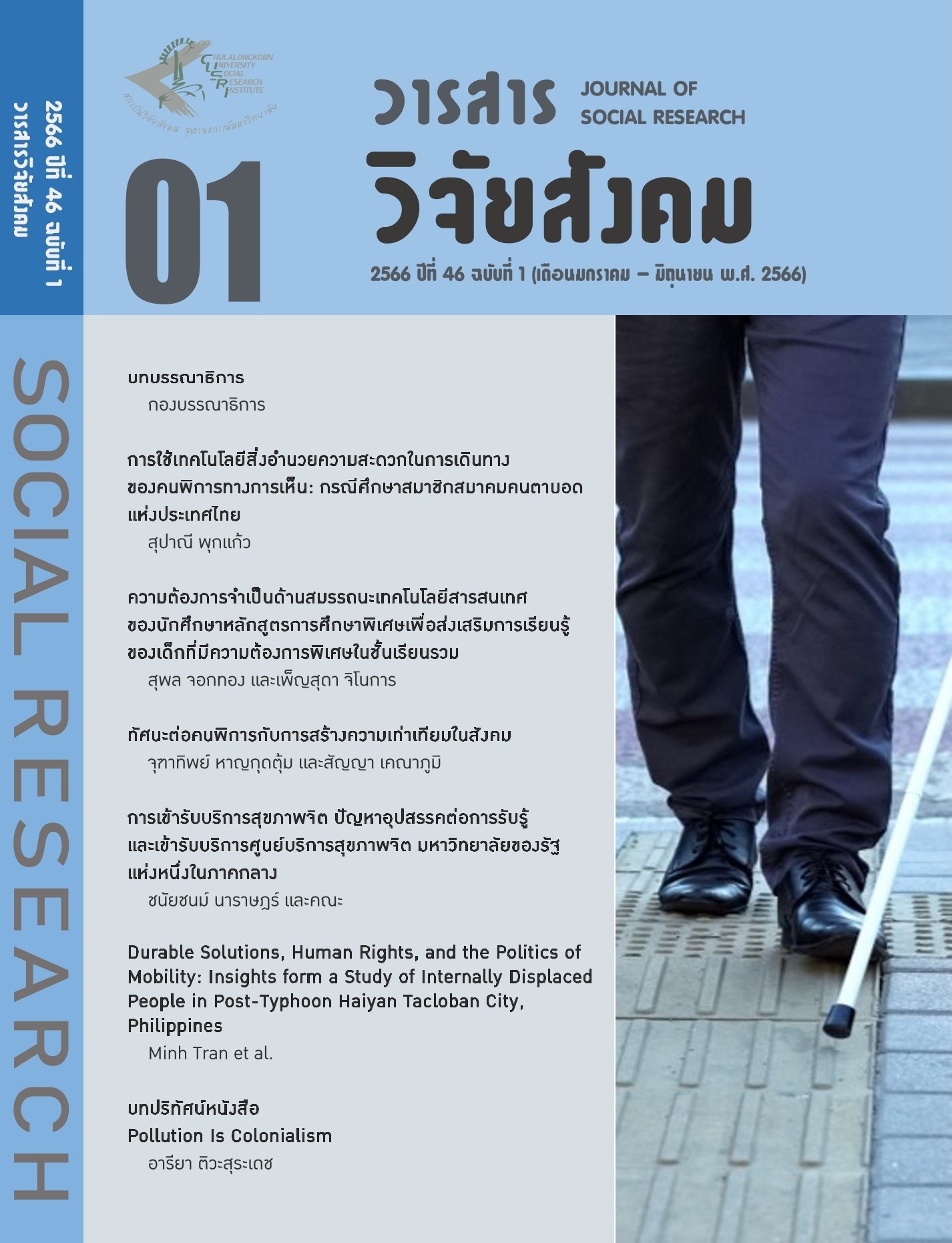
The use of Travel Assistive Technology for people with visual impairment: Study the case of members of The National Association of the Blind
Article Sidebar
Main Article Content
Abstract
This research studies the use of current assistive technology that helps in traveling for visually impaired people. What is the use of, access to, and perception of information about requesting services regarding assistive technology in traveling? What are the needs of visually impaired people that require adjustment and development of assistive technology that helps in travel to be appropriate for visually impaired people, The sample group used in this research were visually impaired people living in Bangkok and surrounding areas. who are members of the Thailand Association of the Blind and are aged 18 years and over, totaling 313 people, using random sampling. The tool used to collect data is a questionnaire.
From the research results, it was found that visually impaired people are able to use assistive technology, including white canes and applications. or other equipment It helps in traveling independently if you are familiar with the place you are going. You can also travel to other places you have never been before by planning and studying travel routes, including using public transportation. And sometimes traveling involves traveling with other people. such as family members and friends
Article Details

This work is licensed under a Creative Commons Attribution-NonCommercial-NoDerivatives 4.0 International License.
- The copyright for this article belongs to the Social Research Institute at Chulalongkorn University. However, the views and content within are solely those of the authors.
- The views and opinions expressed in the articles published in the Journal of Social Research and Review, Social Research Institute, Chulalongkorn University, are the sole responsibility of the authors and do not reflect the views or responsibilities of the editorial board of the Journal of Social Research and Review, Social Research Institute, Chulalongkorn University. The editorial board does not reserve the rights to reproduction but requires proper citation for referencing.
References
ภาษาไทย
- แฉล้ม แย้มเอี่ยม. (2530ก). “ไม้เท้าขาว”. สารานุกรมศึกษาศาสตร์ คณะศึกษาศาสตร์ มหาวิทยาลัยศรีนครินทรวิโรฒ, 2530(6): 55-58.
- แฉล้ม แย้มเอี่ยม. (2530ข). “สุนัขนำทาง”. สารานุกรมศึกษาศาสตร์ คณะศึกษาศาสตร์ มหาวิทยาลัยศรีนครินทรวิโรฒ, 2530(7): 50-53.
- ธัญชนก ผิวคา. (2561). การศึกษาสภาพปัญหาปัจจุบันและความต้องการ ของผู้พิการทางสายตา ครุศาสตร์อุตสาหกรรมมหาบัณฑิต ครุศาสตร์อุตสาหกรรมมหาบัณฑิต. [ออนไลน์]. สืบค้นจาก https://shorturl.asia/W0x7s.
- ธัญชนก ผิวคา และสุรชัย สุขสกุลชัย. (2560). “การศึกษาปัญหาและความต้องการของผู้พิการทางสายตา ศูนย์ฝึกอาชีพหญิงตาบอดสามพราน จังหวัดนครปฐม”. วารสารสหศาสตร์ศรีปทุม ชลบุรี, 3(2): 30-39.
- ประกาศิต ตันติอลงการ และคณะ. (2557). “เครื่องบอกป้ายรถประจำทางสาย 203 สาหรับผู้พิการทางสายตา โดยใช้ GPS ระบุพิกัด”. วารสารวิชาการ มทร. สุวรรณภูมิ, 2557(2): 153-164.
- มูลนิธิธรรมิกชนเพื่อคนตาบอด. (2560). ไม้เท้าอัจฉริยะ (Smart Cane). [ออนไลน์]. สืบค้นจาก https://www.etcb.in.th/index.php/m-etcb-services/29-smart-cane.
- วรรณโชค ไชยสะอาด. (2561). “เบรลล์บล็อก” ทางเดินคนตาบอด อย่าปล่อยให้เมืองทำคนพิการ. [ออนไลน์]. สืบค้นจาก https://www.posttoday.com/social/general/546846.
- วาสนา กาญจนะ และคณะ. (2560). “ประสิทธิผลการฟื้นฟูสมรรถภาพทักษะการทำความคุ้นเคยกับสภาพแวดล้อมและการเคลื่อนไหวของคนตาบอดต่อความสามารถในการดำรงชีวิตประจาวัน ในพื้นที่สถานการณ์ ความไม่สงบ อำเภอตากใบ จังหวัดนราธิวาส”. Princess of Naradhiwas University Journal of Humanities and Social Sciences, 4(2): 81-88.
- วินัดดา ปิยะศิลป์ และวันดี นิงสานนท์. (2558). คู่มือการตรวจประเมิน วินิจฉัย และแนวทางช่วยเหลือเด็กพิการ. ราชวิทยาลัยกุมารแพทย์ แห่งประเทศไทย.
- สาวิตรี ศรีพยัคฆ์ และเหมือนมาศ วิเชียรสินธุ์. (2560). “ปัจจัยในการเลือกใช้รถโดยสารประจำทางของผู้บกพร่องทางการเห็น ในกรุงเทพมหานครและปริมณฑล”. วิศวสารลาดกระบัง, 34(2): 56-62.
ภาษาอังกฤษ
- Tarat, S. (2018). “Senses and Sensory Experience in the World of the Blind”. Journal of Mekong Societies, 14(2): 141-164.
