
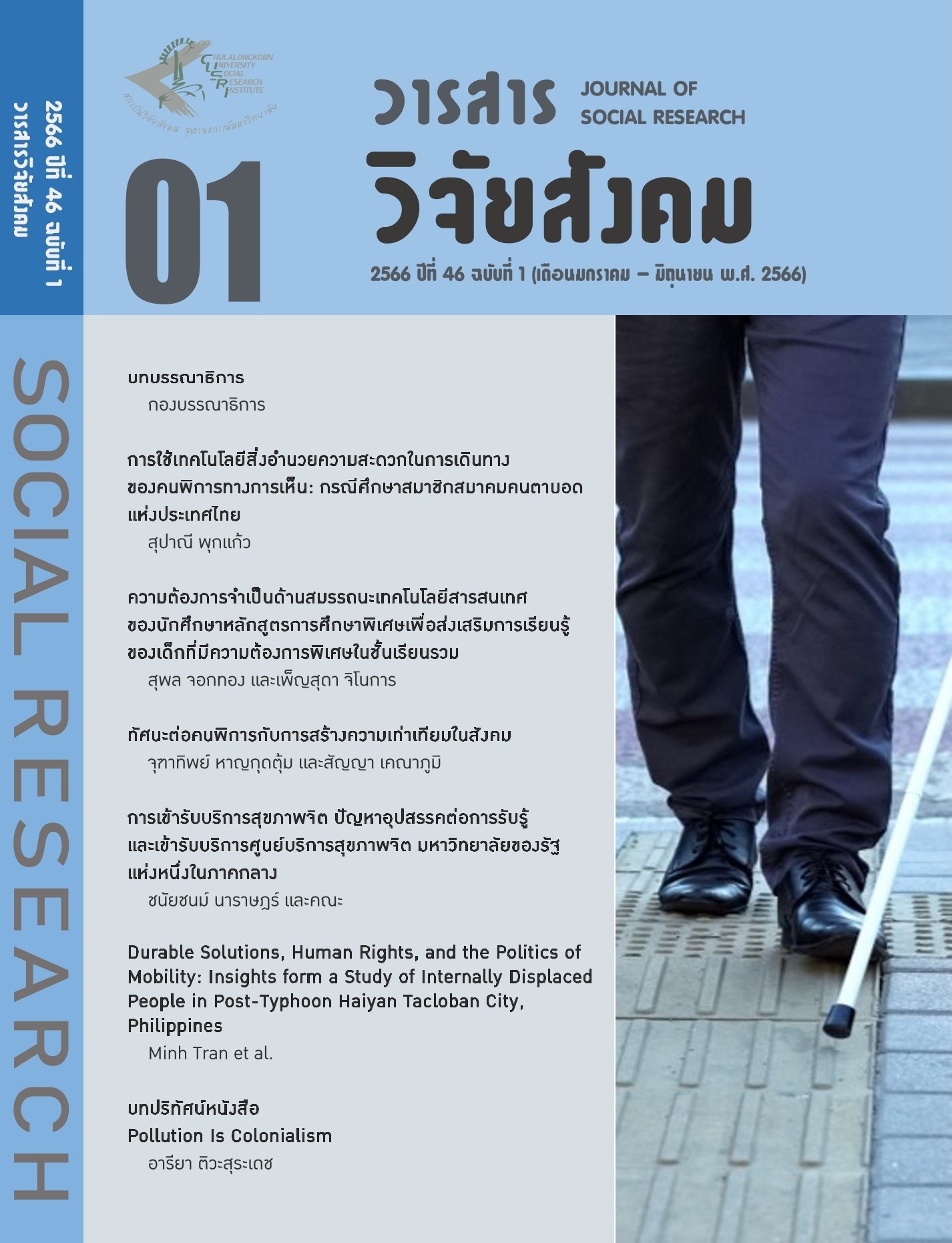
Perspectives on People with Disabilities and Creating Equality in Society
Article Sidebar
Main Article Content
Abstract
Disabled people refer to people who have physical, mental, or intellectual limitations that cause them to experience difficulties in daily living. Disability is often viewed negatively, sometimes reflected in requests for help, resulting in Calling them "beggars" may cause the misconception that everyone who asks for help is disabled. This is a negative image and interpretation that should be changed in society. This paper aims to: Present various perspectives related to disability, societal attitudes, and reflections on individuals in society. The article discusses social barriers and factors influencing attitudes and understanding of disability that are crucial for fostering equality in society and Introduce the role of laws and international agreements concerning the rights of persons with disabilities in promoting equality. The article emphasizes the positive impact of legal frameworks, including those outlined by the United Nations, in shaping positive attitudes and reflections in society. It highlights the awareness of human rights, promoting the sharing of opportunities and equal participation in all aspects of society. Consequently, fostering positive perceptions and reflections on individuals with disabilities contributes to a better understanding of diversity in society, leading to increased awareness of equality that encompasses everyone's participation in creating an equitable environment in all facets of life.
Article Details

This work is licensed under a Creative Commons Attribution-NonCommercial-NoDerivatives 4.0 International License.
- The copyright for this article belongs to the Social Research Institute at Chulalongkorn University. However, the views and content within are solely those of the authors.
- The views and opinions expressed in the articles published in the Journal of Social Research and Review, Social Research Institute, Chulalongkorn University, are the sole responsibility of the authors and do not reflect the views or responsibilities of the editorial board of the Journal of Social Research and Review, Social Research Institute, Chulalongkorn University. The editorial board does not reserve the rights to reproduction but requires proper citation for referencing.
References
ภาษาไทย
- พระราชบัญญัติส่งเสริมและพัฒนาคุณภาพชีวิตคนพิการ พ.ศ. 2550. (2550). ราชกิจจานุเบกษา, 124(61ก). 8.
ฐิติวัจน์ ทองแก้ว, วิรัญญา สุทธิกุล และธีระวัฒน์ จันทึก. (2560). “ทัศนคติ ต่อคนพิการ: ปัจจัยสำคัญที่ผลักดันหรือขวางกั้นการสร้าง ความเท่าเทียม”. วารสารราชภัฏเพชรบูรณ์สาร, 19(2). 19-36.
- ปนัดดา รักษาแก้ว. (2564). “การสร้างความเสมอภาคในสังคม: แนวคิด หลักการ บนฐานคิดธรรมาภิบาล”. วารสาร มจร. สังคมศาสตร์ปริทรรศน์, 10(1). 333-342.
- พีระศักดิ์ พอจิต. (2559). ประชาธิปไตยกับสังคมไทย. กรุงเทพมหานคร: หลักสูตรหลักนิติ ธรรมเพื่อประชาธิปไตย รุ่นที่ 4 วิทยาลัยรัฐธรรมนูญ สานักงานศาลรัฐธรรมนูญ.
- ราชบัณฑิตยสถาน. (2554). พจนานุกรมฉบับราชบัณฑิตยสถาน พ.ศ. 2554. กรุงเทพฯ: นานมีบุ๊คส์พับลิเคชั่นส์, 2556.
สำนักงานส่งเสริมและพัฒนาคุณภาพชีวิตคนพิการแห่งชาติ. (2552). อนุสัญญาว่าด้วยสิทธิคนพิการ, 2552
- อธิภัทร เอิบกมล. (2565). “ที่รักอย่าจากฉันไป : ชีวิต เลือดเนื้อ และการต่อสู้ของผู้พิการในวรรณกรรมของเจิ้งฟงสี่”. วารสารปาริชาติ มหาวิทยาลัยทักษิณ, 35(3). 1-17.
ภาษาอังกฤษ
- Blanck, P., & Flynn, E. (2017). Routledge handbook of disability law and human rights. London: Routledge.
- Cobb, S. (1976). Social support as a moderator of life stress. Psychosomatic Medicine. [ออนไลน์]. สืบค้นจาก https://doi.org/10.1097/00006842-197609000-00003.
- Corrigan, P. W., & Watson, A. C. (2002). “The Paradox of Self-Stigma and Mental Illness”. Clinical Psychology: Science and Practice, 9(1). 35-53.
- Degener, T., and Quinn, G. (Eds.). (2002). Human rights and disability: the current use and future potential of the United Nations human rights instruments in the context of disability. New York; Geneva: UN, Oct.
- Fallon-Kund, M., & Bickenbach, J.E., (2017). “New legal capacity laws and the United Nations Convention on the Rights of Persons with Disabilities: An overview of five countries in Europe”. European Journal of Health Law. 24(3). 285
- Goffman, E. (1963). Stigma: Notes on the management of spoiled identity. Englewood Cliffs, NJ: Prentice-Hall, Inc.
- Haller, B., & Dorries, B. (2010). “Media Made: Disability and the New Moral Imagination”. Disability & Society, 25(6). 677-692.
- Hehir, T., Grindal, T., Freeman, B., Lamoreau, R., Borquaye, Y., & Burke, S. (2019). “Eliminating Ableism in Education”. Harvard Educational Review, 89(3). 369-389.
- Jones, J.M. (2017). “Stereotype Threat and Perceptions of People with Disabilities”. Journal of Applied Social Psychology, 47(12). 689-698.
- Pager, D., & Shepherd, H. (2008). “The Sociology of Discrimination: Racial Discrimination in Employment, Housing, Credit, and Consumer Markets”. Annual Review of Sociology, 34. 181-209.
- Shakespeare, T. (2014). "The Social Model of Disability." In L. J. Davis (Ed.), "The Disability Studies Reader" (4th ed., pp. 214-221). Routledge.
- World Health Organization. (2011). World Report on Disability. WHO Press: Switzerland: 1-14.
