
Unsustainability of Rice Farming in the Eastern Thailand
Article Sidebar
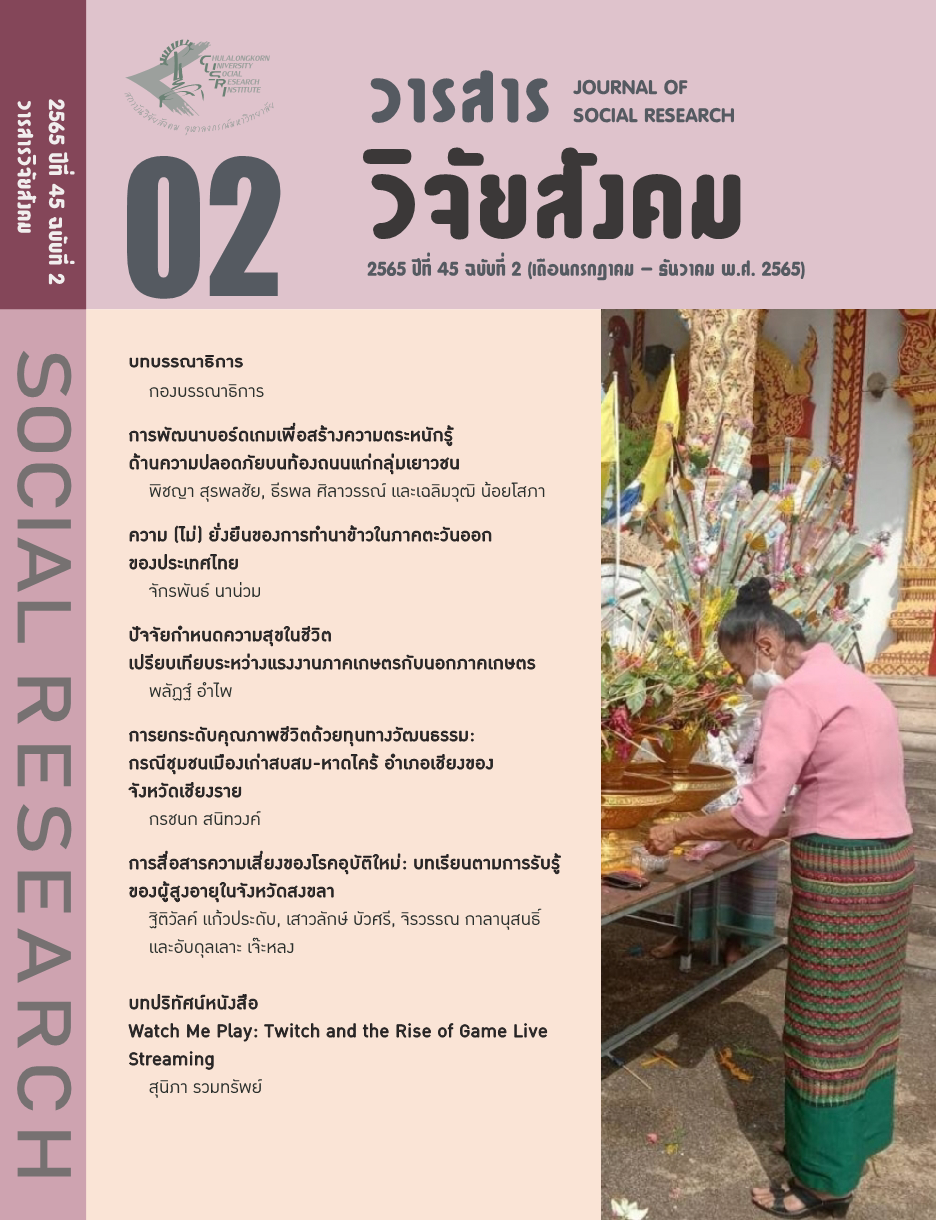
Main Article Content
Abstract
Rice cultivation is the main agricultural activity in Thailand. The output of this activity is rice, which is an important agricultural product for domestic consumption and export. In this article, the author considers the sustainability of Thai rice farming in Eastern Thailand focusing on Sa Kaeo Province, as it has the lowest yield per rai. This finding reflects the signs of problems that are likely to arise in rice farming and impact farmers' poverty. The framework of the economic dimensions of poverty is considered with 5 factors: economic deprivation, economic inequality, lack of basic needs, dependency needs, and social problems. The economic deprivation was caused by the high agricultural costs of farming but fluctuated agricultural prices, including accumulated debt of Thai farmers, both from agricultural and non-agricultural loans. Economic inequality was caused by the limited access to capital and the support of government policy. Lack of basic needs for rice farming, such as soil quality and water resources, causes financial hardship, for example, higher expenses and income. The dependency needs is regarded as an accessibility of knowledge and technology transfer from the acceptance of technology by elderly farmers and the promotion and education of knowledge of agencies. The social problem of poverty in farmers is reflected in the fact that the government must provide assistance. This problem is exacerbated by the aging population of farmers, which leads to a lack of succession in farming.
The author cites an example of farmers in the network of Ban Noen Sai Natural Farming Center, Sa Khwan Subdistrict, Mueang District, Sa Kaeo Province, who are practicing and following the guidelines of “Clean rice in ecological rice fields” approach to creating sustainable livelihood by reducing costs and increasing income. To reduce costs, farmers reduce the use of agricultural chemicals. This reduces the overall cost of agriculture. To increase income, farmers developed methods of caring for, planting and harvesting rice that produce high-quality rice that is in demand. There is no contamination of agricultural chemicals at levels that harm consumers, making it highly sought-after and sellable at a good price.
Article Details

This work is licensed under a Creative Commons Attribution-NonCommercial-NoDerivatives 4.0 International License.
- The copyright for this article belongs to the Social Research Institute at Chulalongkorn University. However, the views and content within are solely those of the authors.
- The views and opinions expressed in the articles published in the Journal of Social Research and Review, Social Research Institute, Chulalongkorn University, are the sole responsibility of the authors and do not reflect the views or responsibilities of the editorial board of the Journal of Social Research and Review, Social Research Institute, Chulalongkorn University. The editorial board does not reserve the rights to reproduction but requires proper citation for referencing.
