Journal Information
Peer Review Process
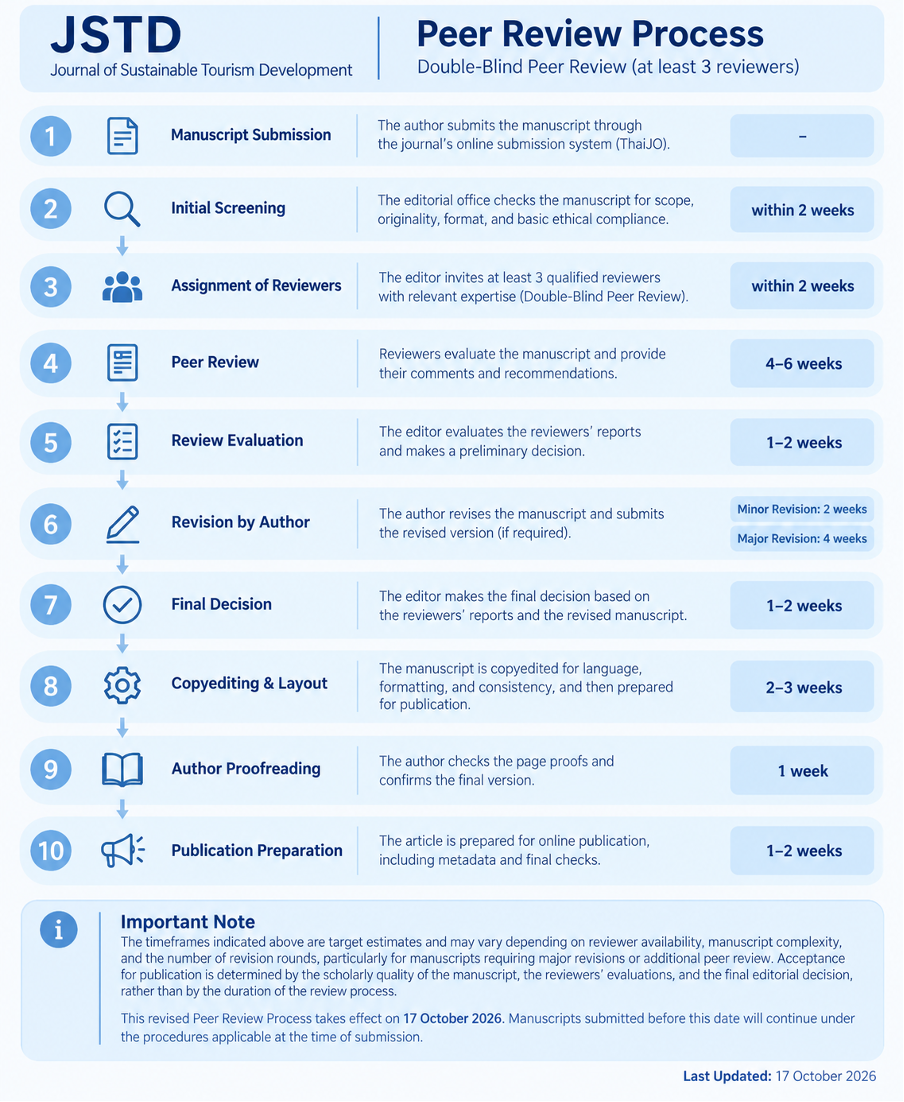
The Journal of Sustainable Tourism Development (JSTD) employs a double-blind peer review process, in which the identities of authors and reviewers are concealed from each other to ensure independence, fairness, and impartiality in scholarly evaluation. All submitted manuscripts undergo an initial editorial screening before being evaluated by at least three qualified reviewers with expertise relevant to the manuscript's subject area. The review and publication process consists of the following ten stages.
Step 1: Manuscript Submission
Authors submit their research articles or academic articles through the Thai Journals Online (ThaiJO) system. Manuscripts and all required supporting documents must be prepared in accordance with the journal's submission guidelines and formatting requirements.
Step 2: Initial Screening by the Editor-in-Chief
The Editor-in-Chief conducts an initial screening to assess the manuscript's alignment with the journal's aims and scope, article type, formatting requirements, publication ethics, originality, and potential scholarly contribution.
Manuscripts that do not meet the journal's requirements may be rejected without external peer review (desk rejection). Manuscripts requiring formatting corrections may be returned to the authors before proceeding to peer review.
Target timeframe: Within 2 weeks
Step 3: Assignment of Reviewers
The Editor-in-Chief selects and invites at least three qualified reviewers with relevant expertise in the manuscript's subject area. Reviewer selection takes into consideration academic qualifications, independence, and potential conflicts of interest.
Target timeframe: Within 2 weeks
Step 4: Peer Review
Reviewers evaluate manuscripts according to the journal's review criteria, including the significance of the research problem, originality, methodological rigor, reliability of findings, quality of discussion, scholarly contribution, and relevance to the journal's aims and scope. Reviewers provide constructive comments and recommendations to support the improvement of manuscript quality.
Target timeframe: Within 4–6 weeks
Step 5: Review Evaluation
The Editor-in-Chief evaluates the reports and recommendations received from all three reviewers and makes a preliminary editorial decision. The possible outcomes are:
Accepted: The manuscript meets the journal's publication requirements and may proceed to the production stage.
Minor Revision: The manuscript requires limited revisions that do not substantially affect its core content.
Major Revision: The manuscript requires substantial revisions and may be subject to an additional round of peer review.
Rejected: The manuscript does not meet the journal's academic quality standards or publication requirements.
Target timeframe: Within 2 weeks after receipt of all required reviewer reports
Step 6: Revision by the Author
Authors revise their manuscripts in accordance with the reviewers' comments and submit a revised manuscript together with a point-by-point response to the reviewers through the ThaiJO system.
For manuscripts requiring major revisions, the Editor-in-Chief may request an additional round of peer review when necessary.
Target timeframes:
Minor Revision: Within 2 weeks
Major Revision: Within 4 weeks
Step 7: Final Decision
The Editor-in-Chief examines the revised manuscript, reviewers' recommendations, and authors' responses before making the final editorial decision on acceptance or rejection. The final decision is communicated to the corresponding author through the journal's online submission system. Where an additional round of peer review is required, the final decision will be made after all necessary reviewer reports have been received.
Target timeframe: Within 2 weeks after receipt of all required documents and reviewer reports
Step 8: Copyediting and Layout Preparation
The editorial team conducts language editing, formatting checks, reference verification, and the preparation of tables, figures, and page layouts in accordance with the journal's publication standards.
Target timeframe: Approximately 2-3 weeks
Step 9: Proofreading by the Author
Authors review the typeset proofs to verify the accuracy of the text, tables, figures, author information, and other publication details. Authors are required to confirm the accuracy of the final version before publication.
Target timeframe: Within 1 week
Step 10: Publication Preparation
The editorial team conducts final quality checks and prepares the article for publication through the Thai Journals Online (ThaiJO) platform. Actual publication follows the journal's scheduled issue dates.
Target timeframe: Approximately 2-3 weeks
Important Note
The timeframes indicated above are target estimates and may vary depending on reviewer availability, manuscript complexity, and the number of revision rounds, particularly for manuscripts requiring major revisions or additional peer review. Acceptance for publication is determined by the scholarly quality of the manuscript, the reviewers' evaluations, and the final editorial decision, rather than by the duration of the review process.
This revised Peer Review Process takes effect on 17 October 2026. Manuscripts submitted before this date will continue under the procedures applicable at the time of submission.
Last Updated: 17 October 2026