Approach to Developing Inclusive Learning Management of School Administrators in Schools under the Bangkok Metropolitan Administration
DOI:
https://doi.org/10.14456/rc-sdj.2025.03Keywords:
inclusive learning management, development of educational administrators, G4 STEPsAbstract
Background: Lack of knowledge and lack of importance given to the development of an integrated education system to improve the quality of education and student outcomes may result in inclusive education management that is not efficient enough for quality school administration. Therefore, it is necessary to reform the education system first, leading to research studies that aim to study the current situation, desired conditions, and necessity, and to propose guidelines for the development of inclusive education management for school administrators under the Bangkok Metropolitan Administration.
Methods: This research used a mixed-method approach, divided into 2 phases. The first phase was the quantitative research phase. The sample group was obtained from Cohen's table, totaling 370 people. Multi-stage random sampling was used to collect data using an online questionnaire for 12 days. 343 sets of data (92.70%) were returned. Descriptive statistics were used to analyze the data to find the mean, standard deviation, and the modified priority needs index (PNImodified). The second phase was the qualitative research phase. The informants were selected by purposive sampling, totaling 7 people. The research instrument was a semi-structured interview form for collecting data using in-depth individual interviews. The data were analyzed using content analysis.
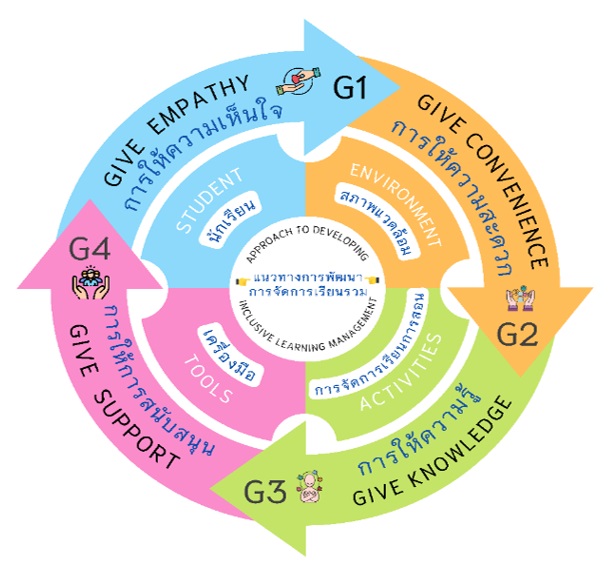
Results: The inclusive education management of school administrators under the Bangkok Metropolitan Administration is at the most desirable level, while the current condition is at a high level, indicating that there are still gaps that should be developed, especially in terms of tools, which are in the highest need for development (PNImodified=0.117). The results of the analysis led to the development of an inclusive education management system for school administrators under the Bangkok Metropolitan Administration, utilizing the “G4 STEPs” approach, which consists of four key steps: G: Giving Empathy, G: Giving Convenience, G: Giving Knowledge, and G: Giving Support.
Conclusions: The highest demand for tool development reflects the need to procure and use tools that are appropriate according to the “G4 STEPs,” which are tools that are used to systematically develop the potential of inclusive learning management for school administrators and respond to the necessities of the school to achieve real efficiency.
References
Ainscow, M., & Booth, T. (2002). Index for inclusion: Developing learning and participation in schools (2nd ed.). Centre for Studies on Inclusive Education (CSIE).
Anantanawi, P. (2008). Principles, concepts, and theories of educational administration. Montree Publisher.
Bangkok Metropolitan Administration, Education Office. (2019, September 10). Educational statistics report for the 2019 academic year, schools under the Bangkok Metropolitan Administration. https://webportal.bangkok.go.th/bangkokeducation/page/sub/14726/ปีการศึกษา-2562
Bangkok Metropolitan Administration. (2023, August 17). Number of students in schools under the Bangkok Metropolitan Administration, academic year 2023. https://data.bangkok.go.th/en/dataset/dept_edu/resource/9766c286-2a2a-4999-bacb-ee5e5729b246?view_id=6c52ad46-6838-481f-869b-72bb1df3ca54
Best, J. W., & Kahn, J. V. (2006). Research in education (10th ed.). Pearson Education.
Charoennum, J. (2015). A study on seat framework administrations and guided development in mainstream schools, the Office of Education, School District 9 [Unpublished master's thesis]. Rajamangala University of Technology Thanyaburi.
Chontharnont, B. (2003). A guide to inclusive education management using the SEAT framework. Petai Printing.
Cohen, L., Manion, L., & Morrison, K. (2018). Research methods in education (8th ed.). Routledge.
Creswell, J. W., & Creswell, J. D. (2017). Research design: Qualitative, quantitative, and mixed methods approaches. Sage.
Dapudong, R. C. (2014). Teachers’ knowledge and attitude towards inclusive education: Basis for an enhanced professional development program. International Journal of Learning & Development, 4(4), 1-24. https://doi.org/10.5296/ijld.v4i4.6116
Echeita, G., Simón, C., Sandoval, M., & Muñoz, Y. (2023). Developing learning and participation in schools: using the Index for inclusion in Spain, lessons learned and common challenges. International Journal of Learning and Change, 15(4), 329-344.
Halawa, Y., Salmi, H., & Zetmin. (2024). Inclusive education strategies for improving access and quality of learning for students with special needs. Jurnal Ilmu Pendidikan dan Kearifan Lokal, 4(3), 174-189. https://jipkl.com/index.php/JIPKL/article/view/117
Jamsai, P., Boonnak, S., & Ruangcham, C. (2024). Studying the current situation of screening, providing assistance, and monitoring elementary school students with learning disabilities in Thailand. Humanities, Arts and Social Sciences Studies, 24(3), 689-697. https://doi.org/10.69598/hasss.24.3.269177
Luesat, R., Phurungruang, S., & Thee-asana, S. (2023). Administrative Strategy for Becoming a Digital School. NRRU Community Research Journal, 17(1), 196-207. https://doi.org/10.14456/nrru-rdi.2023.15
Natun, J., Jaichalad, N., Wechayaluck, N., & Nak Ai, N. (2023). Supervision Roles of School Administrators to Promote Reading, Writing, and Critical Thinking for Small Primary Schools. NRRU Community Research Journal, 17(2), 192-201. https://doi.org/10.14456/nrru-rdi.2023.60
Office of the Civil Service Commission of Bangkok. (2024). Annual operational plan for 2024, Education Office Bangkok. https://webportal.bangkok.go.th/public/user_files_editor/112/yearplan/7-plan67.pdf
Office of the Education Council. (2018). National Education Plan 2017–2027. Highlights of the Office of the Higher Education Commission. https://www.onec.go.th/index.php/book/BookView/1540
Patton, M. Q. (2002). Qualitative research & evaluation methods. Sage.
Runcharoen, T. (2007). Professionalism in education management during the educational reform era. Khaofang.
Rusdiana, R. Y., Putri, W. K., & Sari, V. K. (2021). Pelatihan Pembuatan Media Pembelajaran Menggunakan Canva bagi Guru SMPN 1 Tegalampel Bondowoso [Undergraduate Paper, Universitas Jember]. http://repository.unej.ac.id//handle/123456789/105283
Shuvo, J. M. (2024). Educational Ecosystems for Sustainable Development: Developing Country Perspective [Thesis, Rijksuniversiteit Groningen, campus fryslam]. https://campus-fryslan.studenttheses.ub.rug.nl/506/1/Sustainable-Entrepreneurship-Thesis.pdf
Siriwan, P., & Chaimongkol, S. (2009). Statistics for research. Text and Journal Publication.
Srisathitnarakun, B. (2012). Development and quality control of research instruments: Psychological measurement properties. Chulalongkorn University Printing House.
Stokholm, J. L. (2001). Inclusive education: Policy, practice and research. Nordic Council for Educational Research.
Tanzi, M., & Hermanto, H. (2024). The Role of Principals in Implementing Inclusive Education Through Culturally Responsive School Leadership. Al-Ishlah: Jurnal Pendidikan, 16(1), 570-580. https://doi.org/10.35445/alishlah.v16i1.4274
Tirakanan, S. (2007). Project Evaluation: A Guide to Implementation. Chulalongkorn University.
UNESCO. (2005). Guidelines for inclusion: Ensuring access to education for all. United Nations Educational, Scientific, and Cultural Organization.
Vasianovych, H., & Budnyk, O. (2024). Pragmatism in Philosophy of Inclusive Education Studies. In O. Budnyk & S. Sydoriv. (Eds.), The Space of Inclusive Education: Voices from Ukraine and Beyond (pp. 22-34). Koninklijke Brill NV.
Vaughan, M. (2002). An index for inclusion. European Journal of Special Needs Education, 17(2), 197-201.
Wasila, N. F. W., Imron, A., & Juharyanto, J. (2024). The Urgency of Inclusive Education in the 21st Century: Opportunities, Challenges, Future and Research Recommendations. JDMP (Jurnal Dinamika Manajemen Pendidikan), 9(1), 40-53. https://doi.org/10.26740/jdmp.v9n1.p40-53
Wongwanich, S. (2019). Needs assessment research (4th ed.). Chulalongkorn University Press.
Zhang, W., Suprun, M., Zubrytskyi, I., Smerechak, L., & Lytvyn, I. (2024). Inclusive education: building spaces of equality and support for all students. Journal Of Interdisciplinary Research, Special Issue(14/01-XLII.), 114-118.