แนวทางการพัฒนาการจัดการเรียนรวมของผู้บริหารสถานศึกษาสังกัดกรุงเทพมหานคร
DOI:
https://doi.org/10.14456/rc-sdj.2025.03คำสำคัญ:
การจัดการเรียนรวม, การพัฒนาผู้บริหารสถานศึกษา, แนวทาง “G4 STEPs”บทคัดย่อ
ที่มา(ภูมิหลัง): การขาดความรู้และไม่ให้ความสำคัญกับการพัฒนาระบบการศึกษาแบบบูรณาการ เพื่อปรับปรุงคุณภาพการศึกษาและผลลัพธ์ของผู้เรียน อาจส่งผลให้การจัดการเรียนรวมมีประสิทธิภาพไม่เพียงพอกับการบริหารสถานศึกษาอย่างมีคุณภาพได้ ดังนั้น จึงจำเป็นต้องปฏิรูประบบการศึกษาก่อนเป็นอันดับแรก ทำให้เกิดการศึกษาวิจัยที่มุ่งศึกษาสภาพปัจจุบัน สภาพพึงประสงค์ และความจำเป็น และเสนอแนวทางการพัฒนาการจัดการเรียนรวมของผู้บริหารสถานศึกษาสังกัดกรุงเทพมหานคร
วิธีการ: การวิจัยครั้งนี้ ใช้แนวทางการวิจัยแบบผสมผสาน 2 ระยะ โดยเริ่มจากระยะการวิจัยเชิงปริมาณ กลุ่มตัวอย่างได้มาจากการเปิดตารางของโคเฮน จำนวน 370 คน และทำการสุ่มแบบหลายขั้นตอน เก็บรวบรวมข้อมูลด้วยแบบสอบถามผ่านช่องทางออนไลน์เป็นเวลา 12 วัน ได้รับข้อมูลกลับคืน 343 ชุด (ร้อยละ 92.70) และใช้สถิติเชิงพรรณนาวิเคราะห์ข้อมูลเพื่อหาค่าเฉลี่ย ส่วนเบี่ยงเบนมาตรฐาน และดัชนีความต้องการตามลำดับความสำคัญที่ปรับเปลี่ยนแล้ว (PNImodified) และระยะการวิจัยเชิงคุณภาพ กำหนดกลุ่มผู้ให้ข้อมูลด้วยวิธีเลือกแบบเฉพาะเจาะจง จำนวน 7 คน เครื่องมือการวิจัย คือ แบบสัมภาษณ์กึ่งโครงสร้างสำหรับใช้เก็บรวบรวมข้อมูลด้วยการสัมภาษณ์เชิงลึกเป็นรายบุคคล และวิเคราะห์ข้อมูลด้วยการวิเคราะห์เนื้อหา
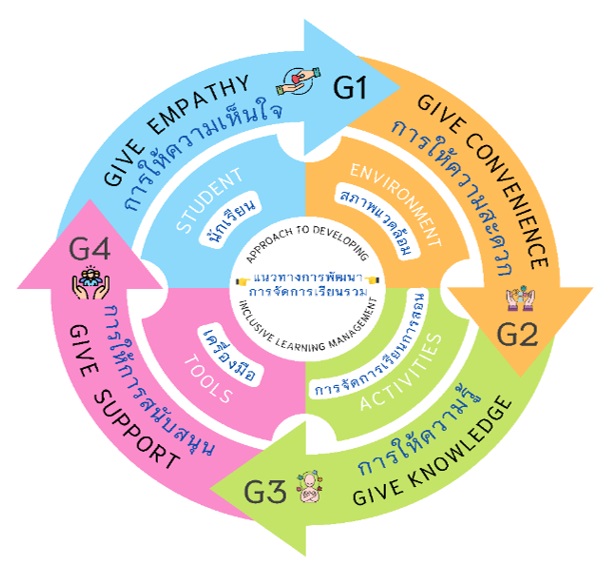
ผลลัพธ์: การจัดการเรียนรวมของผู้บริหารสถานศึกษาสังกัดกรุงเทพมหานคร มีสภาพที่พึงประสงค์อยู่ในระดับมากที่สุด ขณะที่สภาพปัจจุบันอยู่ในระดับมาก แสดงให้เห็นถึงช่องว่างที่ควรพัฒนา โดยเฉพาะด้านเครื่องมือ ซึ่งเป็นความต้องการจำเป็นต่อการพัฒนาสูงที่สุด (PNImodified = 0.117) ทั้งนี้ ผลการวิเคราะห์ดังกล่าว นำมาสู่แนวทางการพัฒนาการจัดการเรียนรวมสำหรับผู้บริหารสถานศึกษาสังกัดกรุงเทพมหานคร โดยใช้แนวทาง “G4 STEPs” ประกอบด้วย 4 ขั้นตอนสำคัญ ได้แก่ G1 การให้ความเห็นใจ G2 การให้ความสะดวก G3 การให้ความรู้ และ G4 การให้การสนับสนุน
บทสรุป: ความต้องการพัฒนาด้านเครื่องมือสูงที่สุด สะท้อนความจำเป็นในการจัดหาและใช้เครื่องมือที่เป็นไปได้ให้เหมาะสมตามรูปแบบแนวทาง “G4 STEPs” ซึ่งเป็นเครื่องมือที่นำไปใช้พัฒนาศักยภาพการจัดการเรียนรวมสำหรับผู้บริหารสถานศึกษาอย่างเป็นระบบ และสนองตอบความต้องการจำเป็นของสถานศึกษาให้เกิดประสิทธิผลได้จริง
เอกสารอ้างอิง
Ainscow, M., & Booth, T. (2002). Index for inclusion: Developing learning and participation in schools (2nd ed.). Centre for Studies on Inclusive Education (CSIE).
Anantanawi, P. (2008). Principles, concepts, and theories of educational administration. Montree Publisher.
Bangkok Metropolitan Administration, Education Office. (2019, September 10). Educational statistics report for the 2019 academic year, schools under the Bangkok Metropolitan Administration. https://webportal.bangkok.go.th/bangkokeducation/page/sub/14726/ปีการศึกษา-2562
Bangkok Metropolitan Administration. (2023, August 17). Number of students in schools under the Bangkok Metropolitan Administration, academic year 2023. https://data.bangkok.go.th/en/dataset/dept_edu/resource/9766c286-2a2a-4999-bacb-ee5e5729b246?view_id=6c52ad46-6838-481f-869b-72bb1df3ca54
Best, J. W., & Kahn, J. V. (2006). Research in education (10th ed.). Pearson Education.
Charoennum, J. (2015). A study on seat framework administrations and guided development in mainstream schools, the Office of Education, School District 9 [Unpublished master's thesis]. Rajamangala University of Technology Thanyaburi.
Chontharnont, B. (2003). A guide to inclusive education management using the SEAT framework. Petai Printing.
Cohen, L., Manion, L., & Morrison, K. (2018). Research methods in education (8th ed.). Routledge.
Creswell, J. W., & Creswell, J. D. (2017). Research design: Qualitative, quantitative, and mixed methods approaches. Sage.
Dapudong, R. C. (2014). Teachers’ knowledge and attitude towards inclusive education: Basis for an enhanced professional development program. International Journal of Learning & Development, 4(4), 1-24. https://doi.org/10.5296/ijld.v4i4.6116
Echeita, G., Simón, C., Sandoval, M., & Muñoz, Y. (2023). Developing learning and participation in schools: using the Index for inclusion in Spain, lessons learned and common challenges. International Journal of Learning and Change, 15(4), 329-344.
Halawa, Y., Salmi, H., & Zetmin. (2024). Inclusive education strategies for improving access and quality of learning for students with special needs. Jurnal Ilmu Pendidikan dan Kearifan Lokal, 4(3), 174-189. https://jipkl.com/index.php/JIPKL/article/view/117
Jamsai, P., Boonnak, S., & Ruangcham, C. (2024). Studying the current situation of screening, providing assistance, and monitoring elementary school students with learning disabilities in Thailand. Humanities, Arts and Social Sciences Studies, 24(3), 689-697. https://doi.org/10.69598/hasss.24.3.269177
Luesat, R., Phurungruang, S., & Thee-asana, S. (2023). Administrative Strategy for Becoming a Digital School. NRRU Community Research Journal, 17(1), 196-207. https://doi.org/10.14456/nrru-rdi.2023.15
Natun, J., Jaichalad, N., Wechayaluck, N., & Nak Ai, N. (2023). Supervision Roles of School Administrators to Promote Reading, Writing, and Critical Thinking for Small Primary Schools. NRRU Community Research Journal, 17(2), 192-201. https://doi.org/10.14456/nrru-rdi.2023.60
Office of the Civil Service Commission of Bangkok. (2024). Annual operational plan for 2024, Education Office Bangkok. https://webportal.bangkok.go.th/public/user_files_editor/112/yearplan/7-plan67.pdf
Office of the Education Council. (2018). National Education Plan 2017–2027. Highlights of the Office of the Higher Education Commission. https://www.onec.go.th/index.php/book/BookView/1540
Patton, M. Q. (2002). Qualitative research & evaluation methods. Sage.
Runcharoen, T. (2007). Professionalism in education management during the educational reform era. Khaofang.
Rusdiana, R. Y., Putri, W. K., & Sari, V. K. (2021). Pelatihan Pembuatan Media Pembelajaran Menggunakan Canva bagi Guru SMPN 1 Tegalampel Bondowoso [Undergraduate Paper, Universitas Jember]. http://repository.unej.ac.id//handle/123456789/105283
Shuvo, J. M. (2024). Educational Ecosystems for Sustainable Development: Developing Country Perspective [Thesis, Rijksuniversiteit Groningen, campus fryslam]. https://campus-fryslan.studenttheses.ub.rug.nl/506/1/Sustainable-Entrepreneurship-Thesis.pdf
Siriwan, P., & Chaimongkol, S. (2009). Statistics for research. Text and Journal Publication.
Srisathitnarakun, B. (2012). Development and quality control of research instruments: Psychological measurement properties. Chulalongkorn University Printing House.
Stokholm, J. L. (2001). Inclusive education: Policy, practice and research. Nordic Council for Educational Research.
Tanzi, M., & Hermanto, H. (2024). The Role of Principals in Implementing Inclusive Education Through Culturally Responsive School Leadership. Al-Ishlah: Jurnal Pendidikan, 16(1), 570-580. https://doi.org/10.35445/alishlah.v16i1.4274
Tirakanan, S. (2007). Project Evaluation: A Guide to Implementation. Chulalongkorn University.
UNESCO. (2005). Guidelines for inclusion: Ensuring access to education for all. United Nations Educational, Scientific, and Cultural Organization.
Vasianovych, H., & Budnyk, O. (2024). Pragmatism in Philosophy of Inclusive Education Studies. In O. Budnyk & S. Sydoriv. (Eds.), The Space of Inclusive Education: Voices from Ukraine and Beyond (pp. 22-34). Koninklijke Brill NV.
Vaughan, M. (2002). An index for inclusion. European Journal of Special Needs Education, 17(2), 197-201.
Wasila, N. F. W., Imron, A., & Juharyanto, J. (2024). The Urgency of Inclusive Education in the 21st Century: Opportunities, Challenges, Future and Research Recommendations. JDMP (Jurnal Dinamika Manajemen Pendidikan), 9(1), 40-53. https://doi.org/10.26740/jdmp.v9n1.p40-53
Wongwanich, S. (2019). Needs assessment research (4th ed.). Chulalongkorn University Press.
Zhang, W., Suprun, M., Zubrytskyi, I., Smerechak, L., & Lytvyn, I. (2024). Inclusive education: building spaces of equality and support for all students. Journal Of Interdisciplinary Research, Special Issue(14/01-XLII.), 114-118.