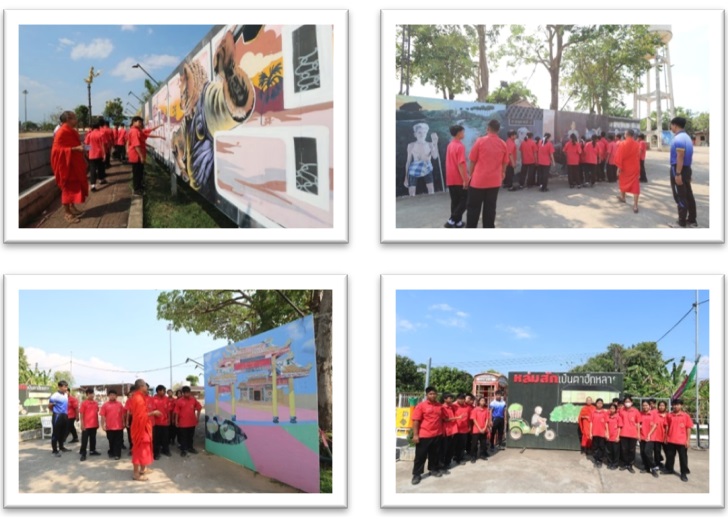
A Creative Street Art Development of Tai Lom in Phetchabun province
DOI:
https://doi.org/10.14456/rc-sdj.2025.05Keywords:
a creative art street, public art, creative cultural tourism destinationAbstract
Background: Promoting local wisdom identity by creating creative spaces is an issue of multicultural development. Consistent with research aims to study history, culture, wisdom, and art, as well as develop learning resources and creative street art for the Tai Lom people in Phetchabun Province.
Methods: The methodology used was qualitative and action research. The key informant groups were purposefully the tourist temple groups, the Tai Lom community artist groups, the research-related network groups, and the tourism-related entrepreneur groups, totaling 56 people. Used semi-structured interviews as a tool for fieldwork to collect data through in-depth interviews, group discussions, and photography. The answers were obtained using interpretive content analysis and presented the research results descriptively.
Results: The historical context with events has long been associated. Culturally, there is clear evidence of the close connection between religion and governance. Wisdom, the temple name changed to reflect auspicious means, and is unique to each area. Art, a combination of royal court styles and local art from the lower north and upper central regions of the early Rattanakosin period, shows the church, temple, pagoda, and Phra-Ceo-Mai. Wat Sri Mongkol has developed as a center for learning about culture, religion, and art. In addition, the architectural design of the temple, which is based on Lan Chang art and Buddhist principles, also reflects creativity. Innovation is a combination of art, Buddhism, and tourism. It has transformed the temple into a contemporary cultural tourist attraction. Creative knowledge, Wat Sri Mongkol effectively conveys the core cultural values (belief, faith, local wisdom). The resource learning development of the 350-meter cultural route between Wat Sri Mongkol and Wat Phraisansakdaram is “Creative Street Art.” Management through 7 main issues: cooperation, development, use of public space, designated roles, community participation, planning and implementation, and maintenance.
Conclusions: The research results in a strong cultural identity, and street art spaces have emerged as “creative cultural tourism destinations.” An important aspect of street art areas is a case study of cultural identity that can be applied to communities through the potential of art and public art as an interdisciplinary research tool.
References
Beel, D., & Wallace, C. (2020). Gathering together: social capital, cultural capital and the value of cultural heritage in a digital age. Social & Cultural Geography, 21(5), 697-717. https://doi.org/10.1080/14649365.2018.1500632
Bell, D., & Jayne, M. (2010). The creative countryside: Policy and practice in the UK rural cultural economy. Journal of rural studies, 26(3), 209-218. https://doi.org/10.1016/j.jrurstud.2010.01.001
Chandratita, C. (2007). Creating a process for creative art research. Faculty of Fine Arts, Chiang Mai University. National Science and Technology Development Agency (NSTDA).
Chen, T. (2025). Arts of the Qing Dynasty. In Illustrated History of Chinese Art (pp. 405-459). Springer Nature Singapore.
Costa, P. (2007). Creativity, Innovation and Territorial Agglomeration in Cultural Activities: The Roots of the Creative City. In P. Cooke & L. Lazzeretti (Eds.), Creative cities, cultural clusters and local economic development (pp. 183-210). Edward Elgar.
Creswell, J. W., & Poth, C. N. (2016). Qualitative Inquiry & Research Design: Choosing among Five Approaches. Sage.
Curry, N., & Owen, S. (2009). Rural planning in England: A critique of current policy. Town Planning Review, 80(6), 575-596. https://doi.org/10.3828/tpr.2009.13
D’Alvia, D. (2020). Financial Markets as Financial Systems: A Philosophical Dialogue between Offshore Tax Haven Islands and Systemic Failures. Pólemos, 14(2), 297-318. https://doi.org/10.1515/pol-2020-2019
Denzin, N. K. (1978). The Research Act: An Introduction to Sociological Methods. McGraw-Hill.
Document and Archives Committee. (1999). Culture, historical development, identity, and wisdom of Phetchabun Province. Ladprao Teachers Council Printing House. https://www.phetchabun.go.th/fileupload/data/1291115464_6bnj67jk.pdf
Dolkeles, G. (2024). Impact of contemporary technology on art and design. IGI Global.
Dovey, K., & Sandercock, L. (2002). Hype and hope. City, 6(1), 83-101. https://doi.org/10.1080/13604810220142853
Duxbury, N. (2021). Cultural and creative work in rural and remote areas: An emerging international conversation. International Journal of Cultural Policy, 27(6), 753-767. https://doi.org/10.1080/10286632.2020.1837788
Gkartzios, M., Gallent, N., & Scott, M. (2022). A capital framework for the rural global countryside. Habitat International, 127, 102625. https://doi.org/10.1016/j.habitatint.2022.102625
Gülümser, A. A., Baycan-Levent, T., & Nijkamp, P. (2010). Measuring regional creative capacity: A literature review for rural-specific approaches. European Planning Studies, 18(4), 545-563. https://doi.org/10.1080/09654311003593614
Herslund, L. (2012). The rural creative class: counterurbanisation and entrepreneurship in the Danish countryside. Sociologia ruralis, 52(2), 235-255. https://doi.org/10.1111/j.1467-9523.2011.00560.x
Jiwbang, T. (1994). Artistic Creativity. Odeon Store.
Jumde, A., & Kumar, N. (2021). Protection of traditional art forms under geographical indications law: a case study of Madhubani and Sujini art forms of Bihar, India. Journal of Intellectual Property Law & Practice, 16(7), 647-665. https://doi.org/10.1093/jiplp/jpaa161
Laursen, B. K., Gonnerman, C., & Crowley, S. J. (2021). Improving philosophical dialogue interventions to better resolve problematic value pluralism in collaborative environmental science. Studies in History and Philosophy of Science Part A, 87, 54-71. https://doi.org/10.1016/j.shpsa.2021.02.004
Lek-Prapai Viriyaphan Foundation. (2016, January 28). Sociocultural pluralism. https://lek-prapai.org/home/view.php?id=444
Ma, T., Wang, Y., Zhang, L., Hong, W., & Yang, X. (2025). Creative assets, people, and places: Rural art action practices of US nonprofit organizations. Journal of Rural Studies, 113, 103476. https://doi.org/10.1016/j.jrurstud.2024.103476
MacDowell, J. (2017). The metamodern, the quirky, and film criticism. In R. van den Akker, A. Gibbons, & T. Vermeulen (Eds.), Metamodernism: Historicity, affect, and depth after postmodernism (Radical Cultural Studies) (pp. 25–40). Rowman & Littlefield.
Manioudis, M., & Angelakis, A. (2023). Creative economy and sustainable regional growth: Lessons from the implementation of the entrepreneurial discovery process at the regional level. Sustainability, 15(9), 7681. https://doi.org/10.3390/su15097681
Mironova, T. (2025). The Impact of Innovative Technologies on Contemporary Media Arts Evolution. Metallurgical and Materials Engineering, 31(3), 284-291. https://doi.org/10.63278/1366
Miwa, N., Bhatt, A., & Kato, H. (2022). High-speed rail development and regional inequalities: Evidence from Japan. Transportation research record, 2676(7), 363-378. https://doi.org/10.1177/0361198122107856
Natarajan, L. (2019). Planning for rural communities and major renewable energy infrastructure. In The Routledge Companion to rural planning (pp. 548-556). Routledge.
Nimsamoe, C. (1988). Elements of Art. Thai Wattana Panich.
Panmanee, A. (2014). Train yourself to think, think creatively. Chulalongkorn University Press.
Phetchabun Provincial Statistical Office. (2024). Phetchabun Provincial Statistical Report: 2023. Phetchabun Provincial Statistical Office.
Rastogi, S. (2025). Cultural Identity in Contemporary Street Art: A Global Perspective on Urban Visual Expression. Shodh Sagar Journal of Language, Arts, Culture and Film, 2(1), 1-6. https://doi.org/10.36676/jlacf.v2.i1.24
Remoaldo, P., Matos, O., Freitas, I., Gôja, R., Araújo Alves, J., Ribeiro, V., Pereira, M., & Xavier, C. (2022). An international overview of certified practices in creative tourism in rural and urban territories. Journal of Hospitality & Tourism Research, 46(8), 1545-1573. https://doi.org/10.1177/10963480209507
Rodrigues-Ferreira, A., Afonso, H., Mello, J. A., & Amaral, R. (2023). Creative economy and the quintuple helix innovation model: A critical factors study in the context of regional development. Creativity Studies, 16(1), 158-177. https://doi.org/10.3846/cs.2023.15709
Tangprasert, T. (2015). Art Elements 1 (10th ed.). Fueangfa Printing.
Tarlo, H., & Tucker, J. (2019). Poetry, painting, and change on the edge of England. Sociologia ruralis, 59(4), 636-660. https://doi.org/10.1111/soru.12232
Teesuk, D. (2023). The Study of Thai Lom Identity for Redesigning Wat Pho Thong Nam Krung Local Museum, the Antique and Cultural Tourist Attraction of Phetchabun Province. Built Environment Inquiry Journal (BEI): Faculty of Architecture, Khon Kaen University, 22(1), 35-53. https://doi.go.th/10.14456/bei.2023.3
Tonts, M. (2020). Developmentalism, path dependence and multifunctionality: Reflections on Australian rural planning cultures. Planning Theory & Practice, 21(5), 776-782.
UNCTAD. (2013). Creative Economy Report 2013 Special Edition: widening local development pathways. UNESCO and UNDP. https://unesdoc.unesco.org/ark:/48223/pf0000224698
Waitt, G., & Gibson, C. (2009). Creative small cities: Rethinking the creative economy in place. Urban studies, 46(5-6), 1223-1246. https://doi.org/10.1177/0042098009103862
Wang, C. (2021). Comparison between computer art design and traditional art design based on big data analysis. Journal of Physics: Conference Series, 1915(3), 032043. https://doi.org/10.1088/1742-6596/1915/3/032043.
Wang, Z. (2025, March). Pathways to Fostering Cultural Identity and Social. In Proceedings of the 2024 4th International Conference on Public Art and Human Development (ICPAHD 2024) (Vol. 910, p. 222). Springer Nature.
White, P. (2010). Creative industries in a rural region: Creative West: The creative sector in the Western Region of Ireland. Creative Industries Journal, 3(1), 79-88. https://doi.org/10.1386/cij.3.1.79_1