Behavior and Satisfaction with Ai-Developed Online Lessons of Communication Faculty of Management Science Students at Udon Thani Rajabhat University
DOI:
https://doi.org/10.14456/rc-sdj.2026.6Keywords:
Online Lessons, Artificial Intelligence, Satisfaction, Self-Directed Learning, Journalism EducationAbstract
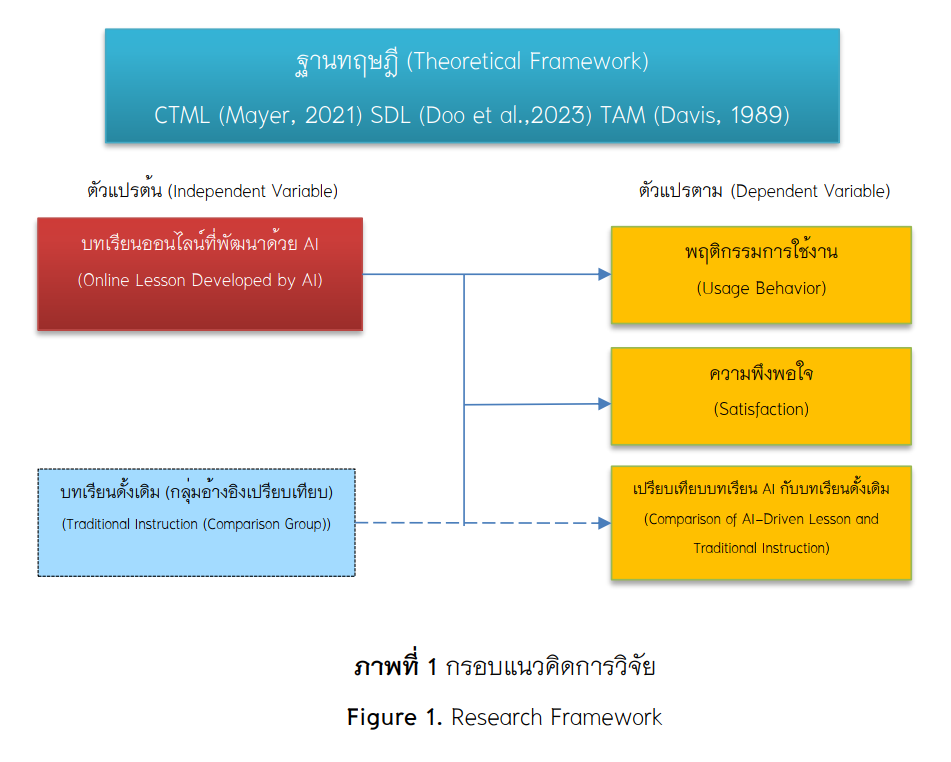
Background and Objective: In the contemporary digital education landscape, Artificial Intelligence (AI) has emerged as a transformative force in higher education instruction. This research aimed to: 1) study the usage behaviors of Communication Arts students, Faculty of Management Science, Udon Thani Rajabhat University regarding AI-developed online lessons, 2) examine their level of satisfaction with these instructional tools, and 3) compare student opinions between AI-developed online lessons and traditional instructional methods.
Methodology: The research sample consisted of 63 Communication Arts students at Udon Thani Rajabhat University enrolled in the News Reporting course during Semester 2, Academic Year 2025, selected using purposive sampling (students who had engaged with all AI-developed online lesson activities, at least 80% of all activities, throughout the semester). The research instrument was an online questionnaire administered via Google Forms, yielding a high reliability coefficient (Cronbach's Alpha = 0.93). Data were analyzed using descriptive statistics—frequency, percentage, mean, and standard deviation—along with a One-Sample t-test for comparative analysis (reference value μ₀ = 3.00).
Results: The majority of participants were female (60.32%), aged 19 years (53.97%), and primarily utilized smartphones as their main device (84.13%), typically 2–3 times per week with peak usage occurring near examination periods and before class sessions. Overall satisfaction was rated at a high level (μ = 4.08, σ = 0.69), with Google Classroom usability receiving the highest score (μ = 4.15), followed by lesson content quality (μ = 4.12). Regarding the comparative analysis, students perceived AI-developed lessons as significantly superior to traditional methods across all measured dimensions (μ = 3.81, σ = 0.79, t(566) = 24.245, p < 0.001), with the highest scores attributed to ease of use and timely assessment feedback (μ = 3.92).
Discussion and/or Suggestion: The findings reflect the digital learning behaviors of Communication students at Udon Thani Rajabhat University, who prioritize convenience and mobile accessibility. It is recommended that instructors adopt a Mobile-First Design approach and selectively integrate AI into appropriate courses to support Self-Directed Learning alongside classroom instruction. Future research should employ quasi-experimental designs with control groups to more rigorously validate these comparative findings.
References
Al-Adwan, A. S., Alsoud, M., Li, N., Al-Adwan, A., Abbasi, G. A., & Al-Rahmi, W. M. (2024). Unlocking future learning: Exploring higher education students’ intentions to adopt AI-generated content. Heliyon, 10(9), e29544. https://doi.org/10.1016/j.heliyon.2024.e29544
Al-Zahrani, A. M. (2024). Unveiling the shadows: Beyond the hype of AI in education. Heliyon, 10(9), e30696. https://doi.org/10.1016/j.heliyon.2024.e30696
Cavanagh, T. M., & Kiersch, C. (2023). Using commonly-available technologies to create online multimedia lessons through the application of the Cognitive Theory of Multimedia Learning. Educational Technology Research and Development, 71, 1033–1053. https://doi.org/10.1007/s11423-022-10181-1
Chokpermpoon, K., Srijinda, P., & Wittayarath, S. (2023). Roles and self-regulation in online news organizations (In Thai). Research Community and Social Development Journal, 17(3), 154–166. https://doi.org/10.14456/nrru-rdi.2023.42
Davis, F. D. (1989). Perceived usefulness, perceived ease of use, and user acceptance of information technology. MIS Quarterly, 13(3), 319–340. https://doi.org/10.2307/249008
Diakopoulos, N. (2020). Automating the news: How algorithms are rewriting the media. Harvard University Press.
Doo, M. Y., Zhu, M., & Bonk, C. J. (2023). Influence of self-directed learning on learning outcomes in MOOCs: A meta-analysis. Distance Education, 44(1), 86–105. https://doi.org/10.1080/01587919.2022.2155618
Garrison, D. R., & Kanuka, H. (2004). Blended learning: Uncovering its transformative potential in higher education. The Internet and Higher Education, 7(2), 95–105. https://doi.org/10.1016/j.iheduc.2004.02.001
Hussein, M. H., Ow, S. H., Al-Azawei, A., & Ibrahim, I. (2022). What drives students' successful reuse of online learning in higher education? A case of Google Classroom. Australasian Journal of Educational Technology, 38(3), 1–21. https://doi.org/10.14742/ajet.7335
Mayer, R. E. (2021). Multimedia learning (3rd ed.). Cambridge University Press.
Ministry of Higher Education, Science, Research and Innovation. (2023). National artificial intelligence action plan for Thailand development (2022–2027). Office of the Permanent Secretary, Ministry of Higher Education, Science, Research and Innovation. (In Thai)
Noetel, M., Griffith, S., Delaney, O., Harris, N. R., Sanders, T., Parker, P., del Pozo Cruz, B., & Lonsdale, C. (2022). Multimedia design for learning: An overview of reviews with meta-meta-analysis. Review of Educational Research, 92(3), 413–454. https://doi.org/10.3102/00346543211052329
Laorach, C. (2024). Digital capabilities of social innovators for learning community development (In Thai). Research Community and Social Development Journal, 18(1), 21–38. https://doi.org/10.14456/nrru-rdi.2024.2
Panitpichetvong, P., Phattanurakkul, C., Thatreenaranont, N., & Limyotin, A. (2024). Using of generative artificial intelligence for teaching and learning in the higher education level (In Thai). Academic Journal Bangkokthonburi University, 13(1), 31–45.
Sweller, J., van Merriënboer, J. J. G., & Paas, F. (2019). Cognitive architecture and instructional design: 20 years later. Educational Psychology Review, 31(2), 261–292. https://doi.org/10.1007/s10648-019-09465-5
Tian, X., Phonnong, I., & Keeratichamroen, W. (2025). The effects of STEAM-based learning package for enhancing the historical creative thinking ability of Chinese's undergraduate students. Research Community and Social Development Journal, 19(2), 179–194. https://doi.org/10.14456/rc-sdj.2025.11
Zawacki-Richter, O., Marín, V. I., Bond, M., & Gouverneur, F. (2019). Systematic review of research on artificial intelligence applications in higher education – where are the educators?. International Journal of Educational Technology in Higher Education, 16(1), 39. https://doi.org/10.1186/s41239-019-0171-0