พฤติกรรมและความพึงพอใจต่อการใช้บทเรียนออนไลน์ที่พัฒนาด้วยปัญญาประดิษฐ์ ของนักศึกษาสาขานิเทศศาสตร์ คณะวิทยาการจัดการ มหาวิทยาลัยราชภัฏอุดรธานี
DOI:
https://doi.org/10.14456/rc-sdj.2026.6คำสำคัญ:
บทเรียนออนไลน์, ปัญญาประดิษฐ์, ความพึงพอใจ, การเรียนรู้นำตนเอง, สื่อการสอนดิจิทัลบทคัดย่อ
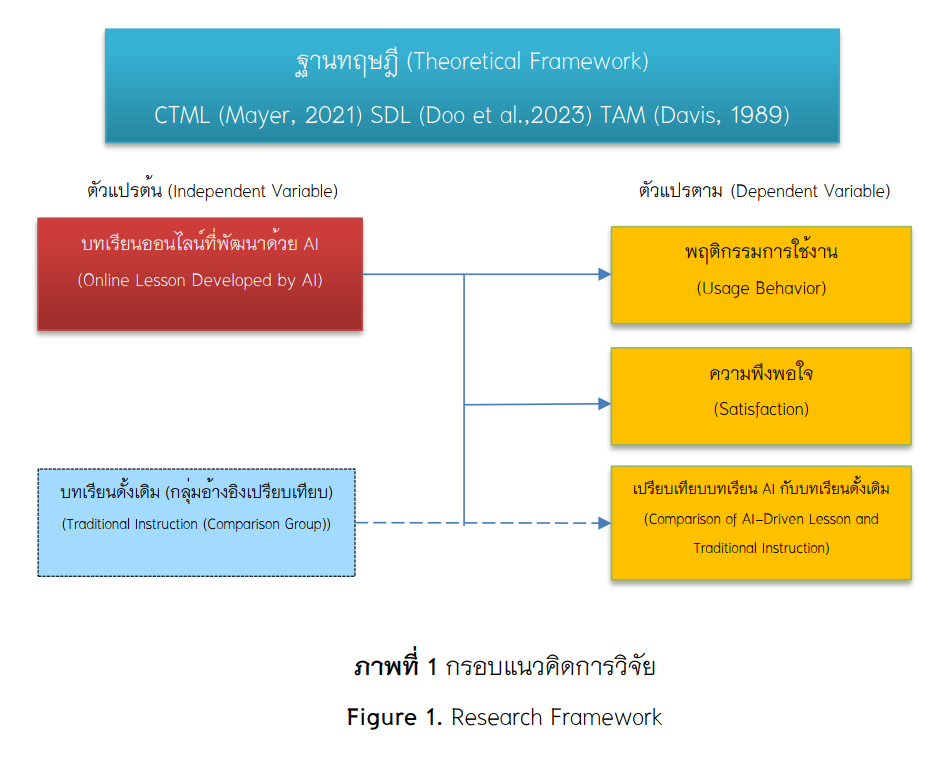
ที่มาและวัตถุประสงค์การวิจัย: ในยุคการศึกษาดิจิทัลในปัจจุบัน เทคโนโลยีปัญญาประดิษฐ์ (Artificial Intelligence: AI) ได้เข้ามามีบทบาทสำคัญในการปฏิรูปกระบวนการจัดการเรียนการสอนระดับอุดมศึกษา การวิจัยครั้งนี้มีวัตถุประสงค์เพื่อ 1) ศึกษาพฤติกรรมการใช้บทเรียนออนไลน์ที่พัฒนาด้วยปัญญาประดิษฐ์ของนักศึกษาสาขานิเทศศาสตร์ คณะวิทยาการจัดการ มหาวิทยาลัยราชภัฏอุดรธานี 2) ศึกษาระดับความพึงพอใจของนักศึกษาที่มีต่อบทเรียนออนไลน์ดังกล่าว และ 3) เปรียบเทียบความคิดเห็นของนักศึกษาระหว่างบทเรียนออนไลน์ที่พัฒนาด้วยปัญญาประดิษฐ์กับบทเรียนแบบดั้งเดิม
ระเบียบวิธีวิจัย (วิธีดำเนินการวิจัย): กลุ่มตัวอย่าง คือ นักศึกษาสาขาวิชานิเทศศาสตร์ มหาวิทยาลัยราชภัฏอุดรธานี ที่ลงทะเบียนเรียนในรายวิชาการสื่อข่าว ภาคเรียนที่ 2 ปีการศึกษา 2568 จำนวน 63 คน ได้มาโดยวิธีการเลือกแบบเจาะจง (Purposive Sampling) จากนักศึกษาที่ใช้บทเรียนออนไลน์ที่พัฒนาด้วยปัญญาประดิษฐ์ครบตลอดภาคเรียน เครื่องมือที่ใช้ คือ แบบสอบถามออนไลน์ผ่าน Google Forms มีค่าความเชื่อมั่น (Cronbach's Alpha) เท่ากับ 0.93 วิเคราะห์ข้อมูลด้วยสถิติเชิงพรรณนา ได้แก่ ค่าความถี่ ค่าร้อยละ ค่าเฉลี่ย และส่วนเบี่ยงเบนมาตรฐาน รวมทั้งการทดสอบที แบบกลุ่มเดียว (One-Sample t-test) โดยกำหนดค่าเฉลี่ยอ้างอิง μ₀ = 3.00
ผลการวิจัย: พบว่านักศึกษาส่วนใหญ่เป็นเพศหญิง (ร้อยละ 60.32) อายุ 19 ปี (ร้อยละ 53.97) และใช้สมาร์ทโฟนเป็นอุปกรณ์หลักในการเข้าถึงบทเรียน (ร้อยละ 84.13) โดยเข้าใช้สัปดาห์ละ 2–3 ครั้ง ในช่วงใกล้วันสอบและก่อนเข้าชั้นเรียนเป็นหลัก ด้านความพึงพอใจ นักศึกษามีความพึงพอใจโดยรวมอยู่ในระดับมาก (μ = 4.08, σ = 0.69) โดยด้านการใช้งานบน Google Classroom มีค่าเฉลี่ยสูงสุด (μ = 4.15) รองลงมาคือด้านเนื้อหาบทเรียน (μ = 4.12) สำหรับผลการเปรียบเทียบ พบว่านักศึกษามีความเห็นว่าบทเรียนออนไลน์ที่พัฒนาด้วยปัญญาประดิษฐ์มีคุณภาพสูงกว่าบทเรียนแบบดั้งเดิมในทุกด้านที่วัดอย่างมีนัยสำคัญทางสถิติ (μ = 3.81, σ = 0.79, t(566) = 24.245, p < 0.001) โดยด้านความสะดวกในการใช้งานและด้านแบบทดสอบที่ช่วยตรวจสอบความเข้าใจได้ทันท่วงทีมีค่าเฉลี่ยสูงสุด (μ = 3.92)
อภิปรายผลและหรือข้อเสนอแนะ: ผลการวิจัยสะท้อนพฤติกรรมการเรียนรู้ดิจิทัลของนักศึกษาสาขานิเทศศาสตร์ มหาวิทยาลัยราชภัฏอุดรธานี ที่เน้นความสะดวกและการเข้าถึงผ่านอุปกรณ์พกพา จึงควรออกแบบบทเรียนให้รองรับการใช้งานบนสมาร์ทโฟน (Mobile-First Design) และบูรณาการปัญญาประดิษฐ์ในรายวิชาที่เหมาะสม เพื่อส่งเสริมการเรียนรู้นำตนเอง (Self-Directed Learning) ควบคู่กับการจัดการเรียนการสอนในชั้นเรียน ทั้งนี้ การวิจัยในอนาคตควรใช้การออกแบบวิจัยกึ่งทดลอง (Quasi-Experimental Design) ที่มีกลุ่มเปรียบเทียบเพื่อยืนยันผลการเปรียบเทียบได้อย่างเข้มแข็งยิ่งขึ้น
เอกสารอ้างอิง
Al-Adwan, A. S., Alsoud, M., Li, N., Al-Adwan, A., Abbasi, G. A., & Al-Rahmi, W. M. (2024). Unlocking future learning: Exploring higher education students’ intentions to adopt AI-generated content. Heliyon, 10(9), e29544. https://doi.org/10.1016/j.heliyon.2024.e29544
Al-Zahrani, A. M. (2024). Unveiling the shadows: Beyond the hype of AI in education. Heliyon, 10(9), e30696. https://doi.org/10.1016/j.heliyon.2024.e30696
Cavanagh, T. M., & Kiersch, C. (2023). Using commonly-available technologies to create online multimedia lessons through the application of the Cognitive Theory of Multimedia Learning. Educational Technology Research and Development, 71, 1033–1053. https://doi.org/10.1007/s11423-022-10181-1
Chokpermpoon, K., Srijinda, P., & Wittayarath, S. (2023). Roles and self-regulation in online news organizations (In Thai). Research Community and Social Development Journal, 17(3), 154–166. https://doi.org/10.14456/nrru-rdi.2023.42
Davis, F. D. (1989). Perceived usefulness, perceived ease of use, and user acceptance of information technology. MIS Quarterly, 13(3), 319–340. https://doi.org/10.2307/249008
Diakopoulos, N. (2020). Automating the news: How algorithms are rewriting the media. Harvard University Press.
Doo, M. Y., Zhu, M., & Bonk, C. J. (2023). Influence of self-directed learning on learning outcomes in MOOCs: A meta-analysis. Distance Education, 44(1), 86–105. https://doi.org/10.1080/01587919.2022.2155618
Garrison, D. R., & Kanuka, H. (2004). Blended learning: Uncovering its transformative potential in higher education. The Internet and Higher Education, 7(2), 95–105. https://doi.org/10.1016/j.iheduc.2004.02.001
Hussein, M. H., Ow, S. H., Al-Azawei, A., & Ibrahim, I. (2022). What drives students' successful reuse of online learning in higher education? A case of Google Classroom. Australasian Journal of Educational Technology, 38(3), 1–21. https://doi.org/10.14742/ajet.7335
Mayer, R. E. (2021). Multimedia learning (3rd ed.). Cambridge University Press.
Ministry of Higher Education, Science, Research and Innovation. (2023). National artificial intelligence action plan for Thailand development (2022–2027). Office of the Permanent Secretary, Ministry of Higher Education, Science, Research and Innovation. (In Thai)
Noetel, M., Griffith, S., Delaney, O., Harris, N. R., Sanders, T., Parker, P., del Pozo Cruz, B., & Lonsdale, C. (2022). Multimedia design for learning: An overview of reviews with meta-meta-analysis. Review of Educational Research, 92(3), 413–454. https://doi.org/10.3102/00346543211052329
Laorach, C. (2024). Digital capabilities of social innovators for learning community development (In Thai). Research Community and Social Development Journal, 18(1), 21–38. https://doi.org/10.14456/nrru-rdi.2024.2
Panitpichetvong, P., Phattanurakkul, C., Thatreenaranont, N., & Limyotin, A. (2024). Using of generative artificial intelligence for teaching and learning in the higher education level (In Thai). Academic Journal Bangkokthonburi University, 13(1), 31–45.
Sweller, J., van Merriënboer, J. J. G., & Paas, F. (2019). Cognitive architecture and instructional design: 20 years later. Educational Psychology Review, 31(2), 261–292. https://doi.org/10.1007/s10648-019-09465-5
Tian, X., Phonnong, I., & Keeratichamroen, W. (2025). The effects of STEAM-based learning package for enhancing the historical creative thinking ability of Chinese's undergraduate students. Research Community and Social Development Journal, 19(2), 179–194. https://doi.org/10.14456/rc-sdj.2025.11
Zawacki-Richter, O., Marín, V. I., Bond, M., & Gouverneur, F. (2019). Systematic review of research on artificial intelligence applications in higher education – where are the educators?. International Journal of Educational Technology in Higher Education, 16(1), 39. https://doi.org/10.1186/s41239-019-0171-0