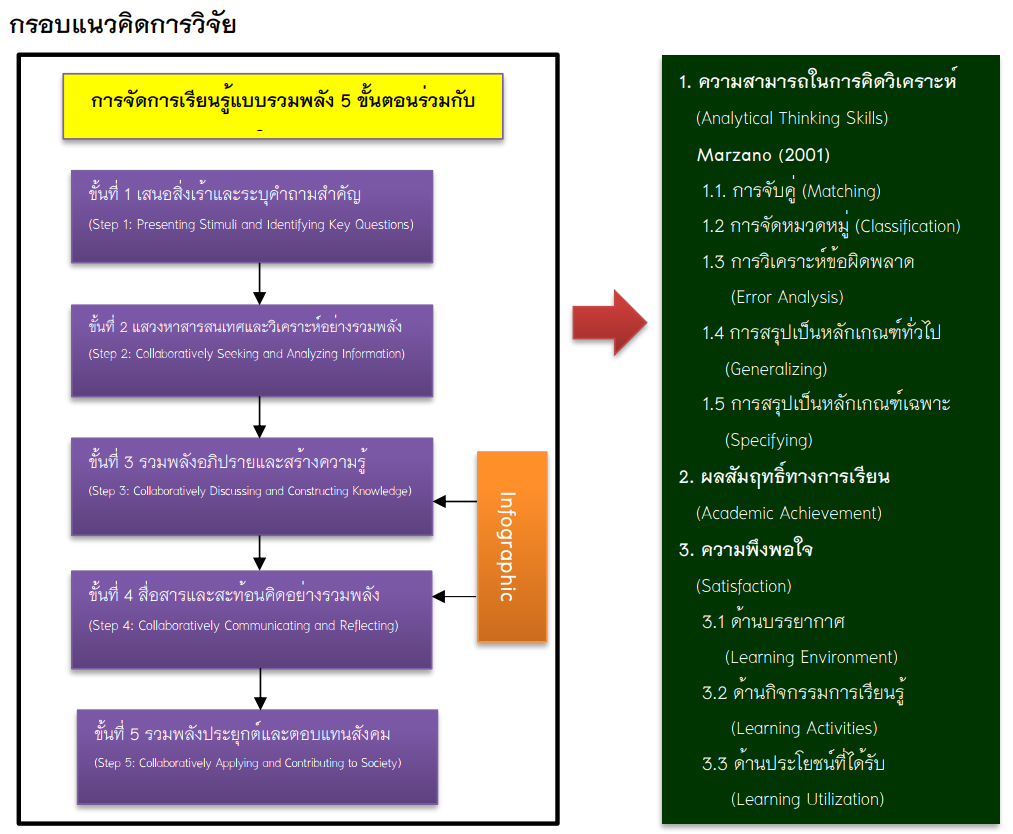
The Study of Analytical Thinking Ability using Collaborative Learning Process (co-5steps) whit Infographics for Home Economics Grade-6 Students at Ban Pasang Nong-Hee School
DOI:
https://doi.org/10.14456/rc-sdj.2026.8Keywords:
Analytical thinking ability, Collaborative Learning Process (co-5steps), InfographicsAbstract
Background and Objective: Contemporary education aims to develop learners' analytical thinking abilities and practical application skills. External assessments indicated that Grade 6 students in the Occupational Studies course at Ban Pasang Nonghee School exhibited limitations in their analytical thinking. This study, therefore, aimed to investigate: 1) students' analytical thinking ability, 2) their learning achievement, and 3) their satisfaction with a learning management model based on a five-step collaborative learning approach integrated with infographics. The baseline benchmark for success was set at a 75% passing criterion. The target group consisted of 11 Grade 6 students selected through purposive sampling.
Methodology: A one-shot case study design was employed. The research instruments comprised structured lesson plans, an analytical thinking test, a learning achievement test, and a satisfaction questionnaire. Quantitative data were analyzed using percentages, means, and standard deviations.
Results: The findings revealed that 10 out of 11 students (90.90%) successfully met both the analytical thinking ability and learning achievement criteria. Furthermore, the students' overall satisfaction with the integrated learning management approach was at the highest level (M = 4.84, SD = 0.37).
Discussion and Recommendations: The implementation of the 5-step collaborative learning approach integrated with infographics demonstrated strong efficacy, enabling 90.90% of the target group to pass the designated benchmarks. However, the "error analysis" dimension yielded a mean score of only 67.27%, failing to meet the criterion. This suggests that error analysis involves higher cognitive complexity and requires more extended, progressive learning experiences. Future research should explore the development of other higher-order thinking skills, expand the sample size, and incorporate action research frameworks to optimize instructional effectiveness across diverse educational contexts.
References
Alabdulaziz, M. S., & Alhammadi, A. A. (2025). The effectiveness of digital education based on the use of infographic technology and its impact on developing visual thinking skills and mathematical achievement among middle school students. International Journal of Information and Education Technology, 15(3), 576–594.
Anderson, L. W., & Krathwohl, D. R. (Eds.). (2001). A taxonomy for learning, teaching, and assessing: A revision of Bloom’s taxonomy of educational objectives. Longman.
Bhuttah, T. M., Xusheng, Q., Abid, M. N., & Sharma, S. (2024). Enhancing student critical thinking and learning outcomes through innovative pedagogical approaches in higher education: the mediating role of inclusive leadership. Scientific reports, 14(1), 24362.
Bloom, B. S. (1956). Taxonomy of educational objectives: The classification of educational goals: Handbook I: Cognitive domain. David McKay.
Chaowalid, S., Wetwiriyasakun, P., & Thongkaemkaew, A. (2025). Learning management using the 5 STEPs collaborative learning process (CO-5 STEPs) with multimedia to develop analytical thinking skills and learning achievement in Biology 4 for Grade 11 students. Journal of Education, Burapha University, 36(1), 105–122. (In Thai) https://doi.org/10.14456/edubuu.2025.8
Dechakup, P., & Yindeesuk, P. (2020). Competency-based active collaborative learning through the Co-5 STEPs approach. Chulalongkorn University Press. (In Thai)
Jaleniauskiene, E., & Kasperiuniene, J. (2022). Infographics in higher education: A scoping review. E-Learning and Digital Media, 19(6), 1–16. https://doi.org/10.1177/20427530221107774
Kaewmanee, P. (2024). The development of an infographics learning activity package on the traditional food wisdom of Phuket Island using community-based learning to engage reading and writing skills for elementary students. Journal of Graduate Research, 15(2), 77–94. (In Thai) https://so02.tci-thaijo.org/index.php/banditvijai/article/view/269548
Kreetep, D., & Chumsukon, M. (2024). The study of analytical thinking skills and collaboration teamwork competency using MACRO model with card games on the subject ng 32101 occupation for Grade 11 students at Nongruawittaya School. RMU Journal, 18(2), 190–200. (In Thai) https://so05.tci-thaijo.org/index.php/rmuj/article/view/275077
Leggette, H. R. (2020). Visualizing the analysis: Using infographics to strengthen critical thinking skills. Communication Teacher, 34(4), 333–339. https://doi.org/10.1080/17404622.2020.1713388
Likert, R. (1967). The human organization: Its management and value. McGraw-Hill.
Maneetem, S., Wannupatham, B., & Homchan, S. (2024). The development of learning achievement and analytical thinking of Grade 7 students using active learning with the 5 STEPs collaborative learning process (CO-5STEPs). Journal of Mani Chettha Ram Wat Chommani, 7(6), 340–361. (In Thai) https://so07.tci-thaijo.org/index.php/JMCR/article/view/6178
Martín-Alguacil, N., & Avedillo, L. (2024). Student-centered active learning improves performance in solving higher-level cognitive questions in health sciences education. International Medical Education, 3(3), 346-362.
Marzano, R. J. (2001). Designing a new taxonomy of educational objectives. Corwin Press.
Marzano, R. J., & Kendall, J. S. (2007). The new taxonomy of educational objectives (2nd ed.). Corwin Press.
Mayer, R. E. (2020). Multimedia learning (3rd ed.). Cambridge University Press. https://doi.org/10.1017/9781316941355
Ministry of Education. (2017). Basic education core curriculum B.E. 2551 (Revised edition B.E. 2560). Kurusapha Ladphrao. (In Thai) https://academic.obec.go.th/images/document/1559878925_d_1.pdf
Organisation for Economic Co-operation and Development. (2023). PISA 2022 results (Volume I): The state of learning and equity in education. OECD Publishing. https://doi.org/10.1787/53f23881-en
Pakkawattana, W., Suwan, S., & Tantichuwet, P. (2025). Small schools: Problems and challenges in the modern world. Journal of Social Studies Perspectives, 1(6), 1–13. (In Thai) https://doi.org/10.64186/jsp1841
Simboot, A., & Chantraukrit, P. (2024). Development of analytical thinking ability and teamwork and collaboration of lower secondary students using the 5 STEPs collaborative learning process. Journal of Education Review, 11(1), 465–477. (In Thai) https://digital.car.chula.ac.th/chulaetd/10179
Toedam, K., Khongchawan, K., & Vipavin, V. (2022). 5 STEPs collaborative learning process (CO-5STEPs) and graphic organizer technique affecting analytical thinking ability and learning achievement in economics subject of 8th graders. In Proceedings of the 13th Hatyai National and International Conference (pp. 1947–1962). Hatyai University. (In Thai) https://www.hu.ac.th/Conference/conference2022/proceedings/doc/07%20%E0%B8%81%E0%B8%B2%E0%B8%A3%E0%B8%A8%E0%B8%B6%E0%B8%81%E0%B8%A9%E0%B8%B2/45-Ed-118%20(1947%20-%201962).pdf
Trakansutthisak, W. (2022). The development of analytical thinking ability based on Marzano’s concept on the topic of Thailand’s physical geography among Grade 5 students through thinking activities based on Edward de Bono’s concept [Master’s thesis, Silpakorn University]. (In Thai)
http://ithesis-ir.su.ac.th/dspace/bitstream/123456789/3838/1/60262404.pdf