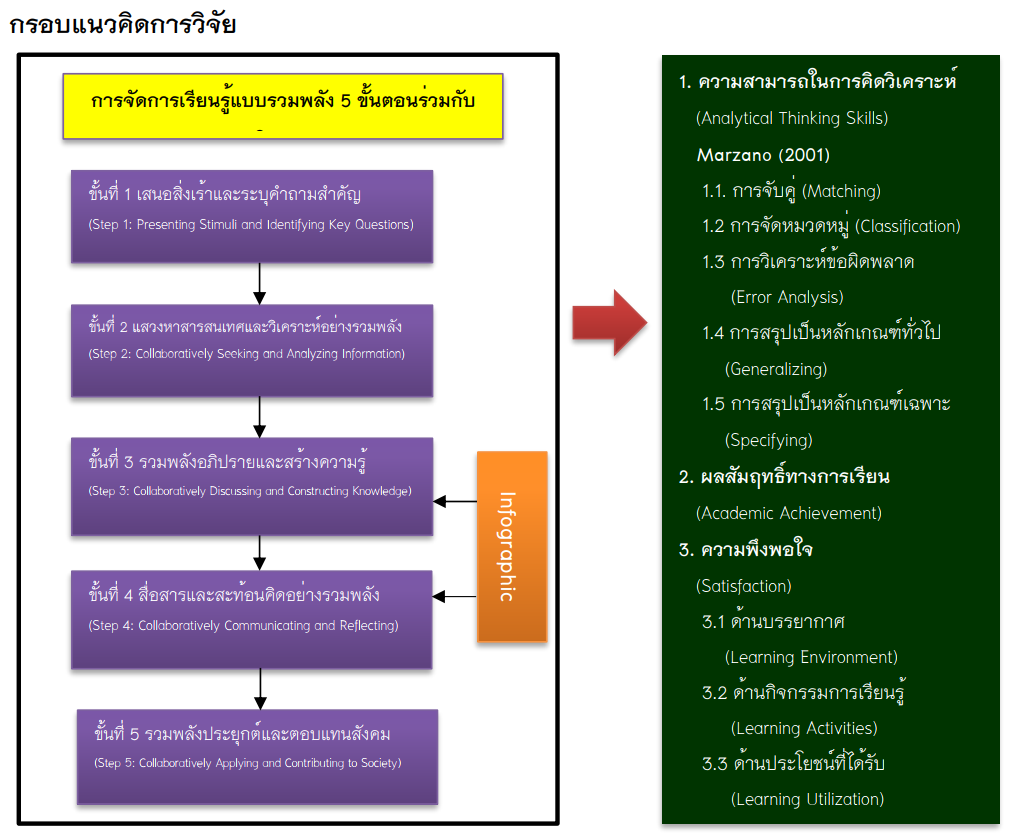
การศึกษาความสามารถในการคิดวิเคราะห์โดยใช้การจัดการเรียนรู้แบบรวมพลัง 5 ขั้นร่วมกับอินโฟกราฟิก รายวิชา ง16101 การงานอาชีพ ชั้นประถมศึกษาปีที่ 6 โรงเรียนบ้านป่าสังข์หนองฮี
DOI:
https://doi.org/10.14456/rc-sdj.2026.8คำสำคัญ:
ความสามารถการคิดวิเคราะห์, การจัดการเรียนรู้แบบรวมพลัง 5 ขั้น, อินโฟกราฟิกบทคัดย่อ
ที่มาและวัตถุประสงค์การวิจัย: การจัดการศึกษาในปัจจุบันมุ่งพัฒนาผู้เรียนให้มีความสามารถในการคิดวิเคราะห์และการประยุกต์ใช้ความรู้ แต่จากการจัดการเรียนการสอนวิชาการงานอาชีพชั้นประถมศึกษาปีที่ 6 โรงเรียนบ้านป่าสังข์หนองฮี มีข้อจำกัดด้านความสามารถในการคิดวิเคราะห์ การวิจัยครั้งนี้จึงมีวัตถุประสงค์เพื่อศึกษา 1) ความสามารถในการคิดวิเคราะห์ 2) ผลสัมฤทธิ์ทางการเรียน และ 3) ความพึงพอใจต่อการจัดการเรียนรู้แบบรวมพลัง 5 ขั้นร่วมกับอินโฟกราฟิก
โดยกำหนดเกณฑ์ผ่านที่ร้อยละ 75 กลุ่มเป้าหมายคือนักเรียนชั้นประถมศึกษาปีที่ 6 จำนวน 11 คน
โดยเลือกแบบเจาะจง
ระเบียบวิธีวิจัย: ใช้การวิจัยแบบกลุ่มเดียวทดสอบหลังเรียน (One-Shot Case Study) เครื่องมือที่ใช้ ได้แก่ แผนการจัดการเรียนรู้ แบบทดสอบความสามารถในการคิดวิเคราะห์ แบบทดสอบวัดผลสัมฤทธิ์ทางการเรียน และแบบสอบถามความพึงพอใจ วิเคราะห์ข้อมูลด้วยร้อยละ ค่าเฉลี่ย และส่วนเบี่ยงเบนมาตรฐาน
ผลการวิจัย: พบว่า 1) นักเรียนผ่านเกณฑ์ความสามารถในการคิดวิเคราะห์ จำนวน 10 คน คิดเป็นร้อยละ 90.90 2) นักเรียนผ่านเกณฑ์ผลสัมฤทธิ์ทางการเรียน จำนวน 10 คน คิดเป็นร้อยละ 90.90 และ 3) นักเรียนมีความพึงพอใจโดยรวมอยู่ในระดับมากที่สุด (Mean = 4.84, S.D. = 0.37)
อภิปรายผลและข้อเสนอแนะ: การจัดการเรียนรู้แบบรวมพลัง 5 ขั้น ร่วมกับอินโฟกราฟิก พบว่านักเรียนร้อยละ 90.90 มีความสามารถในการคิดวิเคราะห์และผลสัมฤทธิ์ทางการเรียนผ่านเกณฑ์ที่กำหนด อย่างไรก็ตาม ด้านการวิเคราะห์ข้อผิดพลาด (Error Analysis) มีคะแนนเฉลี่ยร้อยละ 67.27 ซึ่งยังไม่ผ่านเกณฑ์ ผลดังกล่าวอาจอธิบายได้ว่าทักษะดังกล่าวมีความซับซ้อนและต้องอาศัยประสบการณ์เพิ่มเติม นักเรียนมีความพึงพอใจโดยรวมอยู่ในระดับมากที่สุด การวิจัยครั้งต่อไปควรพัฒนาทักษะการคิดขั้นสูงด้านอื่น ขยายกลุ่มตัวอย่าง และนำวิจัยเชิงปฏิบัติการมาใช้เพื่อเพิ่มประสิทธิภาพในบริบทที่หลากหลาย
เอกสารอ้างอิง
Alabdulaziz, M. S., & Alhammadi, A. A. (2025). The effectiveness of digital education based on the use of infographic technology and its impact on developing visual thinking skills and mathematical achievement among middle school students. International Journal of Information and Education Technology, 15(3), 576–594.
Anderson, L. W., & Krathwohl, D. R. (Eds.). (2001). A taxonomy for learning, teaching, and assessing: A revision of Bloom’s taxonomy of educational objectives. Longman.
Bhuttah, T. M., Xusheng, Q., Abid, M. N., & Sharma, S. (2024). Enhancing student critical thinking and learning outcomes through innovative pedagogical approaches in higher education: the mediating role of inclusive leadership. Scientific reports, 14(1), 24362.
Bloom, B. S. (1956). Taxonomy of educational objectives: The classification of educational goals: Handbook I: Cognitive domain. David McKay.
Chaowalid, S., Wetwiriyasakun, P., & Thongkaemkaew, A. (2025). Learning management using the 5 STEPs collaborative learning process (CO-5 STEPs) with multimedia to develop analytical thinking skills and learning achievement in Biology 4 for Grade 11 students. Journal of Education, Burapha University, 36(1), 105–122. (In Thai) https://doi.org/10.14456/edubuu.2025.8
Dechakup, P., & Yindeesuk, P. (2020). Competency-based active collaborative learning through the Co-5 STEPs approach. Chulalongkorn University Press. (In Thai)
Jaleniauskiene, E., & Kasperiuniene, J. (2022). Infographics in higher education: A scoping review. E-Learning and Digital Media, 19(6), 1–16. https://doi.org/10.1177/20427530221107774
Kaewmanee, P. (2024). The development of an infographics learning activity package on the traditional food wisdom of Phuket Island using community-based learning to engage reading and writing skills for elementary students. Journal of Graduate Research, 15(2), 77–94. (In Thai) https://so02.tci-thaijo.org/index.php/banditvijai/article/view/269548
Kreetep, D., & Chumsukon, M. (2024). The study of analytical thinking skills and collaboration teamwork competency using MACRO model with card games on the subject ng 32101 occupation for Grade 11 students at Nongruawittaya School. RMU Journal, 18(2), 190–200. (In Thai) https://so05.tci-thaijo.org/index.php/rmuj/article/view/275077
Leggette, H. R. (2020). Visualizing the analysis: Using infographics to strengthen critical thinking skills. Communication Teacher, 34(4), 333–339. https://doi.org/10.1080/17404622.2020.1713388
Likert, R. (1967). The human organization: Its management and value. McGraw-Hill.
Maneetem, S., Wannupatham, B., & Homchan, S. (2024). The development of learning achievement and analytical thinking of Grade 7 students using active learning with the 5 STEPs collaborative learning process (CO-5STEPs). Journal of Mani Chettha Ram Wat Chommani, 7(6), 340–361. (In Thai) https://so07.tci-thaijo.org/index.php/JMCR/article/view/6178
Martín-Alguacil, N., & Avedillo, L. (2024). Student-centered active learning improves performance in solving higher-level cognitive questions in health sciences education. International Medical Education, 3(3), 346-362.
Marzano, R. J. (2001). Designing a new taxonomy of educational objectives. Corwin Press.
Marzano, R. J., & Kendall, J. S. (2007). The new taxonomy of educational objectives (2nd ed.). Corwin Press.
Mayer, R. E. (2020). Multimedia learning (3rd ed.). Cambridge University Press. https://doi.org/10.1017/9781316941355
Ministry of Education. (2017). Basic education core curriculum B.E. 2551 (Revised edition B.E. 2560). Kurusapha Ladphrao. (In Thai) https://academic.obec.go.th/images/document/1559878925_d_1.pdf
Organisation for Economic Co-operation and Development. (2023). PISA 2022 results (Volume I): The state of learning and equity in education. OECD Publishing. https://doi.org/10.1787/53f23881-en
Pakkawattana, W., Suwan, S., & Tantichuwet, P. (2025). Small schools: Problems and challenges in the modern world. Journal of Social Studies Perspectives, 1(6), 1–13. (In Thai) https://doi.org/10.64186/jsp1841
Simboot, A., & Chantraukrit, P. (2024). Development of analytical thinking ability and teamwork and collaboration of lower secondary students using the 5 STEPs collaborative learning process. Journal of Education Review, 11(1), 465–477. (In Thai) https://digital.car.chula.ac.th/chulaetd/10179
Toedam, K., Khongchawan, K., & Vipavin, V. (2022). 5 STEPs collaborative learning process (CO-5STEPs) and graphic organizer technique affecting analytical thinking ability and learning achievement in economics subject of 8th graders. In Proceedings of the 13th Hatyai National and International Conference (pp. 1947–1962). Hatyai University. (In Thai) https://www.hu.ac.th/Conference/conference2022/proceedings/doc/07%20%E0%B8%81%E0%B8%B2%E0%B8%A3%E0%B8%A8%E0%B8%B6%E0%B8%81%E0%B8%A9%E0%B8%B2/45-Ed-118%20(1947%20-%201962).pdf
Trakansutthisak, W. (2022). The development of analytical thinking ability based on Marzano’s concept on the topic of Thailand’s physical geography among Grade 5 students through thinking activities based on Edward de Bono’s concept [Master’s thesis, Silpakorn University]. (In Thai)
http://ithesis-ir.su.ac.th/dspace/bitstream/123456789/3838/1/60262404.pdf