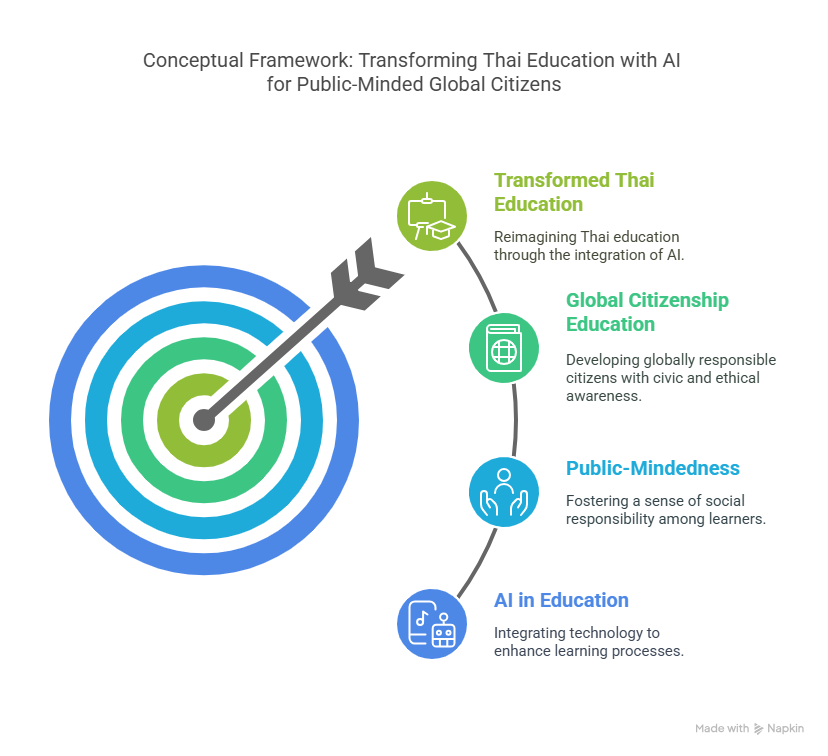
Transforming Thai Education with AI to Cultivate Public-Minded Global Citizens
DOI:
https://doi.org/10.14456/rc-sdj.2026.1Keywords:
Artificial Intelligence in Education, Global Citizenship, Public-Mindedness, Thai Education ReformAbstract
Introduction: The rapid advancement of Artificial Intelligence (AI) has created new opportunities and challenges for education systems worldwide. In Thailand, persistent issues such as educational inequality, uneven access to quality learning resources, centralized administration, and the need to develop future-ready competencies have intensified the urgency of educational reform. This academic article aims to synthesize current knowledge and conceptual perspectives on the integration of AI into Thai education to cultivate public-minded global citizens who are ethically aware, socially responsible, and capable of engaging constructively in an interconnected world.
Subject: The article examines the relationship between AI in education, public-mindedness, and global citizenship education. It discusses how AI can support personalized and adaptive learning, learning analytics, automated assessment, instructional content generation, and inclusive learning for students with diverse needs.
At the same time, it emphasizes that AI should not be viewed merely as a technological tool for efficiency, but as a transformative mechanism for promoting equity, learner agency, civic responsibility, and human-centered learning. The article also addresses key ethical considerations, including data privacy, algorithmic transparency, equitable access to AI technologies, AI literacy, and the preservation of the human role of teachers in AI-enhanced learning environments.
Conclusion: The synthesis indicates that AI has strong potential to reshape Thai education by enabling more flexible, personalized, and inclusive learning experiences. However, successful integration requires coherent national policies, ethical governance, inclusive digital infrastructure, teacher competency development, and continuous evaluation of both learning outcomes and social impacts.
Benefit, Utilization: The article provides a conceptual framework for transforming Thai education with AI to cultivate public-minded global citizens. This framework can be utilized by policymakers, educators, curriculum developers, and educational institutions as a strategic guideline for designing AI-supported learning systems that promote equity, ethical awareness, social responsibility, and sustainable educational development in Thailand.
References
Ahmad, I. (2024). Exploring Advancing Social Equity through Sustainable Development: Challenges and Opportunities. Sustainability Quest, 1(1), 1–7. https://doi.org/10.36923/SQ.v1i1.237
Akkari, A., & Radhouane, M. (2022). Global citizenship education. In A. Akkari & M. Radhouane, Intercultural approaches to education (163–171). Springer. https://doi.org/10.1007/978-3-030-70825-2_12
Alamri, H., Lowell, V. L., Watson, W., & Watson, S. L. (2021). Using personalized learning as an instructional approach to motivate learners in online higher education: Learner self-determination and intrinsic motivation. Journal of Research on Technology in Education, 53(3), 336–352. https://doi.org/10.1080/15391523.2020.1728449
Alfredo, R., Echeverria, V., Jin, Y., Yan, L., Swiecki, Z., Gašević, D., & Martinez-Maldonado, R. (2024). Human-centred learning analytics and AI in education: A systematic literature review. Computers and Education: Artificial Intelligence, 6, 100215. https://doi.org/10.1016/j.caeai.2024.100215
Associated Press. (2025). AI is a game changer for students with disabilities. Schools are still learning to harness it. AP News. https://apnews.com/article/ff1f51379b3861978efb0c1334a2a953
Balaban, D. (2024, March 29). Privacy and security issues of using AI for academic purposes. Forbes. https://www.forbes.com/sites/davidbalaban/2024/03/29/privacy-and-security-issues-of-using-ai-for-academic-purposes/
Bosio, E. (2022). Global citizenship education: A transformative approach to developing responsible global actors. Education Sciences, 12(8), 534. https://doi.org/10.3390/educsci12080534
Buyannemekh, B. (2024). Digital social innovation in cities: A systematic literature review and a research agenda. In Proceedings of the 25th Annual International Conference on Digital Government Research (pp. 116–132). Association for Computing Machinery. https://doi.org/10.1145/3657054.3657073
Campbell, M., Barthwal, A., Joshi, S., Shouli, A., & Shrestha, A. K. (2025). Investigation of the privacy concerns in AI systems for young digital citizens: A comparative stakeholder analysis. In Proceedings of the IEEE Conference on Computing and Wireless Communications (CCWC). https://doi.org/10.1109/CCWC62904.2025.10903925
Carretero, S., Vuorikari, R., & Punie, Y. (2021). DigComp 2.2: The digital competence framework for citizens—With new examples of knowledge, skills, and attitudes. Publications Office of the European Union. https://doi.org/10.2760/115376
Fu, Y., & Weng, Z. (2024). Navigating the ethical terrain of AI in education: A systematic review on framing responsible human-centered AI practices. Computers and Education: Artificial Intelligence, 7, Article 100306. https://doi.org/10.1016/j.caeai.2024.100306
Hariyanto, H., Kristianingsih, F. X. D., & Maharani, R. (2025). Artificial intelligence in adaptive education: A systematic review of techniques for personalized learning. Discover Education, 4, 458. https://doi.org/10.1007/s44217-025-00908-6
IPGCE. (2023). Current challenges in Thailand’s education system. Retrieved April 25, 2025, from https://www.ipgce.com/current-challenges-in-thailands-education-system/
Jenkins, H., Shresthova, S., Gamber-Thompson, L., Kligler-Vilenchik, N., & Zimmerman, A. (2023). By any media necessary: The new youth activism (2nd ed.). New York University Press.
Kamalov, F., Calong, D. S., & Gurrib, I. (2023). New era of artificial intelligence in education: Towards a sustainable multifaceted revolution. Sustainability. https://www.mdpi.com/2071-1050/15/16/12451
Kasa, T., Karilainen, L., Rajala, A., Cantell, H., & Kallioniemi, A. (2023). Finnish UNESCO school educators’ understanding of global citizenship education: Analysis through typologies, ecosocial understanding, and human rights. Prospects, 53(3–4), 459–476. https://doi.org/10.1007/s11125-021-09597-z
Katiyar, N., Awasthi, V. K., Pratap, R., Mishra, K., Shukla, N., Singh, R., & Tiwari, M. (2024). AI-driven personalized learning systems: Enhancing educational effectiveness. Educational Administration: Theory and Practice, 30(5), 11514–11524. https://doi.org/10.53555/kuey.v30i5.4961
Lestari, R., Nurmandi, A., Younus, M., Lawelai, H., & Suardi, W. (2025). Optimizing social media platforms to foster active public engagement in tackling climate change and environmental conservation. Society, 13(1), 18–34. https://doi.org/10.33019/society.v13i1.742
Livingstone, S., Stoilova, M., & Nandagiri, R. (2021). Children’s data and privacy online: Growing up in a digital age. London School of Economics and Political Science.
Luckin, R., Holmes, W., Griffiths, M., & Forcier, L. B. (2022). Empowering educators to be AI-ready. Computers and Education: Artificial Intelligence, 3, 100076. https://doi.org/10.1016/j.caeai.2022.100076
Manokara, K., Lim, L., Lim, Z. Y., & Westgate, E. C. (2025). The elite global citizen: How wealth shapes cosmopolitan identity and charitable intentions. European Journal of Social Psychology, 55(1). https://doi.org/10.1002/ejsp.3114
Ministry of Education, Culture, Sports, Science and Technology (MEXT). (2023). Global citizenship education 2030: Strategic framework. Government of Japan.
Ng, W. (2021). New digital technology in education: Conceptualizing professional learning for educators. Educational Technology & Society, 24(2), 1–14.
Ng, D. T. K., Leung, J. K. L., Chu, S. K. W., & Qiao, M. S. (2021). Conceptualizing AI literacy: An exploratory review. Computers and Education: Artificial Intelligence, 2, 100041. https://doi.org/10.1016/j.caeai.2021.100041
Nurhaliza. (2025). Integration of AI in education systems: Addressing learning quality gaps in remote areas. Journal of Artificial Intelligence Research, 1(1), 21–31.
Organization for Economic Co-operation and Development OECD. (2023). PISA 2022 Results (Volume I): The State of Learning and Equity in Education. PISA, OECD Publishing, Paris. https://doi.org/10.1787/53f23881-en
Owoc, M. L., Sawicka, A., & Weichbroth, P. (2021). Artificial intelligence technologies in education: Benefits, challenges and strategies of implementation. In M. L. Owoc & M. Pondel (Eds.), Artificial intelligence for knowledge management (AI4KM 2019) (IFIP Advances in Information and Communication Technology, Vol. 599). Springer. https://doi.org/10.1007/978-3-030-85001-2_4
Ravšelj, D., Keržič, D., Tomaževič, N., Umek, L., & Brezovar, N. (2025). Higher education students' perceptions of ChatGPT: A global study of early reactions. PLOS ONE. https://doi.org/10.1371/journal.pone.0315011
Ribble, M. (2021). Digital citizenship in schools: Nine elements all students should know (3rd ed.). International Society for Technology in Education.
Robinson-Pant, A. (2023). Literacy: A lever for citizenship? International Review of Education, 69(1–2), 15–30. https://doi.org/10.1007/s11159-023-09998-6
Santamaría-Cárdaba, N., Gajardo, K., Cáceres-Iglesias, J., & Ortega-Quevedo, V. (2024). Global education and critical thinking: A necessary symbiosis to educate for critical global citizenship. Open Education Studies, 6(1), Article 20240010. https://doi.org/10.1515/edu-2024-0010
Sibanda, O. S. (2023). Exploring government transparency as a path to open government. In Public sector communication in the digital age (253–269). Springer.
Stewart, A. J., Plotkin, J. B., & McCarty, N. (2021). Inequality, identity, and partisanship: How redistribution can stem the tide of mass polarization. Proceedings of the National Academy of Sciences, 118(50), e2102140118. https://doi.org/10.1073/pnas.2102140118
Sukolrat, M., & Kajornatthapol, P. (2024). Developing Supplementary Curricula to Foster Public-Mindedness Through Service-Learning and Community-Based Learning for Undergraduate Students at Tak Special Economic Zone Institute. International Journal of Environmental Sciences. 10(4), 1019–1026. https://doi.org/10.64252/cbder855
The Asia Foundation. (2023). Education reform: In Thailand principals are “black box” between national policymaking and kids in the classroom. https://asiafoundation.org/education-reform-in-thailand-principals-are-black-box-between-national-policymaking-and-kids-in-the-classroom/
UNESCO. (2021). Reimagining our futures together: A new social contract for education. UNESCO Publishing.
UNESCO. (2022). Global citizenship education: Topics and learning objectives. UNESCO.
UNESCO. (2023a). Advancing education: Evolving assessments with AI. https://unesdoc.unesco.org/ark:/48223/pf0000387554
UNESCO. (2023b). Global citizenship education: Preparing learners for the challenges of the 21st century. UNESCO Publishing.
UNESCO. (2024). Artificial intelligence in education. https://www.unesco.org/en/digital-education/artificial-intelligence
Walther, C. (2025, March 1). AI is changing how we learn: The new role of human teachers. Forbes. https://www.forbes.com/sites/corneliawalther/2025/03/01/ai-is-changing-how-we-learn-the-new-role-of-human-teachers/
Wang, S., Christensen, C., Cui, W., Tong, R., & Yarnall, L. (2023). When adaptive learning is effective learning: Comparison of an adaptive learning system to teacher-led instruction. Interactive Learning Environments. https://doi.org/10.1080/10494820.2023.2201863
Webster, J. (2025). Defining digital citizenship and digital citizenship education: A Delphi study. Journal of Research on Technology in Education, Advance online publication. https://doi.org/10.1080/15391523.2025.2536564
Wei, L., Hindman, D. B., & Zeng, D. (2022). Digital inequality: The evolving landscape of digital access and participation. Telecommunications Policy, 46(5), 102308. https://doi.org/10.1016/j.telpol.2022.102308
Williamson, B. (2021). Meta-edtech. Learning, Media and Technology, 46(1), 1–5. https://doi.org/10.1080/17439884.2021.1876089
Wongsuwan, P., & Makpa, P. (2025). Educational inequality in Thailand: A structural analysis within the framework of the Sustainable Development Goals (SDGs). VISITSILP Journal of Arts and Culture, 2(2), 37–53.
World Economic Forum. (2024). Shaping the future of learning: The role of AI in education 4.0. https://www3.weforum.org/docs/WEF_Shaping_the_Future_of_Learning_2024.pdf
Zhai, X., Wang, Y., Liang, L., Wang, K., Pei, F., & Fu, E. Y. (2025). Personalized e-learning resource recommendation using multimodal-enhanced collaborative filtering. Knowledge-Based Systems, 319, Article 113605. https://doi.org/10.1016/j.knosys.2025.113605