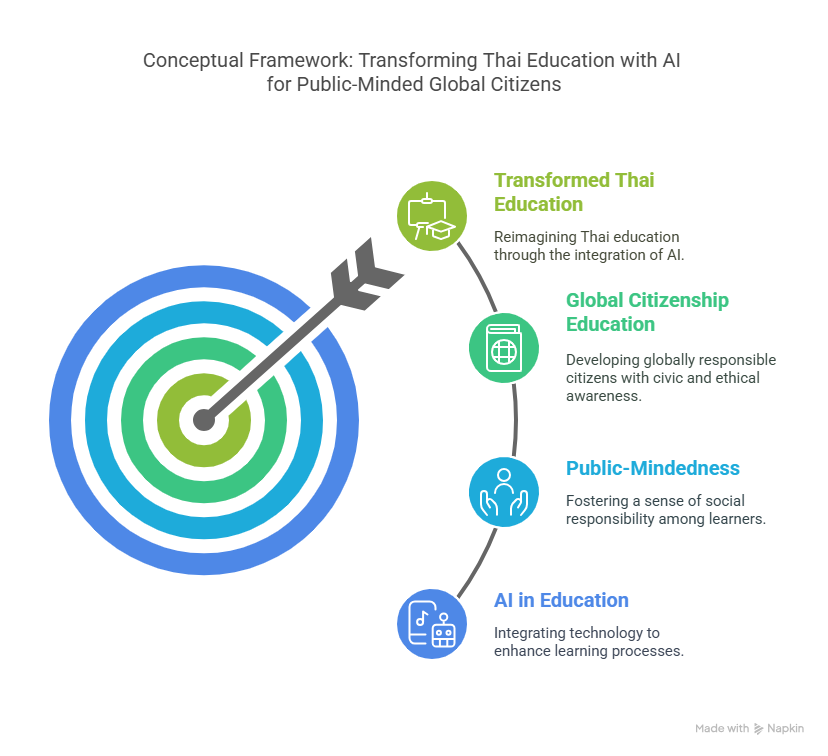
Transforming Thai Education with AI to Cultivate Public-Minded Global Citizens
DOI:
https://doi.org/10.14456/rc-sdj.2026.1คำสำคัญ:
ปัญญาประดิษฐ์ทางการศึกษา, พลเมืองโลก, จิตสาธารณะ, การปฏิรูปการศึกษาไทยบทคัดย่อ
บทนำ: ความก้าวหน้าอย่างรวดเร็วของปัญญาประดิษฐ์ก่อให้เกิดทั้งโอกาสและความท้าทายต่อระบบการศึกษาทั่วโลก สำหรับประเทศไทย ปัญหาความเหลื่อมล้ำทางการศึกษา การเข้าถึงทรัพยากรการเรียนรู้ที่มีคุณภาพอย่างไม่เท่าเทียม การบริหารจัดการศึกษาที่ยังมีลักษณะรวมศูนย์ และความจำเป็นในการพัฒนาสมรรถนะผู้เรียนให้พร้อมต่อโลกอนาคต ล้วนสะท้อนถึงความเร่งด่วนของการปฏิรูปการศึกษา บทความวิชาการนี้มีวัตถุประสงค์เพื่อสังเคราะห์องค์ความรู้และมุมมองเชิงแนวคิดเกี่ยวกับการบูรณาการปัญญาประดิษฐ์ในระบบการศึกษาไทย เพื่อบ่มเพาะผู้เรียนให้เป็นพลเมืองโลกที่มีจิตสาธารณะ มีความตระหนักเชิงจริยธรรม มีความรับผิดชอบต่อสังคม และสามารถ
มีส่วนร่วมอย่างสร้างสรรค์ในโลกที่เชื่อมโยงถึงกัน
เนื้อเรื่อง: บทความนำเสนอความสัมพันธ์ระหว่างปัญญาประดิษฐ์ทางการศึกษา จิตสาธารณะ และการศึกษาเพื่อความเป็นพลเมืองโลก โดยอภิปรายบทบาทของปัญญาประดิษฐ์ในการสนับสนุนการเรียนรู้เฉพาะบุคคล การเรียนรู้แบบปรับเหมาะ การวิเคราะห์ข้อมูลการเรียนรู้ การประเมินผลอัตโนมัติ การสร้างสื่อการเรียนรู้ และการส่งเสริมการเรียนรู้แบบทั่วถึงสำหรับผู้เรียนที่มีความต้องการหลากหลาย ทั้งนี้ ปัญญาประดิษฐ์ควรถูกใช้เป็นกลไกในการส่งเสริมความเสมอภาค ศักยภาพผู้เรียน ความรับผิดชอบต่อในฐานะพลเมือง และการเรียนรู้ที่มีมนุษย์เป็นศูนย์กลาง ควบคู่กับการคำนึงถึงจริยธรรม ความเป็นส่วนตัวของข้อมูล ความโปร่งใสของอัลกอริทึม ความเท่าเทียมในการเข้าถึงเทคโนโลยี สมรรถนะด้านปัญญาประดิษฐ์ และบทบาทสำคัญของผู้สอน
ส่วนสรุป: ผลการสังเคราะห์ชี้ให้เห็นว่า ปัญญาประดิษฐ์มีศักยภาพสูงในการปรับเปลี่ยนการศึกษาไทยให้มีความยืดหยุ่น เฉพาะบุคคล และทั่วถึงมากยิ่งขึ้น อย่างไรก็ตาม การบูรณาการดังกล่าวจำเป็นต้องอาศัยนโยบายระดับชาติที่ชัดเจน ธรรมาภิบาลเชิงจริยธรรม โครงสร้างพื้นฐานดิจิทัลที่ครอบคลุม การพัฒนาสมรรถนะผู้สอน และการประเมินผลอย่างต่อเนื่องทั้งในมิติผลลัพธ์การเรียนรู้และผลกระทบทางสังคม
องค์ความรู้: บทความนี้นำเสนอกรอบแนวคิดการยกระดับการศึกษาไทยด้วยปัญญาประดิษฐ์เพื่อบ่มเพาะพลเมืองโลกที่มีจิตสาธารณะ ซึ่งสามารถใช้เป็นแนวทางเชิงยุทธศาสตร์ในการออกแบบระบบการเรียนรู้ที่ส่งเสริมความเสมอภาค จริยธรรม ความรับผิดชอบต่อสังคม และการพัฒนาการศึกษาไทยอย่างยั่งยืน
เอกสารอ้างอิง
Ahmad, I. (2024). Exploring Advancing Social Equity through Sustainable Development: Challenges and Opportunities. Sustainability Quest, 1(1), 1–7. https://doi.org/10.36923/SQ.v1i1.237
Akkari, A., & Radhouane, M. (2022). Global citizenship education. In A. Akkari & M. Radhouane, Intercultural approaches to education (163–171). Springer. https://doi.org/10.1007/978-3-030-70825-2_12
Alamri, H., Lowell, V. L., Watson, W., & Watson, S. L. (2021). Using personalized learning as an instructional approach to motivate learners in online higher education: Learner self-determination and intrinsic motivation. Journal of Research on Technology in Education, 53(3), 336–352. https://doi.org/10.1080/15391523.2020.1728449
Alfredo, R., Echeverria, V., Jin, Y., Yan, L., Swiecki, Z., Gašević, D., & Martinez-Maldonado, R. (2024). Human-centred learning analytics and AI in education: A systematic literature review. Computers and Education: Artificial Intelligence, 6, 100215. https://doi.org/10.1016/j.caeai.2024.100215
Associated Press. (2025). AI is a game changer for students with disabilities. Schools are still learning to harness it. AP News. https://apnews.com/article/ff1f51379b3861978efb0c1334a2a953
Balaban, D. (2024, March 29). Privacy and security issues of using AI for academic purposes. Forbes. https://www.forbes.com/sites/davidbalaban/2024/03/29/privacy-and-security-issues-of-using-ai-for-academic-purposes/
Bosio, E. (2022). Global citizenship education: A transformative approach to developing responsible global actors. Education Sciences, 12(8), 534. https://doi.org/10.3390/educsci12080534
Buyannemekh, B. (2024). Digital social innovation in cities: A systematic literature review and a research agenda. In Proceedings of the 25th Annual International Conference on Digital Government Research (pp. 116–132). Association for Computing Machinery. https://doi.org/10.1145/3657054.3657073
Campbell, M., Barthwal, A., Joshi, S., Shouli, A., & Shrestha, A. K. (2025). Investigation of the privacy concerns in AI systems for young digital citizens: A comparative stakeholder analysis. In Proceedings of the IEEE Conference on Computing and Wireless Communications (CCWC). https://doi.org/10.1109/CCWC62904.2025.10903925
Carretero, S., Vuorikari, R., & Punie, Y. (2021). DigComp 2.2: The digital competence framework for citizens—With new examples of knowledge, skills, and attitudes. Publications Office of the European Union. https://doi.org/10.2760/115376
Fu, Y., & Weng, Z. (2024). Navigating the ethical terrain of AI in education: A systematic review on framing responsible human-centered AI practices. Computers and Education: Artificial Intelligence, 7, Article 100306. https://doi.org/10.1016/j.caeai.2024.100306
Hariyanto, H., Kristianingsih, F. X. D., & Maharani, R. (2025). Artificial intelligence in adaptive education: A systematic review of techniques for personalized learning. Discover Education, 4, 458. https://doi.org/10.1007/s44217-025-00908-6
IPGCE. (2023). Current challenges in Thailand’s education system. Retrieved April 25, 2025, from https://www.ipgce.com/current-challenges-in-thailands-education-system/
Jenkins, H., Shresthova, S., Gamber-Thompson, L., Kligler-Vilenchik, N., & Zimmerman, A. (2023). By any media necessary: The new youth activism (2nd ed.). New York University Press.
Kamalov, F., Calong, D. S., & Gurrib, I. (2023). New era of artificial intelligence in education: Towards a sustainable multifaceted revolution. Sustainability. https://www.mdpi.com/2071-1050/15/16/12451
Kasa, T., Karilainen, L., Rajala, A., Cantell, H., & Kallioniemi, A. (2023). Finnish UNESCO school educators’ understanding of global citizenship education: Analysis through typologies, ecosocial understanding, and human rights. Prospects, 53(3–4), 459–476. https://doi.org/10.1007/s11125-021-09597-z
Katiyar, N., Awasthi, V. K., Pratap, R., Mishra, K., Shukla, N., Singh, R., & Tiwari, M. (2024). AI-driven personalized learning systems: Enhancing educational effectiveness. Educational Administration: Theory and Practice, 30(5), 11514–11524. https://doi.org/10.53555/kuey.v30i5.4961
Lestari, R., Nurmandi, A., Younus, M., Lawelai, H., & Suardi, W. (2025). Optimizing social media platforms to foster active public engagement in tackling climate change and environmental conservation. Society, 13(1), 18–34. https://doi.org/10.33019/society.v13i1.742
Livingstone, S., Stoilova, M., & Nandagiri, R. (2021). Children’s data and privacy online: Growing up in a digital age. London School of Economics and Political Science.
Luckin, R., Holmes, W., Griffiths, M., & Forcier, L. B. (2022). Empowering educators to be AI-ready. Computers and Education: Artificial Intelligence, 3, 100076. https://doi.org/10.1016/j.caeai.2022.100076
Manokara, K., Lim, L., Lim, Z. Y., & Westgate, E. C. (2025). The elite global citizen: How wealth shapes cosmopolitan identity and charitable intentions. European Journal of Social Psychology, 55(1). https://doi.org/10.1002/ejsp.3114
Ministry of Education, Culture, Sports, Science and Technology (MEXT). (2023). Global citizenship education 2030: Strategic framework. Government of Japan.
Ng, W. (2021). New digital technology in education: Conceptualizing professional learning for educators. Educational Technology & Society, 24(2), 1–14.
Ng, D. T. K., Leung, J. K. L., Chu, S. K. W., & Qiao, M. S. (2021). Conceptualizing AI literacy: An exploratory review. Computers and Education: Artificial Intelligence, 2, 100041. https://doi.org/10.1016/j.caeai.2021.100041
Nurhaliza. (2025). Integration of AI in education systems: Addressing learning quality gaps in remote areas. Journal of Artificial Intelligence Research, 1(1), 21–31.
Organization for Economic Co-operation and Development OECD. (2023). PISA 2022 Results (Volume I): The State of Learning and Equity in Education. PISA, OECD Publishing, Paris. https://doi.org/10.1787/53f23881-en
Owoc, M. L., Sawicka, A., & Weichbroth, P. (2021). Artificial intelligence technologies in education: Benefits, challenges and strategies of implementation. In M. L. Owoc & M. Pondel (Eds.), Artificial intelligence for knowledge management (AI4KM 2019) (IFIP Advances in Information and Communication Technology, Vol. 599). Springer. https://doi.org/10.1007/978-3-030-85001-2_4
Ravšelj, D., Keržič, D., Tomaževič, N., Umek, L., & Brezovar, N. (2025). Higher education students' perceptions of ChatGPT: A global study of early reactions. PLOS ONE. https://doi.org/10.1371/journal.pone.0315011
Ribble, M. (2021). Digital citizenship in schools: Nine elements all students should know (3rd ed.). International Society for Technology in Education.
Robinson-Pant, A. (2023). Literacy: A lever for citizenship? International Review of Education, 69(1–2), 15–30. https://doi.org/10.1007/s11159-023-09998-6
Santamaría-Cárdaba, N., Gajardo, K., Cáceres-Iglesias, J., & Ortega-Quevedo, V. (2024). Global education and critical thinking: A necessary symbiosis to educate for critical global citizenship. Open Education Studies, 6(1), Article 20240010. https://doi.org/10.1515/edu-2024-0010
Sibanda, O. S. (2023). Exploring government transparency as a path to open government. In Public sector communication in the digital age (253–269). Springer.
Stewart, A. J., Plotkin, J. B., & McCarty, N. (2021). Inequality, identity, and partisanship: How redistribution can stem the tide of mass polarization. Proceedings of the National Academy of Sciences, 118(50), e2102140118. https://doi.org/10.1073/pnas.2102140118
Sukolrat, M., & Kajornatthapol, P. (2024). Developing Supplementary Curricula to Foster Public-Mindedness Through Service-Learning and Community-Based Learning for Undergraduate Students at Tak Special Economic Zone Institute. International Journal of Environmental Sciences. 10(4), 1019–1026. https://doi.org/10.64252/cbder855
The Asia Foundation. (2023). Education reform: In Thailand principals are “black box” between national policymaking and kids in the classroom. https://asiafoundation.org/education-reform-in-thailand-principals-are-black-box-between-national-policymaking-and-kids-in-the-classroom/
UNESCO. (2021). Reimagining our futures together: A new social contract for education. UNESCO Publishing.
UNESCO. (2022). Global citizenship education: Topics and learning objectives. UNESCO.
UNESCO. (2023a). Advancing education: Evolving assessments with AI. https://unesdoc.unesco.org/ark:/48223/pf0000387554
UNESCO. (2023b). Global citizenship education: Preparing learners for the challenges of the 21st century. UNESCO Publishing.
UNESCO. (2024). Artificial intelligence in education. https://www.unesco.org/en/digital-education/artificial-intelligence
Walther, C. (2025, March 1). AI is changing how we learn: The new role of human teachers. Forbes. https://www.forbes.com/sites/corneliawalther/2025/03/01/ai-is-changing-how-we-learn-the-new-role-of-human-teachers/
Wang, S., Christensen, C., Cui, W., Tong, R., & Yarnall, L. (2023). When adaptive learning is effective learning: Comparison of an adaptive learning system to teacher-led instruction. Interactive Learning Environments. https://doi.org/10.1080/10494820.2023.2201863
Webster, J. (2025). Defining digital citizenship and digital citizenship education: A Delphi study. Journal of Research on Technology in Education, Advance online publication. https://doi.org/10.1080/15391523.2025.2536564
Wei, L., Hindman, D. B., & Zeng, D. (2022). Digital inequality: The evolving landscape of digital access and participation. Telecommunications Policy, 46(5), 102308. https://doi.org/10.1016/j.telpol.2022.102308
Williamson, B. (2021). Meta-edtech. Learning, Media and Technology, 46(1), 1–5. https://doi.org/10.1080/17439884.2021.1876089
Wongsuwan, P., & Makpa, P. (2025). Educational inequality in Thailand: A structural analysis within the framework of the Sustainable Development Goals (SDGs). VISITSILP Journal of Arts and Culture, 2(2), 37–53.
World Economic Forum. (2024). Shaping the future of learning: The role of AI in education 4.0. https://www3.weforum.org/docs/WEF_Shaping_the_Future_of_Learning_2024.pdf
Zhai, X., Wang, Y., Liang, L., Wang, K., Pei, F., & Fu, E. Y. (2025). Personalized e-learning resource recommendation using multimodal-enhanced collaborative filtering. Knowledge-Based Systems, 319, Article 113605. https://doi.org/10.1016/j.knosys.2025.113605