An Exploratory Study of Pharmacists’ and Migrant Workers’ Perspectives toward the Use of a Digital Language Translation Platform
DOI:
https://doi.org/10.14456/rc-sdj.2026.5Keywords:
Digital Translation Platform, Intercultural Communication, Pharmacy, Migrant WorkersAbstract
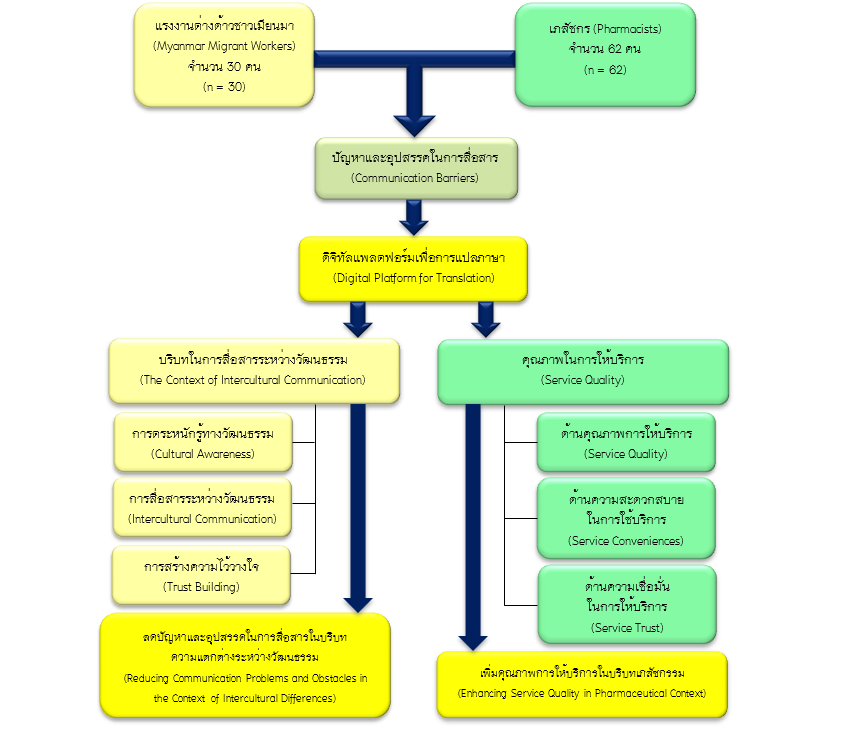
Introduction: Community pharmacies serve as highly accessible primary healthcare units for both the general public and migrant workers. However, persistent language barriers remain a critical constraint that can compromise the quality of pharmaceutical care. This study aimed to identify communication barriers between migrant workers and pharmacists, assess their awareness of and attitudes toward digital translation platforms, and compare the perspectives of both groups regarding the communication effectiveness and service quality facilitated by these platforms.
Methodology: Utilizing a quantitative survey research design, data were gathered from two distinct cohorts: 62 community pharmacists via an online questionnaire, and 30 Myanmar migrant workers via a questionnaire administered with the assistance of an interpreter. Intergroup differences were analyzed using descriptive statistics and evaluated using the Mann–Whitney U test.
Results: Both pharmacists and migrant workers indicated that digital translation platforms significantly enhance communication and pharmaceutical service quality. These platforms were found to minimize communication errors, improve comprehension of medication instructions, bolster migrant workers’ perceived safety during consultations, increase convenience, foster trust, and project a positive image for community pharmacies. Furthermore, Mann–Whitney U test analysis revealed that pharmacists held significantly more positive perceptions regarding the platform's capacity to reflect service quality, standards, and readiness compared to the Myanmar migrant workers.
Discussion: Digital translation platforms act as vital mechanisms for facilitating intercultural communication within community pharmacies. To bridge critical language gaps linked directly to patient trust and clinical safety, translation software tailored specifically for pharmaceutical contexts should be developed. Future research should expand the cohort to include international tourists to examine language-related limitations across diverse cultural and demographic contexts.
Recommendations: The development of a dedicated, pharmacy-specific digital translation platform supporting Myanmar and Cambodian languages is highly recommended. This platform should incorporate a validated, high-accuracy database of clinical and health advice terminology, establish strict safety usage standards, and be paired with intercultural communication training programs for pharmacists.
References
Balakrishnan, K., Harji, M. B., & Angusamy, A. (2021). Intercultural communication competence: Well-being and performance of multicultural teams. Journal of Intercultural Communication, 21(2), 82-96. https://doi.org/10.36923/jicc.v21i2.16
Díaz-Millón, M., & Olvera-Lobo, M. D. (2025). Systematic meta-review on migrant healthcare access: Language barriers and the role of translation. Journal of Migration and Health, 12, 100358. https://doi.org/10.1016/j.jmh.2025.100358
Filmer, T., Ray, R., & Glass, B. D. (2023). Barriers and facilitators experienced by migrants and refugees when accessing pharmaceutical care: A scoping review. Research in Social and Administrative Pharmacy, 19(7), 977-988. https://doi.org/10.1016/j.sapharm.2023.02.016
Gül, İ., Helvacıoğlu, E. T., & Saraçlı, S. (2023). Service quality, outpatient satisfaction and loyalty in community pharmacies in Turkey: A structural equation modeling approach. Exploratory Research in Clinical and Social Pharmacy, 12, 100361. https://doi.org/10.1016/j.rcsop.2023.100361
Hwang, K., Williams, S., Zucchi, E., Chong, T. W., Mascitti‐Meuter, M., LoGiudice, D., . . . Batchelor, F. (2022). Testing the use of translation apps to overcome everyday healthcare communication in Australian aged‐care hospital wards—An exploratory study. Nursing open, 9(1), 578-585. https://doi.org/10.1002/nop2.1099
Jesiek, B., Lapka, S., Acheson, K., & Kung, F. (2026). Interpersonal intercultural adaptation orientations: A qualitative study of engineering professionals. Journal of Intercultural Communication, 26(1), 19-31. https://doi.org/10.36923/jicc.v26i1.1324
Kreienbrinck, A., Hanft-Robert, S., & Mösko, M. (2024). Usability of technological tools to overcome language barriers in health care: a scoping review protocol. BMJ open, 14(3), e079814. https://doi.org/10.1136/bmjopen-2023-079814
McCann, J., Lau, W. M., Husband, A., Todd, A., Sile, L., Doll, A. K., Varia, S. and Robinson‐Barella, A. (2023). ‘Creating a culturally competent pharmacy profession’: A qualitative exploration of pharmacy staff perspectives of cultural competence and its training in community pharmacy settings. Health Expectations, 26(5), 1941-1953. https://doi.org/10.1111/hex.13803
Okoye, K., & Hosseini, S. (2024). Mann–Whitney U test and Kruskal–Wallis H test statistics in R. In R programming: Statistical data analysis in research (pp. 225-246). Springer.
Pukhut, P., Jitnom, J., Panyaroj, N., & Pukhut, P. (2024). Service quality factors affecting user satisfaction with freight transport services in Thailand. Research Community and Social Development Journal, 18(1), 90–107. https://doi.org/10.14456/nrru-rdi.2024.6 [in Thai]
Saleem, S. M. U., Taib, C. A., Ikram, M., & Mehmood, W. (2024). A comprehensive analysis of service quality: a systematic literature review. Total Quality Management & Business Excellence, 35(9-10), 1124-1166. https://doi.org/10.1080/14783363.2024.2357805
Tanujaya, B., Prahmana, R. C. I., & Mumu, J. (2022). Likert scale in social sciences research: Problems and difficulties. FWU Journal of Social Sciences, 16(4), 89-101.
Taylor, B., & McLean, G. (2024). Exploring the use of mobile translation applications for culturally and linguistically diverse patients during medical imaging examinations in Australia–a systematic review. Journal of Medical Radiation Sciences, 71(3), 432-444. https://doi.org/10.1002/jmrs.755
Tunpaiboon, N. (2024). Industry Outlook 2025 - 2027: Pharmaceuticals. Krungsri. https://www.krungsri.com/en/research/industry/industry-outlook/chemicals/phamaceuticals/io/io-pharmaceuticals-2025-2027
Uzir, M. U. H., Al Halbusi, H., Thurasamy, R., Hock, R. L. T., Aljaberi, M. A., Hasan, N., & Hamid, M. (2021). The effects of service quality, perceived value and trust in home delivery service personnel on customer satisfaction: Evidence from a developing country. Journal of Retailing and Consumer Services, 63, 102721. https://doi.org/10.1016/j.jretconser.2021.102721
Westjohn, S. A., Magnusson, P., Franke, G. R., & Peng, Y. (2022). Trust propensity across cultures: The role of collectivism. Journal of International Marketing, 30(1), 1-17. https://doi.org/10.1177/1069031X211036688
Wongvedvanij, R., & Darawong, C. (2023). Enhancing the service quality of community pharmacies for non-prescription medicines based on the perspectives of pharmacists and patients: a qualitative study. Journal of Communication in Healthcare, 16(1), 38-45. https://doi.org/10.1080/17538068.2022.2026057
Wilkins, S., Hazzam, J., & Megicks, P. (2023). Consumers’ propensity for rollover service contracts: the influences of perceived value, convenience and trust on service loyalty. Journal of Strategic Marketing, 31(3), 516-531. https://doi.org/10.1080/0965254X.2021.1946127
Yu, W., Cormican, K., Wu, Q., & Sampaio, S. (2021). In whom do we trust? Critical success factors impacting intercultural communication in multicultural project teams. International Journal of Information Systems and Project Management, 9(3), 21-40. https://doi.org/10.12821/ijispm090302
Zhu, X. (2021). Sample size calculation for Mann-Whitney U test with five methods. International Journal of Clinical Trials, 8(3), 184-195. https://doi.org/10.18203/2349-3259.ijct20212840