A Study of Learning Achievement on Collision with Momentum Effect Learning Unit and Scientific Literacy of Grade 10 Students using Phenomenon -based Learning with Think-Talk-Write Technique
DOI:
https://doi.org/10.14456/nrru-rdi.2024.23Keywords:
Phenomenon-Based Learning, Think-Talk-Write Technique, Scientific LiteracyAbstract
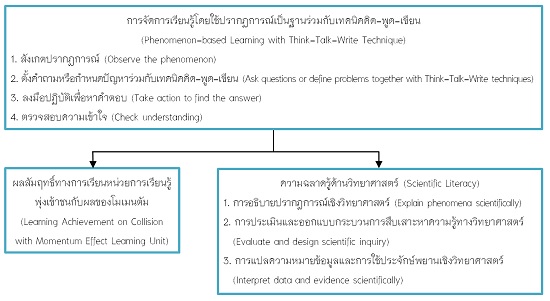
Background and Objective: Phenomenon-based learning leverages real-world phenomena as a starting point for learning, enabling students in real life. The aligns with the goal of scientific education which is to develop science literacy. This research aims to compare students' learning achievements before and after instruction, assess post-learning achievement against a 70% benchmark, and compare scientific literacy before and after phenomenon-based learning, using the Think-Talk-Write technique.
Methodology: This preliminary experimental study utilized a single sample group comprising 40 students selected through cluster sampling. The research instruments included a learning management plan rated with an appropriateness score of 4.93, an achievement test with a reliability coefficient (KR-20) of 0.91, and a scientific literacy assessment with a Cronbach's alpha reliability coefficient of 0.71. Data collection adhered to a structured learning management plan over 16 hours, divided into four sessions of 4 hours each. Pre-tests and post-tests were conducted, and the data were analyzed using descriptive statistics (percentages, means, standard deviations) and inferential statistics (t-tests) to compare learning achievement means and assess scientific literacy (One-sample t-test for the mean).
Results: The findings revealed that the mean post-learning achievement score (x̄=14.65) was significantly higher than the pre-learning score (x̄=8.00) at the 0.05 significance level. The post-learning achievement score met the 70% benchmark (p=0.185) without statistical significance. Additionally, the post-learning scientific literacy score (mean=13.88) was significantly higher than the pre-learning literacy score (mean=8.40) at the 0.05 significance level.
Discussion: The results suggest that well-designed instructional methods that align with students' potential significantly enhance both learning achievement and scientific literacy. The high satisfaction levels among students highlight the critical role of supportive teaching environments, active student engagement, and challenging content in secondary science education. The non-significant difference in achievement against the benchmark underscores the effectiveness of the phenomenon-based learning approach.
Suggestion: Ensuring adequate sample sizes is vital for robust hypothesis testing and reliable application of t-tests. Future research should emphasize maintaining sufficient sample sizes to enhance the reliability and practical applicability of the findings.
References
Akkas, E., & Eker, C. (2021). The effect of phenomenon-based learning approach on students' metacognitive awareness. Journal of Educational Research and review, 16(5), 181-188.
Bureau of Academic Affairs and Educational Standards at Office of the Basic Education Commission. (2010). Guidelines for Measuring and Evaluating Learning Outcomes According to the Basic Education Core Curriculum, 2008 (2nd ed.). The Agricultural Co-operative Federation of Thailand.
Campbell, D. T., & Stanley, J. C. (1969). Experimental and quasi-experimental designs for research. Houghton Mifflin.
Chaiseeha, N., & Intasena, A. (2022). Learning management using Think Talk Write Learning Activities techniques to improve Mathematical problem solving ability for Mathayomsuksa 2 student. Journal of Roi Kaensarn Acadami, 7(11), 146-159.
Funfuengfu, V. (2022). The development of phenomenon-based learning Model for enhancing Active learning Competencies of Teacher Student. International journal of Positive School Psychology, 6(7), 1366-1377.
Huinker, D., & Laughlin,C. (1996). Talk your way into writing. In P. Elliott & M. Kenny (eds.), Communication in mathematics, K-12 and beyond (pp. 81-88). National Council of Teacher of Mathematics.
Keeratichamroen, W., & Phonnong, I. (2020). A comparison of learning of learning achievement and communication skills for undergraduate students using 5E inquiry-based Leraning and Phenomenon-based Learning. NRRU Community Research Journal, 14(1), 29-43. https://doi.org/10.14456/nrru-rdi.2020.3
Kuder, G., & Richardson, M. (1937). The theory of estimation of test reliability. Psychometrika.
Milton, J. S., & Arnold. J. C. (1995). Introduction to Probability and Statistics (3rd ed.). McGraw-Hill.
Ministry of Education. (2022). Announcement from the Thai Ministry of Education on education management policies for fiscal year 2023-2024. Bureau of Policy and Strategy.
Muhaini, R. N., Putro, N. H. P. S., & Istiyono, E. (2023, December). The effect of think talk write learning model on students’ cognitive biology learning outcomes. In AIP Conference Proceedings (Vol. 2621, No. 1). AIP Publishing.
Pengsantia, S., Tulmethakaan, M., & Suwathanpornkul, I. (2022). Effect of Learning Management by Using Phenomenon-based Learning on Critical Thinking and Creative Thinking of Grade 12 Students. Journal Silpakorn Educational Research, 13(2), 240-257.
Phimai Wittaya School. (2022). Number of Grade 7 and 10 Students in School Classifiled by Study Plans [Unpublished document]. Phimai Wittaya School.
Purwita, T. D., Sari, L. P., & Wilujeng, I. (2020). Utilizing of TTW (Think-Talk-Write) instructional model in the use of pictorial riddle-aided student worksheets for students’ critical thinking skills enhancement. In Journal of Physics: Conference Series (Vol. 1440, No. 1, p. 012046). IOP Publishing. 10.1088/1742-6596/1440/1/012046
Rosana, D., Widodo, E., Setianingsih, W., & Setyawarno, D. (2020). Developing assessment instruments of PISA model to measure students’ problem-solving skills and scientific literacy in junior high schools. Jurnal Pendidikan Sains Indonesia (Indonesian Journal of Science Education), 8(2), 292-305. https://doi.org/10.24815/jpsi.v8i2.17468
Saengchan, S., & Kijkuakul, S. (2023). Phenomenon-based learning Approach Promoting Scientific Literacy on the Buoyancy of Liquids for 8th Grade Students. Journal of Roi Kaensarn Academi, 8(9), 56-73.
Sankaburanurak S., Kornpiphat W., Chukieatwattanakul W., & Thongteangyai, P. (2020). Developing learning skills that are related to real life by phenomenon based learning, learning styles from Finland. Chinese Studies Journal, 13(1), 61-81.
Santhalia, P. W. & Yuliati, L. (2021). An Exploration of Scientific Literacy on Physics Subjects within Phenomenon-based Experiential Learning. Journal Penelitian Fisika dan Aplikasinya (JPFA), 11(1), 72-81.
Shohib, M., Rahayu, Y. S., Wasis, W., & Hariyono, E. (2021). Scientific literacy ability of junior high school students on static electricity and electricity in living things. IJORER: International Journal of Recent Educational Research, 2(6), 700-708. https://doi.org/10.46245/ijorer.v2i6.170
Srisa-ard, B. (2011). Basic Research (9th ed.). Suweeriyasan.
Sthapitanonda, P. (2014). Communication Research Methods. (7th ed. (Rev. ed.)). Chulalongkorn University.
Tanya, S. (2012). Educational Research Methodology. Faculty of Education at Nakhon Ratchasima Rajabhat University.
Taylor, C. (2022). Phenomenon-based Instruction in the Elementary Classroom: Impact on Student Engagement and Student Achievement in Science Content Learning [Doctoral dissertation, Boise State University]. https://scholarworks.boisestate.edu/cgi/viewcontent.cgi?article=3089&context=td
The Institute for the Promotion of Teaching Science and Technology. (2017). Student evaluation structure framework for the PISA 2015 project. Evaluation framework.
The Institute for the Promotion of Teaching Science and Technology. (2023, December 6). Press Conference on PISA Evaluation Results 2022. Press Conference. https://pisathailand.ipst.ac.th/news-21/
The Organization for Economic Co-operation and Development. (2023). PISA 2022 assessment and analytical framework. OECD Publishing.
Downloads
Published
How to Cite
Issue
Section
License
Copyright (c) 2024 Research and Development Institute, Nakhon Ratchasima Rajabhat University

This work is licensed under a Creative Commons Attribution-NonCommercial-NoDerivatives 4.0 International License.