
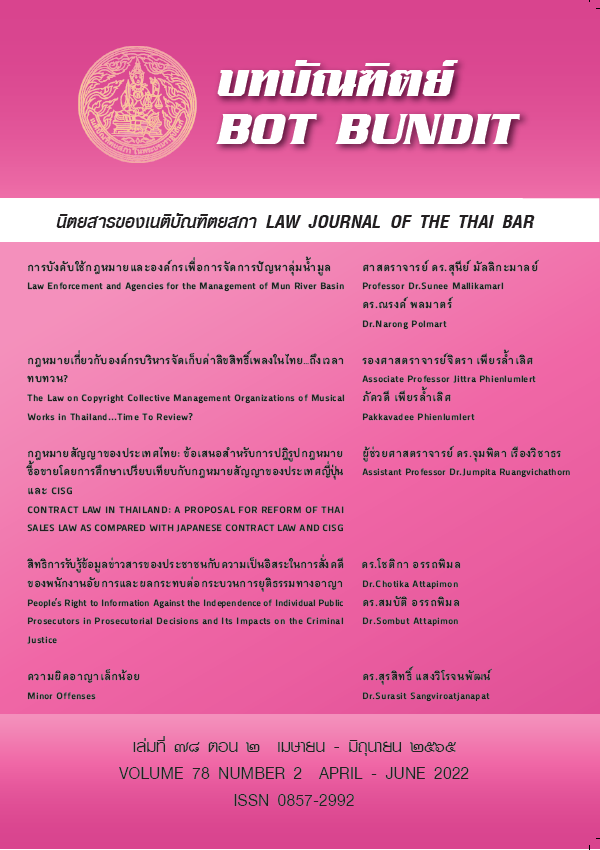
Minor Offenses
Article Sidebar
Main Article Content
Abstract
In foreign legal systems such as Germany and France, the concepts of serious crimes and minor crimes were divided. Thailand received the idea of such minor crimes from Germany; when drafting the Act on fine-only offenses. According to the Act, the idea was to bring minor crimes that did not affect the peace of society out of ordinary crime, which is in line with the Constitution of the Kingdom of Thailand, B.E. 2560, Section 77, the last paragraph, which lays down the principle of stating criminal offenses only in the case of serious crimes. Understanding the concepts of minor crimes, the author thinks that it should help better understand the meaning of fine-only offenses under the fine-only offenses Act; when the said law has come into force. In this article, the evolution of minor crimes and the guidelines used to differentiate between serious and minor crimes will be discussed, using the concepts of a German and French jurist in the presentation, leading to further analysis of the aforementioned concepts of Thai lawyers. The author thinks that minor crimes may be divided into two cases, namely, in form, which is a fine-only offense as provided in the Act on Fine-Only Offenses, which is considered as part of the mandatory measures. In its content, it is an offense that is technical and not taken to convey moral condemnation.
Article Details

This work is licensed under a Creative Commons Attribution-NonCommercial-NoDerivatives 4.0 International License.
References
หนังสือภาษไทย
กมลชัย รัตนสกาววงศ์. (๒๕๖๐, ๒๙ กันยายน). ทฤษฎีและแนวคิดเกี่ยวกับการกำหนดโทษทางปกครองในการตรากฎหมาย โครงการสัมมนา เรื่อง หลักเกณฑ์ในการกำหนดโทษทางปกครองในการตรากฎหมาย. การสัมมนาเรื่อง หลักเกณฑ์ในการกำหนดโทษทางปกครองในการตรากฎหมาย (น. ๑), สำนักงานคณะกรรมการกฤษฎีกา, กรุงเทพมหานคร. https://www.lawreform.go.th/uploads/files/1570531312-obcrk-7npih.pdf
ชาญชัย แสวงศักดิ์. (๒๕๖๔). โทษทางปกครอง : กฎหมายเปรียบเทียบ. สำนักพิมพ์วิญญูชน.
มานิตย์ วงศ์เสรี. (๒๕๖๐, ๒๙ กันยายน). เกณฑ์การกำหนดโทษทางปกครอง, การประชุมสัมมนา เรื่อง หลักเกณฑ์ในการกำหนดโทษทางปกครองในการตรากฎหมาย ( น. ๓๓-๓๙), สำนักงานคณะกรรมการกฤษฎีกา, กรุงเทพมหานคร. https://www.lawreform.go.th/uploads/files/1570531312-obcrk-7npih.pdf
สมคิด เลิศไพฑูรย์. (๒๕๖๑). เส้นแบ่งบาง ๆ ระหว่างความรับผิดทางอาญาและความรับผิดทางปกครอง. ใน อานนท์ มาเม้า (บ.ก.), นิติธรรมประจักษ์ สุรศักดิ์ ๖๐ ปี. (น. ๑๑๙–๑๓๔). โรงพิมพ์เดือนตุลา.
สุรสิทธิ์ แสงวิโรจนพัฒน์. (๒๕๖๔). พระราชบัญญัติหลักเกณฑ์การจัดทำร่างกฎหมายและการประเมินผลสัมฤทธิ์ของกฎหมาย พ.ศ.๒๕๖๒ : ศึกษากรณีบทบัญญัติของกฎหมายหมดความจำเป็นในส่วนที่เกี่ยวข้องกับการพิจารณาพิพากษาคดีของศาลยุติธรรม (น. ๖๙-๗๓). สำนักงานศาลยุติธรรม. https://rabi.coj.go.th/th/file/get/file/20210907d17abfa009304ecfcdba6a2c42e068b0134038.pdf
สุรสิทธิ์ แสงวิโรจนพัฒน์. (๒๕๖๔). หลักเกณฑ์การกำหนดความผิดอาญาตามกฎหมาต่างประเทศ. บทบัณฑิตย์, ๗๗ (๒), น. ๑๒๕–๑๕๙.
ศุภวัฒน์ สิงห์สุวงษ์. (๒๕๖๐, ๒๙ กันยายน). เกณฑ์พิจารณาในการเลือกกำหนดโทษทางปกครอง แทนโทษอาญา. การประชุมสัมมนาเรื่อง หลักเกณฑ์การกำหนดโทษทางปกครองในการตรากฎหมาย, สำนักงานคณะกรรมการกฤษฎีกา, กรุงเทพมหานคร. https://www.krisdika.go.th/data/article77/filenew/03-1-3.pdf
หนังสือภาษาต่างประเทศ
Bohnert, J. (1989). Karlsruher Kommentar zum Gesetz ueber Ordnungswidrigkeiten. C.H.Beck.
Bohnert, J., & Bülte, J. (2016). Ordnungswidrigkeitenrecht (5 Auflage). C.H.Beck.
Heine, G. (1999). Unterscheidung zwischen Straftaten und Ordnungswidrigkeiten. Jurisprudencija, 12(4), 16–27. https://repository.mruni.eu/bitstream/handle/007/14306/3838-7978-1-SM.pdf?sequence=1&isAllowed=y
BVerfGE 9, 167, 171; 22, 49, 79; 27, 18, 33
BVerfGE 22, 49, 79
BVerfGE 22, 49, 80; 27, 18, 33
BVerfGE 22, 49, 81; 22, 125, 133; 23, 113, 126
BVerfGE 27, 18, 28; 45, 272, 289
BVerfGE 27, 18, 29; 22, 49, 80
BVerfGE 27, 18, 30 ff
BVerfGE 27, 18, 33
BVerfGE 51, 60, 74
Roxin, C. (2006). Strafrecht Allgemeiner Teil (4 Auflage) (pp. 178-185). C.H.Beck.
Staniszewska, L. (2018). Models of liability for the administrative tort sanctioned with financial penalties on the example of selected European countries. Studia Prawa Publicznego, 1(13), 67-84. https://doi.org/10.14746/stpp.2016.1.13.3
