
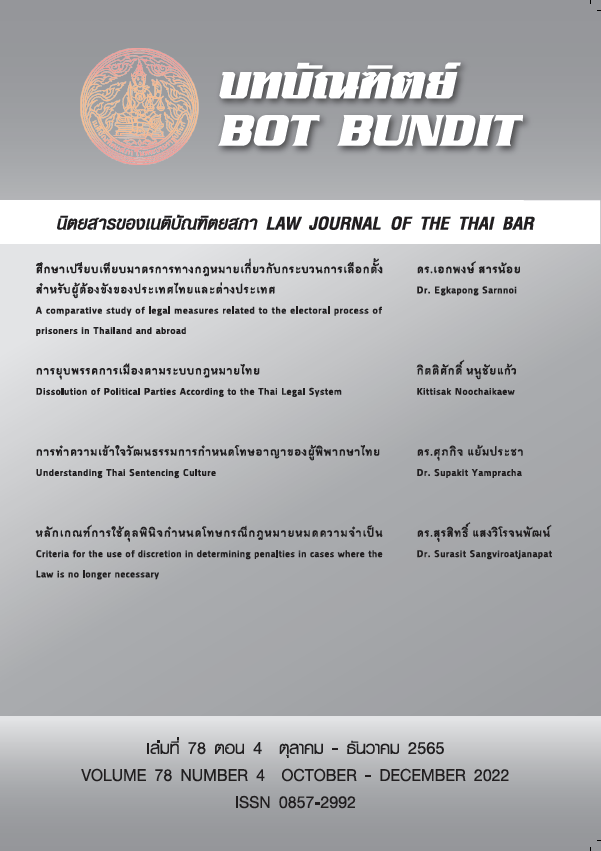
Criteria for the use of discretion in determining penalties in cases where the Law is no longer necessary
Article Sidebar
Main Article Content
Abstract
The discretion of the Court of Justice in the event that the law is no longer needed, inconsistent with the present context, or hinders the livelihood or occupation, according to the Act on Legislative Drafting and Evaluation of Law B.E. 2562 Section 6, which states that the court can exercise its discretion not to punish or lessen penalties than those required by law or determine the consequent force conditions that are different from those prescribed by the law. From the results of the study, it was concluded that the idea of protecting legal interests as a last resort, the concept that the criminal penalty must be proportional to the offense which is the concept of finding the criteria for determining crimes, the principles that the use of discretion in determining the punishment is in accordance with the seriousness of the offense and the culpability of the offender, as well as the theory of preventive unification could be adopted as guidelines for discretionary punishment. For such reason, if the court exercises its discretion not to punish as the law is no longer necessary, that is because it contradicts to the principle of proportionality in a narrow sense which is part of the concept of protecting legal interests as a last resort. As for the use of discretion in lessening penalties than those required by law or setting consequent forceful conditions that are different than those required by law, it applies when the law is no longer necessary in minor cases or even in non-minor cases where alternative measures other than criminal measures can yield similar results, which is the concept of the concept of protecting legal interests as a last resort. In addition, this also applies to cases where criminal penalties are disproportionate to offences, which is in line with the concept of criminal punishment must be proportional to the offense. It also includes offenses are that punishable by fine only under the Fine-Only Offence Act, B.E. 2022.
Article Details

This work is licensed under a Creative Commons Attribution-NonCommercial-NoDerivatives 4.0 International License.
References
ภาษาไทย
เชลียง เทียมสนิท, ‘ปัญหาและอุปสรรคทางกฎหมายในการบังคับใช้พระราชบัญญัติภาพยนตร์และวีดิทัศน์ พ.ศ. 2551’ (ธันวาคม 2559 - มีนาคม 2560) 2 วารสารบัณฑิตศึกษา มหาวิทยาลัยธุรกิจบัณฑิตย์ 158.
ณัฐพล จุลละเกศ, ‘การใช้ดุลพินิจรับพิจารณาพิพากษาความผิดที่มีโทษทางอาญาบางบทหรือบางกรรมที่ไม่อยู่ในอำนาจของศาลทรัพย์สินทางปัญญาและการค้าระหว่างประเทศ’ (รายงานส่วนบุคคลหลักสูตรผู้พิพากษาผู้บริหารในศาลชั้นต้น สถาบันพัฒนาข้าราชการฝ่ายตุลาการศาลยุติธรรม 2563) <https://ipitc.coj.go.th/th/file/get/file/202005140cff61bc91c05e17d55e1778b0cedab1111834.pdf> สืบค้นเมื่อ 13 สิงหาคม 2565.
ณรงค์ ใจหาญ และคณะ, ‘การจัดแบ่งกลุ่มความผิดและโทษทางอาญาตามประมวลกฎหมายอาญาของไทย’ (รายงานวิจัยฉบับสมบูรณ์ สำนักกิจการยุติธรรม กระทรวงยุติธรรม 2554).
ดล บุนนาค, ‘ทางเลือกในการลงโทษจำเลยในคดีอาญา : มาตการลงโทษระดับกลาง’ (2556) 1 ดุลพาห 148.
ปกป้อง ศรีสนิท, กฎหมายอาญาชั้นสูง (พิมพ์ครั้งที่ 2, วิญญูชน 2561).
ประสพสุข บุญเดช, ‘ดุลพินิจในการกำหนดโทษ’ (2540) 2 ดุลพาห 161.
สภานิติบัญญัติแห่งชาติ, รายงานการประชุมคณะกรรมาธิการวิสามัญพิจารณาร่างพระราชบัญญัติหลักเกณฑ์การจัดทำร่างกฎหมายและการประเมินผลสัมฤทธิ์ของกฎหมาย พ.ศ... ครั้งที่ 9/2562 (21 มกราคม 2562).
สภานิติบัญญัติแห่งชาติ, รายงานการประชุมคณะกรรมาธิการวิสามัญพิจารณาร่างพระราชบัญญัติหลักเกณฑ์การจัดทำร่างกฎหมายและการประเมินผลสัมฤทธิ์ของกฎหมาย พ.ศ... ครั้งที่ 11/2562 (31 มกราคม 2562) ครั้งที่ 10/2562 (28 มกราคม 2562).
วัชรี วรรณลี, ‘ปัญหาการใช้โทษอาญาโดยไม่จำเป็น : กรณีการล่วงสิทธิในเครื่องหมายการค้า’ (2564) 1 บทบัณฑิตย์ 95.
ศุภกิจ แย้มประชา, ‘การลงโทษผู้กระทำความผิดเกี่ยวกับยาเสพติดให้ได้สัดส่วนกับความร้ายแรงของความผิด’ (2564) 3 ดุลพาห 1.
สุรศักดิ์ ลิขสิทธิ์วัฒนกุล และปกป้อง ศรีสนิท, ‘การศึกษาเพื่อพัฒนาแนวทางการลงโทษ : หลักการลงโทษที่ได้สัดส่วนกรณีคดียาเสพติดให้โทษ’ (2560) 4 วารสารนิติศาสตร์ 903.
สุรสิทธิ์ แสงวิโรจนพัฒน์, ‘พระราชบัญญัติหลักเกณฑ์การจัดทำร่างกฎหมายและการประเมินผลสัมฤทธิ์ของกฎหมาย พ.ศ. 2562 : ศึกษากรณีบทบัญญัติของกฎหมายหมดความจำเป็นในส่วนที่เกี่ยวข้องกับการพิจารณาพิพากษาคดีของศาลยุติธรรม’ (รายงานวิจัยฉบับสมบูรณ์ สำนักงานศาลยุติธรรม 2564).
-- ‘หลักเกณฑ์การกำหนดความผิดอาญาตามกฎหมายต่างประเทศ’ (2564) 2 บทบัณฑิตย์ 127.
-- ‘การตีความกฎหมายที่สอดคล้องกับรัฐธรรมนูญตามกฎหมายเยอรมัน’ (2565) 1 บทบัณฑิตย์ 150.
-- ‘ความผิดอาญาเล็กน้อย’ (2565) 2 บทบัณฑิตย์ 110.
ภาษาต่างประเทศ
Catherine Heard, Community sentences since 2000 : How they work – and why they have not cut prisoner numbers (Centre for Crime and Justice Studies 2015) 13–20 <https://www.crimeandjustice.org.uk/sites/crimeandjustice.org.uk/files/CCJS_ACE_Rep_Sept15_ONLINE%20FINAL3.pdf> สืบค้นเมื่อ 13 สิงหาคม 2565.
Claus Roxin, Strafrecht Allgemeiner Teil Grundlagen. Der Aufbau der Verbrechenslehre (4 Auflage, Verlag C.H. Beck 2006).
Franz Streng, Strafrechtliche Sanktionen : Die Strafzumessung und ihre Grundlagen (3 Auflage, Verlag W. Kohlhammer 2012).
Hans-Jörg Albrecht, ‘Sanction Policies and Alternative Measures to Incarceration : European Experiences with Intermediate and Alternative Criminal Penalties’ (Visiting Experts’ Papers of the UNAFEI’s 142nd International Training Course) <https://www.unafei.or.jp/publications/pdf/RS_No80/No80_07VE_Albrecht.pdf> สืบค้นเมื่อ 13 สิงหาคม 2565.
James M. Markham and Shea Riggsbee Denning, North Carolina Sentencing Handbook with Felony, Misdemeanor, and DWI Sentencing Grids (2018 edn, UNC School of Government 2018) <https://www.sog.unc.edu/sites/default/files/course_materials/Sentencing%20Handbook.pdf> สืบค้นเมื่อ 13 สิงหาคม 2565.
Joel Goh, ‘Porportionality – An Unattainable Ideal in the Criminal Justice System Manchester’ (2013) 41 Student Law Review 41.
Mirko Bagaric, ‘The Punishment Should Fit the Crime’ (2014) 2 San Diego Law Review 343.
Richard G Fox, ‘The Meaning of Proportionalityin Sentencing’ (1994) 3 Melbourne University Law Review 489.
The Sentencing Council of England and Wales, ‘Aggravating and mitigating factors’ (sentencingcouncil, no publication date) <https://www.sentencingcouncil.org.uk/explanatory-material/magistrates-court/item/aggravating-and-mitigating-factors/> สืบค้นเมื่อ 13 สิงหาคม 2565.
Silvia D’Ascoli, Sentencing in International Criminal Law : The approach of the two UN ad hoc Tribunals and future perspectives for the International Criminal Court (European University Institute 2008).
The United Nations Standard Minimum Rules for Non-custodial Measures (The Tokyo Rules).
