
Problem-Based Learning Integrated With Design Thinking Process to Enhance Creative Thinking Skills in Digital Photography for Educational Communications
Keywords:
problem-based learning, design thinking, creative thinking skills, digital photographyAbstract
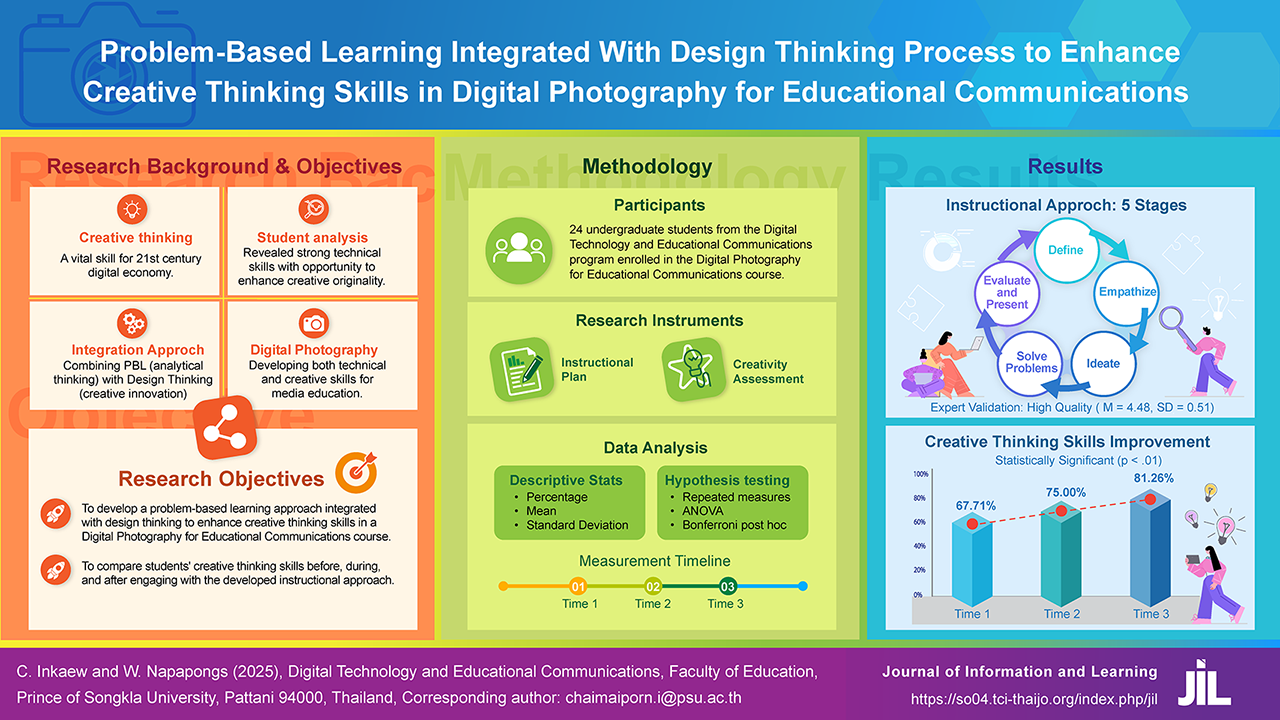
This study aimed 1) to develop a problem-based learning approach integrated with design thinking to enhance creative thinking skills in a Digital Photography for Educational Communications course, and 2) to compare students' creative thinking skills before, during, and after engaging with the developed instructional approach. Twenty-four undergraduate students from the Digital Technology and Educational Communications program enrolled in the Digital Photography for Educational Communications course participated. Research instruments included an instructional plan and a creativity assessment tool. Data were analyzed using descriptive statistics including percentage, mean, and standard deviation, and hypothesis testing was conducted using repeated measures ANOVA with Bonferroni post hoc testing. Results revealed that the instructional approach consisted of five stages: Define, Empathize, Ideate, Solve Problems, and Evaluate and Present. Expert evaluation confirmed the model's high quality (M = 4.48, SD = 0.51), validating the research hypothesis. Creativity assessments showed statistically significant improvements (p < .01), with mean scores progressively increasing from 67.71% to 75.00% and ultimately to 81.26%. These findings fulfill both research objectives, demonstrating that the developed approach effectively promotes continuous creative development in digital photography education.
References
Acharya, S., Bhatt, A. N., & Chakrabarti, A. (2023). Problem based learning through design thinking to strengthen education in South Asia [Conference presentation]. International Conference on Engineering and Product Design Education (E&PDE 2023), India. https://doi.org/10.35199/EPDE.2023.85
Ali, S. S. (2019). Problem based learning: A student-centered approach. English Language Teaching, 12(5), 73–78. https://doi.org/10.5539/elt.v12n5p73
American Association of School Librarians. (2024). Developing creative collaborators, flexible partners, and resilient citizens activity guide. https://eric.ed.gov/?id=ED655321
Balakrishnan, B. (2022). Exploring the impact of design thinking tool among design undergraduates: A study on creative skills and motivation to think creatively. International Journal of Technology and Design Education, 32(3), 1799–1812. https://doi.org/10.1007/s10798-021-09652-y
Brown, T. (2009). Change by design: How design thinking transforms organizations and inspires innovation. HarperBusiness.
Campbell, D. T., & Stanley, J. C. (2015). Experimental and quasi-experimental designs for research. Ravenio Books.
Chen, D., Lu, J., & Okawa, K. (2023). ICT-supported design thinking workshop program: A case study of encouraging social lean-in for high school students in Japan. 15th International Conference on Computer Supported Education - Volume 2: CSEDU (pp. 527–534), Prague, Czech Republic. https://doi.org/10.5220/0011969300003470
Clarke, R. I., Amonkar, S., & Rosenblad, A. (2020). Design thinking and methods in library practice and graduate library education. Journal of Librarianship and Information Science, 52(3), 749–763. https://doi.org/10.1177/0961000619871989
Ernawati, M. D. W., Rusdi, M., Asrial, A., Muhaimin, M., Wulandari, M., & Maryani, S. (2022). Analysis of problem based learning in the scaffolding design: Students' creative-thinking skills. Cypriot Journal of Educational Sciences, 17(7), 2333–2348. https://doi.org/10.18844/cjes.v17i7.7551
Guilford, J. P. (1967). The nature of human intelligence. McGraw-Hill. https://doi.org/10.1002/j.2162-6057.1967.tb00002.x
Haekawee, P., & Katwibun, D. (2020). 9th grade students' creative thinking and mathematics achievement in a mathematics problem-based learning classroom. Silpakorn Educational Research Journal, 12(2), 426–441. https://so05.tci-thaijo.org/index.php/suedureasearchjournal/article/view/244737
Hasso Plattner Institute of Design at Stanford. (2010). Design thinking bootleg. https://dschool.sfo3.digitaloceanspaces.com/documents/dschool_bootleg_deck_2018_final_sm2-6.pdf
Henriksen, D., Richardson, C., & Mehta, R. (2017). Design thinking: A creative approach to educational problems of practice. Thinking Skills and Creativity, 26, 140–153. https://doi.org/10.1016/j.tsc.2017.10.001
Khammanee, T. (2018). Sāt kānsō̜n: ʻOngkhwāmrū phư̄a kānčhat krabūankān rīanrū thī mī prasitthiphāp (22nd ed.) [Teaching science: Knowledge for organizing effective learning processes]. Chulalongkorn University.
Long, C., Sam, R., Ny, C., Chhang, C., Ren, R., Ngork, C., Sorn, R., Sorn, M., & Sor, C. (2024). The impact of assessment for 21st century skills in higher education institutions: A narrative literature review. International Journal of Advance Social Sciences and Education (IJASSE), 2(1), 19–42. https://penerbitjurnalinternasional.com/index.php/ijasse/article/view/503
Mahadi, I., & Ariska, D. (2022). The effect of e-learning based on the problem-based learning model on students' creative thinking skills during the COVID-19 pandemic. International Journal of Instruction, 15(2), 329-348. https://e-iji.net/ats/index.php/pub/article/view/387
Maneeratana, K., Chancharoen, R., Thongnuek, P., Sukmuen, P., Inkaew, C., & Suwannatthachote, P. (2019, December). A reflection on teaching design thinking to first-year engineering students [Conference presentation]. IEEE International Conference on Engineering, Technology and Education (TALE), Yogyakarta, Indonesia. https://doi.org/10.1109/TALE48000.2019.9225890
McCarthy, S. (2020). Design at Stanford: The d.school's daddy. In Research & education in design: People & processes & products & philosophy (pp. 207–210). CRC Press.
Ministry of Higher Education, Science, Research and Innovation. (2019). Nayōbāi læ yutthasāt kān ʻudomsưksā witthayāsāt wičhai læ nawak tok ra rom B.E. 2563-2570 læ phǣn dān witthayāsāt wičhai læ nawattakam B.E. 2563-2565 [Higher education, science, research and innovation policy and strategy 2020-2027 and science, research and innovation plan 2020-2022]. https://www.mhesi.go.th/index.php/stg-policy/930-2563-2570.html
Nordin, N. S., Junaidi, J., & Abdul Hanid, M. F. (2024). Integrating problem-based learning and design thinking: Innovative approaches to enhancing student engagement. Journal of Research, Innovation, and Strategies for Education, 1(1), 41–57. https://rise.teknologi.edu.my/index.php/journal/article/view/4
Office of the Education Council. (2007). Kānčhatkān rīanrū bǣp chai panhā pen thān [Problem-based learning]. http://thesis.swu.ac.th/swuebook/h234917v3.pdf
Office of the Education Council. (2017). Phǣnkān sưksā hǣng chāt B.E. 2560-2579 [National education plan 2017-2036]. https://backoffice.onec.go.th/uploads/Book/1540-file.pdf
Pusca, D., & Northwood, D. O. (2018). Design thinking and its application to problem solving. Global Journal of Engineering Education, 20(1), 48–53. http://www.wiete.com.au/journals/GJEE/Publish/vol20no1/06-Pusca-D.pdf
Savery, J. R. (2015). Overview of problem-based learning: Definitions and distinctions. In A. Walker, H. Leary, C. Hmelo-Silver, & P. A. Ertmer (Eds.), Essential readings in problem-based learning: Exploring and extending the legacy of Howard S. Barrows (pp. 5–15). Purdue University Press.
Tan, O. S. (2021). Problem-based learning innovation: Using problems to power learning in the 21st century. Gale Cengage Learning.
Ulger, K. (2018). The effect of problem-based learning on the creative thinking and critical thinking disposition of students in visual arts education. Interdisciplinary Journal of Problem-Based Learning, 12(1), 1–21. https://doi.org/10.7771/1541-5015.1649
World Economic Forum. (2020). The future of jobs report 2020. https://www.weforum.org/reports/the-future-of-jobs-report-2020/
World Economic Forum. (2023). Future of jobs report 2023. https://www3.weforum.org/docs/WEF_Future_of_Jobs_2023.pdf
Yunita, Y., Juandi, D., Tamur, M., Adem, A. M. G., & Pereira, J. (2020). A meta-analysis of the effects of problem-based learning on students' creative thinking in mathematics. Beta: Jurnal Tadris Matematika, 13(2), 104–116. https://doi.org/10.20414/betajtm.v13i2.380
Downloads
Additional Files
Published
How to Cite
Issue
Section
Categories
License
Copyright (c) 2025 Journal of Information and Learning [JIL]

This work is licensed under a Creative Commons Attribution-NonCommercial-NoDerivatives 4.0 International License.
Free access to published articles. Current licensing policy: CC BY-NC 4.0 from Volume 37, Issue 2 (2026). For earlier articles, consult the rights information on the individual article page. See our Open Access, Copyright and Licensing policy.


