
Development of an Intelligent Tutoring System for SQL SELECT Statement Practice: A Case Study of Buriram Rajabhat University
Keywords:
intelligent tutoring system, structured query language, SELECT statement, personalize learningAbstract
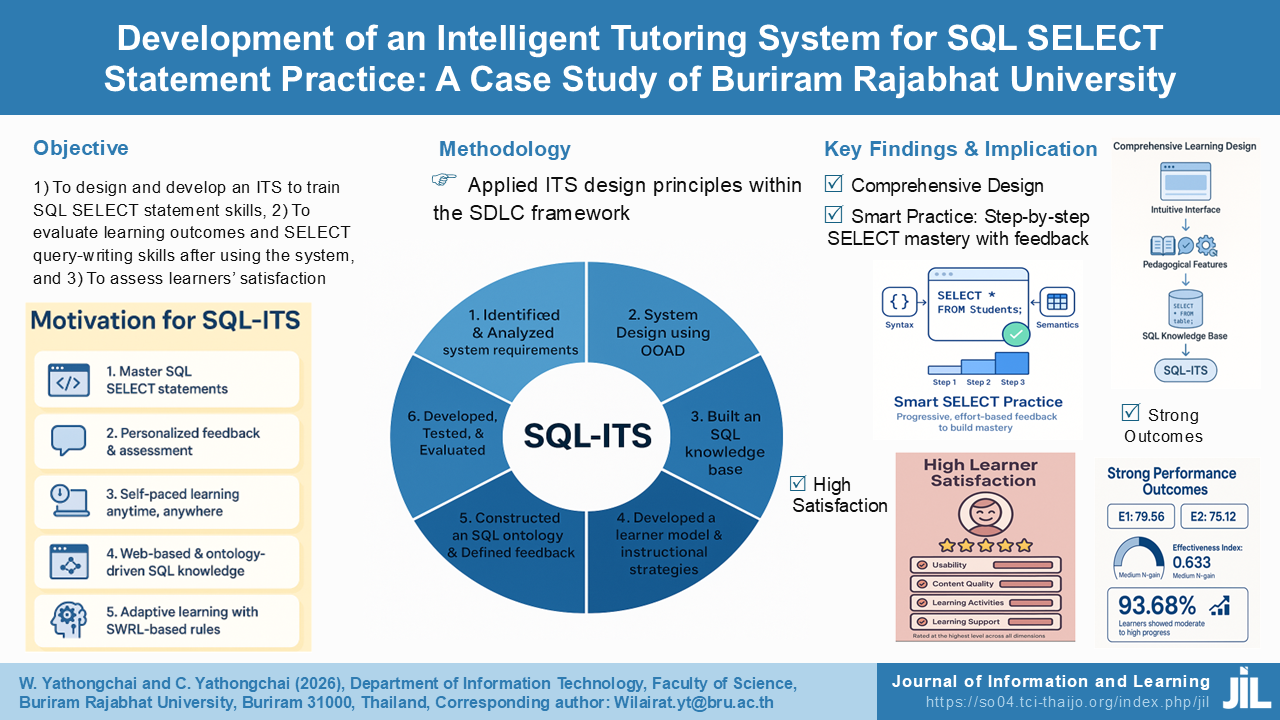
This research aims to: 1) design and develop an intelligent tutoring system (ITS) for the learners to practice SQL SELECT statement skills, 2) evaluate learning outcomes and SELECT query-writing skills after using the system, and 3) assess learners’ satisfaction. The study integrated ITS design principles with the system development life cycle (SDLC). The participants were 95 undergraduate students of information technology program at Buriram Rajabhat University, selected via cluster sampling. The proposed ITS comprises four modules—User Interface, Pedagogical, SQL Knowledge Base, and Learner—leveraging an ontology with rule-based inference to select appropriate resources/practice tasks, and deliver personalized feedback. The system consists of two major functions: (a) a SELECT practice component that validates both syntax and semantics and provides progressive, effort-contingent feedback; and (b) contents for the SELECT statement. Evaluation results showed process/product efficiency scores of E1/E2 = 79.56/75.12 (exceeding the 75/75 criterion) and an effectiveness index of 0.633, corresponding to a medium N-gain with 93.68% of learners demonstrating medium to high progress. Log analysis indicated purposeful trial-and-error behavior; however, while success rates decreased because of task difficulty, learner engagement persisted due to the specific, timely, and incremental feedback. Learner satisfaction reached the highest level across four areas: usability, content, learning activities, and learning support. This reflects that the system is effective and efficient, and can be used to develop skills and promote learning for students.
References
Abu Ghali, M., Abu Ayyad, A. A., Abu-Naser, S. S., & Abu Laban, M. (2018). An intelligent tutoring system for teaching English grammar. International Journal of Academic Engineering Research, 2(2), 1–6. http://ijeais.org/wp-content/uploads/2018/2/IJAER180201.pdf
Ahn, J., Chang, M., Watson, P., Tejwani, R., Sundararajan, S., Abuelsaad, T., & Prabhu, S. (2018). Adaptive visual dialog for intelligent tutoring systems. In Penstein Rosé, C., et al. Artificial Intelligence in Education. AIED 2018. Lecture Notes in Computer Science, 10948. Springer, Cham. https://doi.org/10.1007/978-3-319-93846-2_77
Alrakhawi, H. A., Jamiat, N., & Abu-Naser, S. S. (2023). Intelligent tutoring systems in education: A systematic review of usage, tools, effects and evaluation. Journal of Theoretical and Applied Information Technology, 101(4), 1205–1226. https://www.jatit.org/volumes/Vol101No4/6Vol101No4.pdf
Burhan, M. I., Sediyono, E., & Adi, K. (2021). Intelligent tutoring system using Bayesian Network for vocational high schools in Indonesia. E3S Web of Conferences, 317, Article 05027. https://doi.org/10.1051/e3sconf/202131705027
Cao, J., Yang, T., Lai, I.K-W., & Wu, J., (2021). RETRACTED: Student acceptance of intelligent tutoring systems during COVID-19: The effect of political influence. International Journal of Electrical Engineering & Education, 60(1_suppl), 2495–2509. https://doi.org/10.1177/00207209211003270
Dahbi, M., (2023). Integrating an intelligent language tutoring system in teaching english grammar. Arab World English Journal, 14(4), 189–196. https://ssrn.com/abstract=4677399
Date, C. J. (2015). SQL and relational theory: How to write accurate SQL code (3rd edition). O'Reilly. https://www.oreilly.com/library/view/sql-and-relational/9781491941164
del Olmo-Muñoz, J., González-Calero, J. A., Diago, P. D., Arnau, D., & Arevalillo-Herráez, M. (2023). Intelligent tutoring systems for word problem solving in COVID-19 days: Could they have been (part of) the solution? ZDM–Mathematics Education, 55, 35–48. https://doi.org/10.1007/s11858-022-01396-w
Fodouop Kouam, A. W. (2024). The effectiveness of intelligent tutoring systems in supporting students with varying levels of programming experience. Discover Education, 3(278). https://doi.org/10.1007/s44217-024-00385-3
Hake, R. R. (1998). Interactive-engagement versus traditional methods: A six-thousand-student survey of mechanics test data for Introductory physics courses. American Journal of Physics, 66(1), 64–74. http://dx.doi.org/10.1119/1.18809
Hare, R., & Tang, Y. (2024). Ontology-driven reinforcement learning for personalized student support [Conference presentation]. IEEE International Conference on Systems, Man, and Cybernetics (SMC), Kuching, Malaysia. https://ieeexplore.ieee.org/document/10832036
Kochmar, E., Vu, D. D., Belfer, R., Gupta, V., Serban, I. V., & Pineau, J. (2022). Automated data-driven generation of personalized pedagogical interventions in intelligent tutoring systems. International Journal of Artificial Intelligence in Education, 32(2), 323–349. https://doi.org/10.1007/s40593-021-00267-x
Kumar, A., & Ahuja, N.J. (2020). An adaptive framework of learner model using learner characteristics for intelligent tutoring systems. In S., Choudhury, R., Mishra, R. Mishra, & A. Kumar (Eds), Intelligent Communication, Control and Devices. Advances in Intelligent Systems and Computing, 989, 425–433. Springer, Singapore. https://doi.org/10.1007/978-981-13-8618-3_45
Kumar, A. N., Raj, R. K., Aly, S. G., Anderson, M. D., Becker, B. A., Blumenthal, R. L., Eaton, E., Epstein, S. L., Goldweber, M., Jalote, P., Lea, D., Oudshoorn, M., Pias, M., Reiser, S., Servin, C., Simha, R., Winters, T., & Xiang, Q. (2023). Computer science curricula 2023. ACM Press, IEEE Computer Society Press and AAAI Press. https://doi.org/10.1145/3664191
Lai, C.-H., & Lin, C.-Y. (2025). Analysis of learning behaviors and outcomes for students with different knowledge levels: A case study of intelligent tutoring system for coding and learning (ITS-CAL). Applied Sciences, 15(4), Article 1922. https://doi.org/10.3390/app15041922
Lavbič, D., Matek, T., & Zrnec, A. (2016). Recommender system for learning SQL using hints. Interactive Learning Environments, 25(8), 1048–1064. https://doi.org/10.1080/10494820.2016.1244084
Matek, T., Zrnec, A., & Lavbič, D. (2017). Learning SQL with artificial intelligent aided approach. International Journal of Information and Education Technology, 7(11), 803–808. https://doi.org/10.18178/ijiet.2017.7.11.976
Narciss, S. (2008). Feedback strategies for interactive learning tasks. In D. Jonassen, M. J. Spector, M. Driscoll, M. D. Merrill, J. van Merrienboer, & M. P. Driscoll (Eds.), Handbook of research on educational communications and technology (3rd ed., pp. 125–144). Routledge. https://www.taylorfrancis.com/chapters/edit/10.4324/9780203880869-13/feedback-strategies-interactive-learning-tasks-susanne-narciss
Na Nongkhai, L., Wang, J., & Mendori, T. (2025). Development and evaluation of adaptive learning support system based on ontology of multiple programming languages. Education Sciences, 15(6), Article 724. https://doi.org/10.3390/educsci15060724
Noy, N. F., & McGuinness, D. L. (2001). Ontology development 101: A guide to creating your first ontology. Standford University. https://protege.stanford.edu/publications/ontology_development/ontology101.pdf
Office of National Higher Education Science Research and Innovation Policy Council. (2021, December 9). Kan songsoem kanrianru talot chiwit (Lifelong learning) phua rong rap kan phlik chom chapphlan lae wikrittakan lok [Promoting lifelong learning to support sudden changes and global crises]. NXPO. https://www.nxpo.or.th/th/report/9519
Okechi, K. L. Francine, N., & Etikan, I. (2024) A comprehensive analysis of cluster sampling versus multi-stage sampling techniques: methodologies, applications, and comparative insights. Pioneer Journal of Biostatistics and Medical Research, 2(1), 21–30. https://www.pjbmr.com/index.php/pjbmr/article/view/52
Sabin, M., Alrumaih, H., Impagliazzo, J., Lunt, B., Zhang, M., Byers, B., Newhouse, W., Paterson, B., Peltsverger, S., Tang, C., van der Veer, G., & Viola, B. (2017). Curriculum guidelines for baccalaureate degree programs in information technology (IT2017). ACM. https://www.acm.org/binaries/content/assets/education/curricula-recommendations/it2017.pdf
Schez-Sobrino, S., Gómez-Portes, C., Vallejo, D., Glez-Morcillo, C., & Redondo, M. A. (2020). An intelligent tutoring system to facilitate the learning of programming through the usage of dynamic graphic visualizations. Applied Sciences, 10(4), Article 1518. https://doi.org/10.3390/app10041518
Sharma, P., & Harkishan, M. (2022). Designing an intelligent tutoring system for computer programing in the Pacific. Education and Information Technologies, 27, 6197–6209. https://doi.org/10.1007/s10639-021-10882-9
Shute, V. J. (2008). Focus on formative feedback. Review of Educational Research, 78(1), 153–189. https://doi.org/10.3102/0034654307313795
Son, T. (2024). Intelligent tutoring systems in mathematics education: A systematic literature review using the substitution, augmentation, modification, redefinition model. Computers, 13(10), Article 270. https://doi.org/10.3390/computers13100270
Spitzer, M. W. H., & Moeller, K. (2023). Performance increases in mathematics during COVID-19 pandemic distance learning in Austria: Evidence from an intelligent tutoring system for mathematics. Trends in Neuroscience and Education, 31, Article 100203. https://doi.org/10.1016/j.tine.2023.100203
Venkatesh, V., & Davis, F. D. (2000). A theoretical extension of the technology acceptance model: Four longitudinal field studies. Management Science, 46(2), 186–204. https://doi.org/10.1287/mnsc.46.2.186.11926
Wang, M., Sibia, N., Dema, I., Liut, M. & Suárez, C. A. (2021). Building a better SQL automarker for database courses [Conference presentation]. 21st Koli Calling International Conference on Computing Education Research. https://doi.org/10.1145/3488042.3489970
Weston, M., Sun, H., Herman, G. L., Benotman, H. & Alawini, A. (2021). Echelon: An AI tool for clustering student-written SQL queries [Conference presentation]. IEEE Frontiers in Education Conference, Lincoln, NE, USA,. https://doi.org/10.1109/fie49875.2021.9637203
Yang, S., Wei, Z., Herman, G. L. & Alawini, A. (2021). Analyzing patterns in student SQL solutions via levenshtein edit distance [Conference presentation]. Proceedings of the Eighth ACM Conference on Learning, Virtual Event, Germany. https://doi.org/10.1145/3430895.3460979
Yathongchai, C., Angsakun, T., & Angsakun, J. (2018). A design of a feedback model based on student metacognition in learning Structured Query Language. Journal of Research Unit on Science, Technology and Environment for Learning, 9(1), 46–59. https://ejournals.swu.ac.th/index.php/JSTEL/article/view/10254
Yathongchai, W., Angskun, J., & FUNG C. C. (2017). An ontology model for developing a SQL personalized intelligent tutoring system. Naresuan University Journal: Science and Technology, 25(4), 88–96. https://ph03.tci-thaijo.org/index.php/ahstr/article/view/1679
Zhang, J., Nie, K., & Li, H. (2023). Based on ontology construction for personalized learning resource recommendation research [Conference presentation]. Proceedings of the 3rd International Conference on Internet Technology and Educational Informatization, Zhengzhou, China. https://doi.org/10.4108/eai.24-11-2023.2343624
Downloads
Additional Files
Published
How to Cite
Issue
Section
Categories
License
Copyright (c) 2026 Journal of Information and Learning

This work is licensed under a Creative Commons Attribution-NonCommercial-NoDerivatives 4.0 International License.
The Journal of Information and Learning is operated by the Office of Academic Resources, Prince of Songkla University. All articles published in the journal are protected by Thailand copyright law. This copyright covers the exclusive rights to share, reproduce and distribute the article, including in electronic forms, reprints, translations, photographic reproductions, or similar. Authors own copyrights in the works they have created as well as the Office of Academic Resources. The Journal reserves the right to edit the language of papers accepted for publication for clarity and correctness, as well as to make formal changes to ensure compliance with the journal's guidelines. All authors must take public responsibility for the content of their paper.


