
The Development of an AI-Driven Personalized Project-Based Learning Model to Strengthen Programmers’ Competencies in Higher Education
Keywords:
project-based learning, AI agent, programming competenciesAbstract
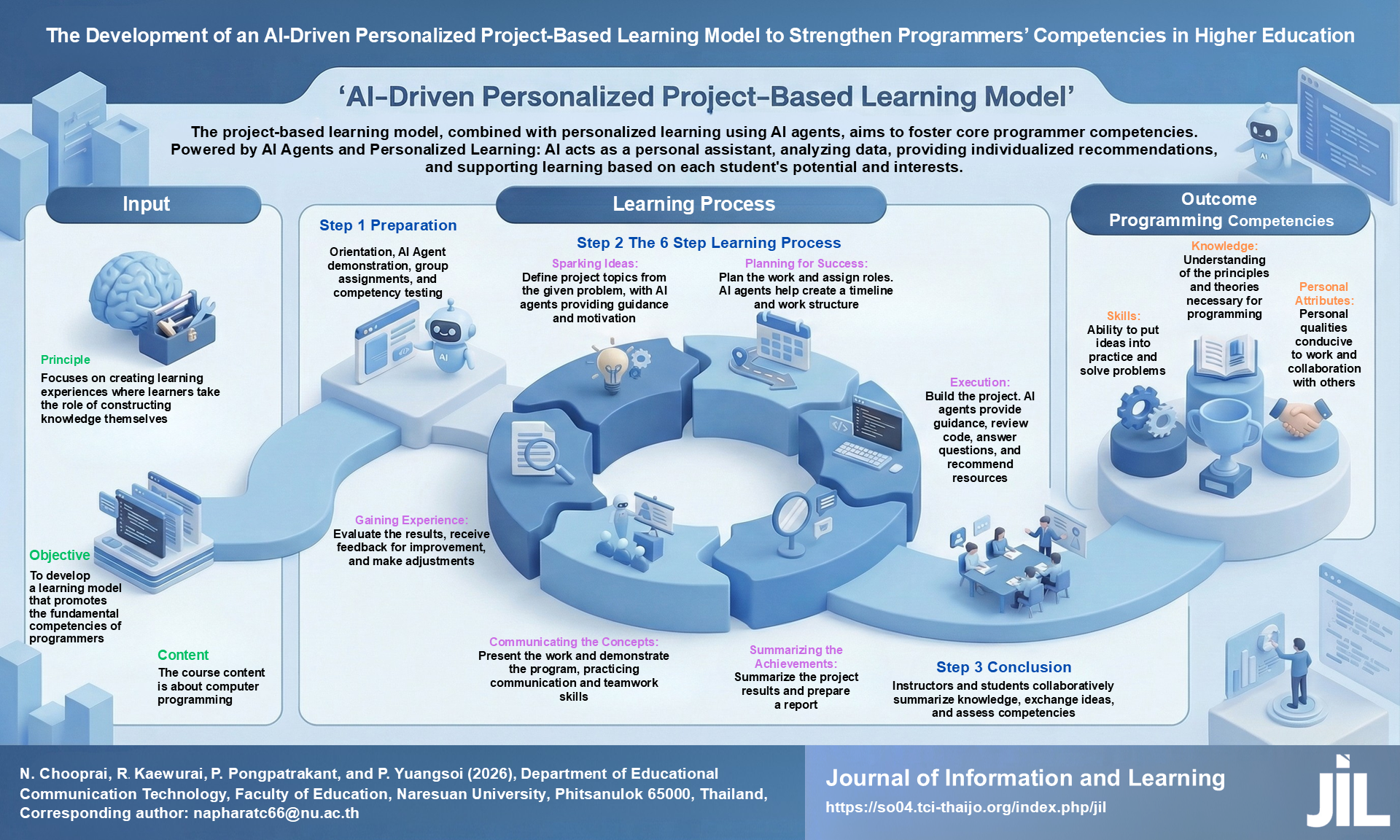
The role of technology in the digital era extends to economic and social development, including developing various capabilities for students' education. In technology fields, programming competence is considered a fundamental and essential skill for graduate studies, therefore, it is promoted in higher education curricula. This research study aims to synthesize and evaluate a conceptual framework of a learning model that integrates project-based learning (PBL) with personalized learning driven by artificial intelligence agents, to enhance programmers’ basic competencies in higher education. The research methodology involved developing a learning model through a study of concepts and theories, drafting a detailed model, conducting focus group discussions to refine the draft, and evaluating the model's suitability with experts. A group of nine experts participating in the evaluation. The research instruments included learning model that integrates Project-Based Learning with personalized learning driven by artificial intelligence agents, to enhance the basic competencies of programmers in higher education, in-dept higher education, in-depth interviews and group discussions, Data were analyzed using basic statistical methods, specifically mean and standard deviation. The results indicated that the developed model consisted of three main components: 1) input factors encompassing core principles, objectives, and content; 2) learning process featuring a six-step framework (1) conceptual sparking, (2) strategic planning, (3) implementation, (4) success summarizing, (5) idea dissemination, and (6) experiential reflection and summarization; 3) Assessment and evaluation of programmers’ competencies before and after the learning. The evaluation of the model’s appropriateness was at the highest level (M = 4.70, SD = 0.50) indicating that the model is highly suitable and can be applied as a prototype for actual instructional practices.
References
Almulla, M. A. (2020). The effectiveness of the project-based learning (PBL) approach as a way to engage students in learning. SAGE Open, 10(3), 1–15. https://doi.org/10.1177/2158244020938702
Belmekki, M. (2024). Project-based learning implementation in higher education: Theoretical and practical issues. The Journal of Quality in Education, 14(24), 94–104. https://doi.org/10.37870/joqie.v14i24.383
Bharti, M. (2025). Ai agents: A systematic review of architectures, components, and evolutionary trajectories in autonomous digital systems. International Journal of Computer Engineering and Technology, 15(6), 809–820. https://doi.org/10.34218/IJCET_16_01_065
Bryndin, E. (2020). Development of artificial intelligence by ensembles of virtual agents with mobile interaction. Automation, Control and Intelligent Systems, 8(1), 1–8. https://doi.org/10.11648/j.acis.20200801.11
Chudleigh, S. (2024), What is an AI agent?. Botpress. https://botpress.com/blog/what-is-an-ai-agent
Daosri, T., Thipkonglad, P., Khemphong, P., Dubsork, S., Pengpis, S., Wisarutphaisan, W., & Phutiariyawat, J. (2021). The study of the learning management approach of school in the 21st century. Journal of Humanities and Social Sciences, Nakhon Pathom Rajabhat University, 11(1), 59–74. https://so07.tci-thaijo.org/index.php/HUSO-J/article/view/692
Digital Economy Promotion Agency. (2024, April 10). Phon samrūat ʻutsāha kan madi čhi than Thai pī sō̜ngphanhārō̜ihoksipsī phop phǣ lotfō̜m bō̜rikān di čhi than tō rǣng khāt pī sō̜ngphanhārō̜ihoksiphā talāt bō̜rikān di čhi than yai sǣng hātwǣ [Revealing the survey results of the Thai digital industry in 2021: Digital service platforms show strong growth, expected to surpass hardware in 2022]. depa. https://www.depa.or.th/th/article-view/20220926_02
Dumont, H., & Ready, D. D. (2023). On the promise of personalized learning for educational equity. npj Science of Learning, 8, Article 26. https://doi.org/10.1038/s41539-023-00174-x
Farhood, H., Nyden, M., Beheshti, A., & Muller, S. (2025). Artificial intelligence-based personalised learning in education: A systematic literature review. Discover Artificial Intelligence, 5. Article 331. https://doi.org/10.1007/s44163-025-00598-x
Fharaksa, N. (2024). Learning AI agent. Netnapis Fharaksa Publishing.
Fitra, R., Prasetya, F., & Adri, J. (2024). Exploration of the implementation of project-based learning in technical drawing courses toward. Journal of Engineering Researcher and Lecturer, 4(1), 46–55. https://doi.org/10.58712/jerel.v3i1.128
Fosnot, C. T., & Perry, R. S. (2005). Constructivism: A psychological theory of learning. In C. T. Fosnot (Ed.), Constructivism: Theory, perspectives, and practice (2nd ed., pp. 8-33). Teachers College Press.
Glazunova, O. H., Parkhomenko, O. V., Korolchuk, V. I., & Voloshyna, T. V. (2022). Building the professional competence of future programmers using methods and tools of flexible development of software applications. Information Technologies and Learning Tools, 89(3), 48–64. https://doi.org/10.33407/itlt.v89i3.4894
Guo, P., Saab, N., Post, L. S., & Admiraal, W. (2020). A review of project-based learning in higher education: Student outcomes and measures. International Journal of Educational Research, 102, Article 101586. https://doi.org/10.1016/j.ijer.2020.101586
Hedi, T., Nouzri, S., Mualla, Y., & Abbas-Turki, A. (2025). Artificial intelligence agents for personalized adaptive learning. Procedia Computer Science, 265, 252–259. https://doi.org/10.1016/j.procs.2025.07.179
Istrate, O. (2024). AI agents in education: An early systematic review of emerging roles, potential, and limitations. Revista de Pedagogie Digitală, 3(1), 24–30. https://www.researchgate.net/publication/387500666_AI_Agents_in_Education_An_Early_Systematic_Review_of_Emerging_Roles_Potential_and_Limitations
Istiyowati, L. S., Syahrial, Z., & Muslim, S. (2020). Programmer’s competencies between industry and education. Universal Journal of Educational Research, 8(9A), 10–15. https://doi.org/10.13189/ujer.2020.082002
Jiang, Y. H., Li, R., Zhou, Y., Qi, C., Hu, H., Wei, Y., Jiang, B., & Wu, Y. (2024). AI agent for education: Von Neumann multi-agent system framework. arXiv preprint. https://doi.org/10.48550/arXiv.2501.00083
Jitjuk, U., Simmathan, P., & Songsanit, S. (2020). Development of a project-based learning model on the website to enhance the basic competencies of programmers for undergraduate students. Journal of Education, Mahasarakham Rajabhat University, 17(1), 247–256. https://so06.tci-thaijo.org/index.php/edu-rmu/article/view/252068
Joyce, B. R., Weil, M., & Calhoun, E. (2015). Models ofteaching (9 ed.). Pearson.
Juneja, K. (2020). Design of programmer’s skill evaluation metrics for effective team selection. Wireless Personal Communications, 114(4), 3049–3080. https://doi.org/10.1007/s11277-020-07517-6
Katsenou, R., Kotsidis, K., Papadopoulou, A., Anastasiadis, P., & Deliyannis, I. (2025). Beyond assistance: Embracing AI as a collaborative co-agent in education. Education Sciences, 15(8), Article 1006. https://doi.org/10.3390/educsci15081006
Khetkhan, C., Boontongtherng, P., & Supakwarakul, C. (2024). The development of computer and information for careers subject learning activities using project-based learning for vocational certificate students. Academic Journal of Mahamakut Buddhist University Roi Et Campus, 13(1), 79–93. https://so01.tci-thaijo.org/index.php/AJMBU/article/view/275006
Lekhawattana, S., Pongsiri, W., & Pholsana, C. (2023). Personalized learning model in the 21st century after the COVID-19 pandemic. Ubon Ratchathani University Journal of Humanities and Social Sciences, 14(2), 315–338. https://so02.tci-thaijo.org/index.php/human_ubu/article/view/253025
Ministry of Education. (2017, June 20). Phǣnkān sưksā hǣng chāt B.E. 2560–2579 [National education plan A.C. 2017–2036. https://backoffice.onec.go.th/uploaded/Outstand/2017-EdPlan60-79.pdf
Ministry of Education. (2021, June 20). MOE digital transformation for education action plan 2020–2022. https://bict.moe.go.th/wp-content/uploads/2022/03/digital-63-65.pdf
Mursid, R., Saragih, A. H., & Hartono, R. (2022). The effect of the blended project-based learning model and creative thinking ability on engineering students’ learning outcomes. International Journal of Education in Mathematics, Science and Technology, 10(1), 218–235. https://doi.org/10.46328/ijemst.2244
Nuntasri, W., & Chaichomchuen, S. (2022). The development of project-based learning with positive thinking repository for improving growth mindset in a digital environment. Journal of Education, Prince of Songkla University, Pattani Campus, 33(1), 140–155. https://so02.tci-thaijo.org/index.php/edupsu/article/view/243650
Prakrongjai, P. (2020). Project-based learning management. Silpakorn University Journal, 40(1), 155–163. https://so05.tci-thaijo.org/index.php/sujthai/article/view/187294
Pongam, N. (2014, April 30). A development of competency programmer [Conference paper]. ACTIS 2014, Bangkok, Thailand. https://url.in.th/cvRYi
Puri, A. (2024). Skills mismatch in entry-level programmer positions: Employer expectations vs. observations in Lalitpur, Nepal. Journal of Education and Research, 14(1), 1–135. https://www.researchgate.net/publication/381359308_Skills_Mismatch_in_Entry-level_Programmer_Positions_Employer_Expectations_vs_Observations_in_Lalitpur_Nepal
Qiu, Y., Khan, M. H., Zhu, S., Chen, S., & Chan, C. (2024). Enhancing sustainability in academic guidance: Develop an AI-driven agent for Education 5.0. INTI Journal, 2024(40). http://eprints.intimal.edu.my/2010/3/ij2024_40r.pdf
Sajja, R., Sermet, Y., Cikmaz, M., Cwiertny, D., & Demir, I. (2024). Artificial intelligence-enabled intelligent assistant for personalized and adaptive learning in higher education. Information, 15(10), Article 596. https://doi.org/10.3390/info15100596
Samngamjan, N., Malangpoo, P., & Philuek, W. (2019). The study of problems in learning programming of computer and educational technology students, the Faculty of Education, Nakhon Sawan Rajabhat University [Paper presentation]. Proceedings of the 2nd National Conference on Undergraduate Student Research in Education, Nakhon Sawan, Thailand. https://www.researchgate.net/publication/371956169_The_Study_of_Problems_in_Learning_Programming_of_Computer_and_Educational_Technology_Students_the_Faculty_of_Education_Nakhon_Sawan_Rajabhat_University
Schmid, R., Pauli, C., Stebler, R., Reusser, K., & Petko, D. (2022). Implementation of technology-supported personalized learning—its impact on instructional quality. The Journal of Educational Research, 115(3), 187–198. https://doi.org/10.1080/00220671.2022.2089086
Shemshack, A., & Spector, J. M. (2020). A systematic literature review of personalized learning terms. Smart Learning Environments, 7(1), Article 33. https://doi.org/10.1186/s40561-020-00140-9
Siripipattanakul, S., Chaivisit, S., & Sriboonruang, P. (2024). ChatGPT: Intelligent chatbot technology for future learning. Chulalongkorn University Journal of Education, 52(2), 1–16. https://so02.tci-thaijo.org/index.php/EDUCU/article/view/261975
Thong-em, A. (2018). Project-based learning for developing learners in the 21st century. Walailak Journal of Education, 8(3), 185–199. https://so06.tci-thaijo.org/index.php/var/article/view/163191
Wongyai, W., & Patthaphon, M. (2018). Personalized learning. Charan Sanitwong Printing.
Yuangsoi, P. (2024). The development of blended learning using online learning with project-based learing to encourage team-work’ Undergraduate Students. Journal of Graduate Studies Valaya Alongkorn Rajabhat University, 18(2), 75–90. https://so02.tci-thaijo.org/index.php/JournalGradVRU/article/view/261675
Zhang, J., Zhang, L., Zhang, G., & Yu, Y. (2024). From theory to practice: Project-based learning in computer science education. Frontiers in Computing and Intelligent Systems, 8(1), 130–133. https://doi.org/10.54097/jv09dw34
Zhang, L., Basham, J. D., & Yang, S. (2020). Understanding the implementation of personalized learning: A research synthesis. Educational Research Review, 31, Article 100339. https://doi.org/10.1016/j.edurev.2020.100339
Downloads
Additional Files
Published
How to Cite
Issue
Section
Categories
License
Copyright (c) 2026 Journal of Information and Learning

This work is licensed under a Creative Commons Attribution-NonCommercial-NoDerivatives 4.0 International License.
The Journal of Information and Learning is operated by the Office of Academic Resources, Prince of Songkla University. All articles published in the journal are protected by Thailand copyright law. This copyright covers the exclusive rights to share, reproduce and distribute the article, including in electronic forms, reprints, translations, photographic reproductions, or similar. Authors own copyrights in the works they have created as well as the Office of Academic Resources. The Journal reserves the right to edit the language of papers accepted for publication for clarity and correctness, as well as to make formal changes to ensure compliance with the journal's guidelines. All authors must take public responsibility for the content of their paper.


