
Digital Learning Assistant Using Artificial Intelligence for Elderly Health Literacy: A Systematic Review
Keywords:
artificial intelligence, digital learning assistants, elderly, health literacy, systematic reviewAbstract
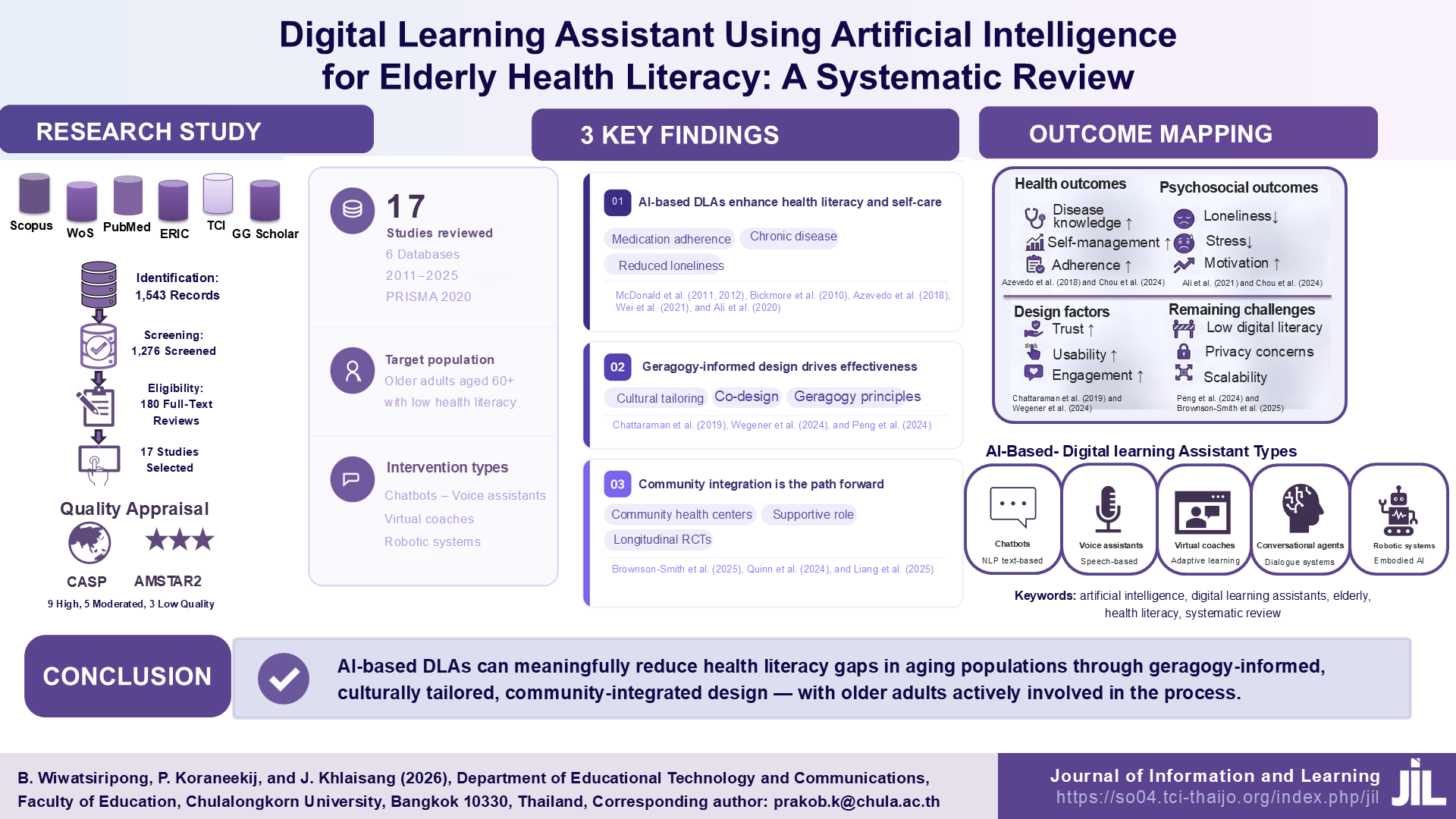
This review focuses on the use of digital learning assistants (DLAs) powered by Artificial Intelligence (AI) in supporting health literacy of older adults. The objectives of this review are to examine the characteristics of existing studies, identify the types of AI-based DLAs and design approaches employed, and synthesize reported outcomes related to health literacy and self-care among older adults. Following the PRISMA 2020 guidelines, 17 studies published between 2011 and 2025 were retrieved from six databases and reviewed. The interventions studied included chatbots, virtual coaches, conversational agents, voice assistants, and integrated systems. Overall, the tools enhanced functional health literacy, self-care, health provider communication, and psychosocial outcomes such as loneliness and stress relief. The most successful initiatives applied geragogy principles, culturally and linguistically tailored approaches, and co-design strategies to strengthen trust and enhance usability. Remaining challenges include low digital literacy levels in older adults, brief program length, scalability, and persistent ethical issues of privacy and misinformation. DLAs powered by AI can meaningfully contribute to diminishing health literacy gaps in the aging population. Integrating these tools with primary health care, community health centers, and educational programs for older adults is a practical suggestion. Future studies should focus on randomized controlled trials, longitudinal studies, cross-cultural research, and meaningful engagement of older adults in participatory design. The evidence presented showcases the potential of designed DLAs to promote equitable and informed aging.
References
Ali, R., Hoque, E., Duberstein, P. R., Schubert, L. K., Razavi, S. Z., Kane, B., Silva, C., Daks, J. S., Huang, M., & Van Orden, K. (2021). Aging and engaging: A pilot randomized controlled trial of an online conversational skills coach for older adults. The American Journal of Geriatric Psychiatry, 29(8), 804–815. https://doi.org/10.1016/j.jagp.2020.11.004
Azevedo, R. F. L., Morrow, D., Graumlich, J., Willemsen-Dunlap, A., Hasegawa-Johnson, M., Huang, T. S., Gu, K., Bhat, S., Sakakini, T., Sadauskas, V., & Halpin, D. J. (2018). Using conversational agents to explain medication instructions to older adults. AMIA Annual Symposium Proceedings, 2018, 185–194. https://pmc.ncbi.nlm.nih.gov/articles/PMC6371340
Bickmore, T., Schulman, D., & Yin, L. (2010). Maintaining engagement in long-term interventions with relational agents. Applied Artificial Intelligence, 24(6), 648–666. https://doi.org/10.1080/08839514.2010.492259
Bickmore, T. W., Silliman, R. A., Nelson, K., Cheng, D. M., Winter, M., Henault, L., & Paasche-Orlow, M. K. (2013). A randomized controlled trial of an automated exercise coach for older adults. Journal of the American Geriatrics Society, 61(10), 1676–1683. https://doi.org/10.1111/jgs.12449
Bickmore, T., Trinh, H., Asadi, R., & Olafsson, S. (2018). Safety first: Conversational agents for health care. In R. J. Moore, M. H. Szymanski, R. Arar, & G. J. Ren (Eds), Studies in conversational UX Design. Springer, Cham. https://doi.org/10.1007/978-3-319-95579-7_3
Bosco, C., Shojaei, F., Theisz, A. A., Osorio Torres, J., Cureton, B., Himes, A. K., Jessup, N. M., Barnes, P. A., Lu, Y., Hendrie, H. C., Hill, C. V., & Shih, P. C. (2024). Testing 3 modalities (voice assistant, chatbot, and mobile app) to assist older African American and Black adults in seeking information on Alzheimer disease and related dementias: Wizard of Oz usability study. JMIR Formative Research, 8, Article e60650. https://doi.org/10.2196/60650
Brownson-Smith, R., Ananthakrishnan, A., Hagen, O., Cong, C., Aly, A., Jones, R. B., & Meinert, E. (2025). Conversational systems for social care in older adults: Protocol for a scoping review. JMIR Research Protocols, 14(1), Article e72310. https://doi.org/10.2196/72310
Chattaraman, V., Kwon, W. S., Gilbert, J. E., & Ross, K. (2019). Should AI-based, conversational digital assistants employ social- or task-oriented interaction style? A task-competency and reciprocity perspective for older adults. Computers in Human Behavior, 90, 315–330. https://doi.org/10.1016/j.chb.2018.08.048
Chou, Y.-H., Lin, C., Lin, C., Lee, S. -H., Lee, Y. -F., & Cheng, L.-C. (2024). User-friendly chatbot to mitigate the psychological stress of older adults during the COVID-19 pandemic: Development and usability study. JMIR Formative Research, 8, Article e49462. https://doi.org/10.2196/49462
Jabjone, S., Lowanichchai, S., Puttasimma, T., & Jongmuanwai, B. (2020). Developing media of chatbot online learning for elderly. Journal of Technology Management, Rajabhat Maha Sarakham University, 7(2), 47–58. https://ph02.tci-thaijo.org/index.php/itm-journal/article/view/241426
Leung, A. Y. M., Cheung, M. K. T., Lou, V. W. Q., Chan, F. H. W., Ho, C. K. Y., Do, T. L., Chan, S. S. C., & Chi, I. (2013). Development and validation of the Chinese health literacy scale for chronic care. Journal of Health Communication, 18(sup1), 205–222. https://doi.org/10.1080/10810730.2013.829138
Liang, X., Sun, F., Zhang, Q., Fang, Y., Yu, F. -Y., Ye, D., Zhang, B., Liao, Q., Mo, P. K., & Wang, Z. (2025). Chatbot-delivered stage-of-change–tailored web-based intervention to promote physical activity among inactive community-dwelling people aged 65 years or more: Protocol for a randomized controlled trial. JMIR Research Protocols, 14, Article e68796. https://doi.org/10.2196/68796
McDonald, D. D., Gifford, T., & Walsh, S. (2011). Effect of a virtual pain coach on older adults' pain communication: A pilot study. Pain Management Nursing, 12(1), 50–56. https://doi.org/10.1016/j.pmn.2009.10.001
McDonald, D. D., Walsh, S., Vergara, C., Gifford, T., & Weiner, D. K. (2012). The effect of a Spanish virtual pain coach for older adults: A pilot study. Pain Medicine, 13(11), 1397–1406. https://doi.org/10.1111/j.1526-4637.2012.01491.x
Moher, D., Shamseer, L., Clarke, M., Ghersi, D., Liberati, A., Petticrew, M., Shekelle, P., Stewart, L. A., PRISMA-P Group. (2015). Preferred reporting items for systematic review and meta-analysis protocols (PRISMA-P) 2015 statement. Systematic Reviews, 4, Article 1. https://doi.org/10.1186/2046-4053-4-1
Nutbeam, D. (2000). Health literacy as a public health goal: A challenge for contemporary health education and communication strategies into the 21st century. Health Promotion International, 15(3), 259–267. https://doi.org/10.1093/heapro/15.3.259
Nutbeam, D., & Lloyd, J. E. (2021). Understanding and responding to health literacy as a social determinant of health. Annual Review of Public Health, 42(1), 159–173. https://doi.org/10.1146/annurev-publhealth-090419-102529
Page, M. J., McKenzie, J. E., Bossuyt, P. M., Boutron, I., Hoffmann, T. C., Mulrow, C. D., Shamseer, L., Tetzlaff, J. M., Akl, E. A., Brennan, S. E., Chou, R., Glanville, J., Grimshaw, J. M., Hróbjartsson, A., Lalu, M. M., Li, T., Loder, E. W., Mayo-Wilson, E., McDonald, S., … Moher, D. (2021). The PRISMA 2020 statement: An updated guideline for reporting systematic reviews. BMJ, 372, Article n71. https://doi.org/10.1136/bmj.n71
Peng, W., Lee, H. R., & Lim, S. (2024). Leveraging chatbots to combat health misinformation for older adults: Participatory design study. JMIR Formative Research, 8, Article e49763. https://doi.org/10.2196/60712
Quinn, K., Ransom, S. L., O'Connell, C., Muramatsu, N., Marquez, D., & Chin, J. (2024). Assessing the feasibility and acceptability of smart speakers in behavioral intervention research with older adults: Mixed methods study. Journal of Medical Internet Research, 26, Article e54800. https://doi.org/10.2196/54800
Sorensen, K., Van den Broucke, S., Fullam, J., Doyle, G., Pelikan, J., Slonska, Z., & Brand, H. (2012). Health literacy and public health: A systematic review and integration of definitions and models. BMC Public Health, 12, Article 80. https://doi.org/10.1186/1471-2458-12-80
Stormacq, C., Van den Broucke, S., & Wosinski, J. (2020). Does health literacy mediate the relationship between socioeconomic status and health disparities? Integrative review. Health Promotion International, 35(5), e1–e17. https://doi.org/10.1093/heapro/day062
Sumruamjit, U., Roosomkai, P., & Wongpattananipas, P. (2023). Developing a chatbot application with dialogflow providing advice on positive depressive disorder concepts for the elderly. Journal of Industrial Education, 22(1), 75–87. https://ph01.tci-thaijo.org/index.php/JIE/article/view/250560
Tangcharoensathien, V., Witthayapipopsakul, W., Viriyathorn, S., & Patcharanarumol, W. (2018). Improving access to assistive technologies: Challenges and solutions in low-and middle-income countries. WHO South-East Asia Journal of Public Health, 7(2), 84–89. https://pubmed.ncbi.nlm.nih.gov/30136666
United Nations, Department of Economic and Social Affairs, Population Division. (2019). World population prospects 2019: Highlights (ST/ESA/SER.A/423). United Nations. https://www.un.org/development/desa/pd/content/world-population-prospects-2019-highlights
Vaidyam, A. N., Wisniewski, H., Halamka, J. D., Kashavan, M. S., & Torous, J. B. (2019). Chatbots and conversational agents in mental health: A review of the psychiatric landscape. Canadian Journal of Psychiatry, 64(7), 456–464. https://doi.org/10.1177/0706743719828977
Wegener, E. K., Bergschöld, J. M., Kramer, T., Wong Schmidt, C., & Borgnakke, K. (2024). Co-designing a conversational agent with older adults with chronic obstructive pulmonary disease who age in place: Qualitative study. JMIR Human Factors, 11, Article e63222. https://doi.org/10.2196/63222
Wei, C. -W., Kao, H. -Y., Wu, W. -H., Chen, C. -Y., & Fu, H. -P. (2021). The influence of robot-assisted learning system on health literacy and learning perception. International Journal of Environmental Research and Public Health, 18(21), Article 11053. https://doi.org/10.3390/ijerph182111053
Wongworasun, S., Hunsrisakhun, J., Watanapa, A., & Wannapahool, D. (2023). Effect of oral health promoting chatbot program on knowledge in oral health care of the elderly. Khon Kaen University Dental Journal, 26(1), 33–44. https://he01.tci-thaijo.org/index.php/KDJ/article/view/255571
Zhou, X., Snoswell, C. L., Harding, L. E., Bambling, M., Edirippulige, S., Bai, X., & Smith, A. C. (2020). The role of telehealth in reducing the mental health burden from COVID-19. Telemedicine and e-Health, 26(4), 377–383. https://doi.org/10.1089/tmj.2020.0068
Downloads
Additional Files
Published
How to Cite
Issue
Section
Categories
License
Copyright (c) 2026 Journal of Information and Learning

This work is licensed under a Creative Commons Attribution-NonCommercial-NoDerivatives 4.0 International License.
The Journal of Information and Learning is operated by the Office of Academic Resources, Prince of Songkla University. All articles published in the journal are protected by Thailand copyright law. This copyright covers the exclusive rights to share, reproduce and distribute the article, including in electronic forms, reprints, translations, photographic reproductions, or similar. Authors own copyrights in the works they have created as well as the Office of Academic Resources. The Journal reserves the right to edit the language of papers accepted for publication for clarity and correctness, as well as to make formal changes to ensure compliance with the journal's guidelines. All authors must take public responsibility for the content of their paper.


