
A Bibliometric Analysis of Recent Research on Major Rice Components
Keywords:
bibliometric analysis, knowledge mapping, rice bran oil, rice protein, rice starchAbstract
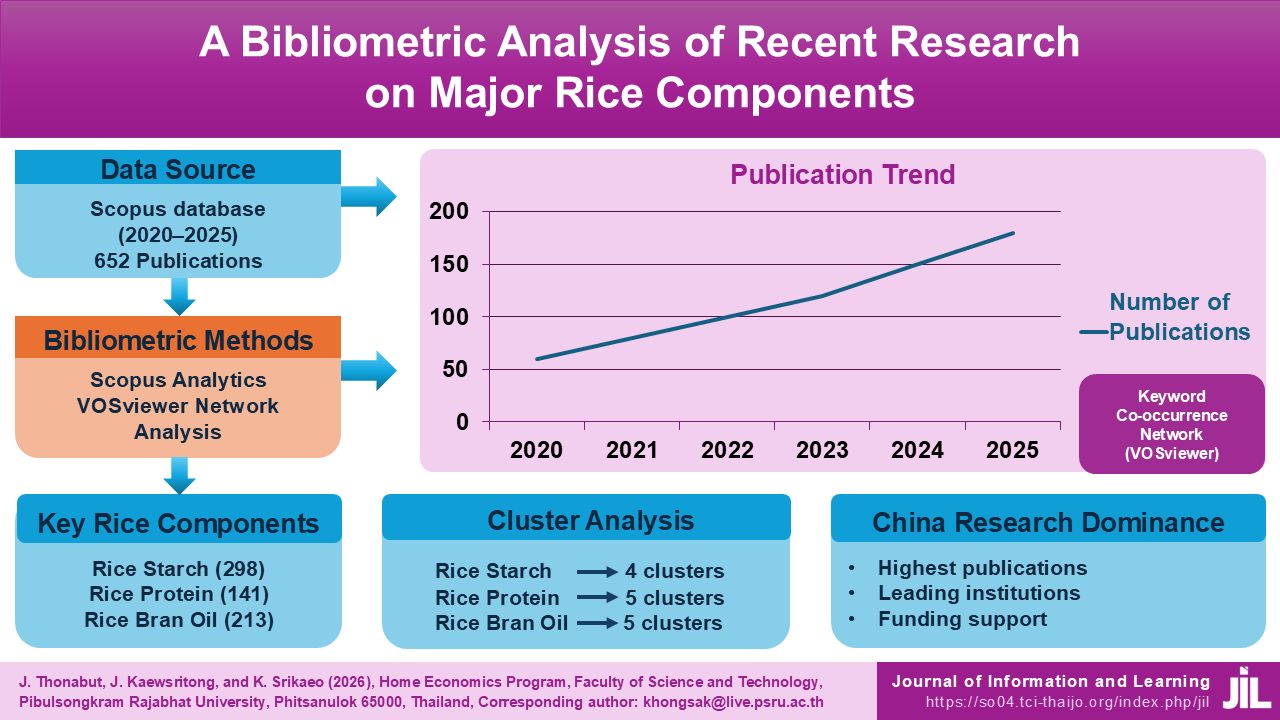
Rice is a globally important staple crop with growing scientific attention to its value-added components. This study aimed to conduct a bibliometric analysis to map research trends related to three major rice components: rice starch, rice protein, and rice bran oil. Bibliometric data were retrieved from the Scopus database, covering publications from 2020 to early 2025. A total of 298 documents on rice starch, 141 on rice protein, and 213 on rice bran oil were analyzed using Scopus analytical tools and VOSviewer software for keyword co-occurrence and author co-citation mapping. The findings revealed a consistent growth in research output across all three components, with rice starch receiving the greatest scientific attention, followed by rice bran oil and rice protein. China demonstrated dominant research productivity across authorship, institutional contributions, and funding support. Thematic analysis indicates a strong emphasis on structural characterization, functional properties, processing technologies, and functional food applications. Cluster analysis identified four, five, and five thematic clusters for rice starch, rice protein, and rice bran oil, respectively, highlighting diverse research trajectories. Despite the increasing research output, rice protein remains comparatively underexplored. This study contributes to knowledge mapping in food science by providing a component-level bibliometric perspective and offers insights for research planning, policy development, and industrial innovation in rice-based product development. This bibliometric analysis emphasizes the dynamic and developing nature of rice research, concentrating on three primary components: rice starch, rice protein, and rice bran oil. A substantial rise in research output is evident from the upward trend of research documents between 2020 and 2025. Rice starch is the most extensively researched component, succeeded by rice bran oil and rice protein. China far surpasses other nations in global contributions regarding rice research.
References
Al-Doury, M. K. W., Hettiarachchy, N. S., & Horax, R. (2018). Rice-endosperm and rice-bran proteins: a review. Journal of the American Oil Chemists’ Society, 95(8), 943–956. https://doi.org/10.1002/aocs.12110
Arruda, H., Silva, E. R., Lessa, M., Proença Jr, D., & Bartholo, R. (2022). VOSviewer and bibliometrix. Journal of the Medical Library Association, 110(3), 392–395. https://doi.org/10.5195/jmla.2022.1434
Bautista, R. C., & Counce, P. A. (2020). An overview of rice and rice quality. Cereal Foods World, 65(5), Article 52. https://doi.org/10.1094/CFW-65-5-0052
Bayer, A. E., Smart, J. C., & McLaughlin, G. W. (1990). Mapping intellectual structure of a scientific subfield through author cocitations. Journal of the American Society for Information Science, 41(6), 444–452. https://doi.org/10.1002/(SICI)1097-4571(199009)41:6<444::AID-ASI12>3.0.CO;2-J
Bin Rahman, A. N. M. R., & Zhang, J. (2023). Trends in rice research: 2030 and beyond. Food and Energy Security, 12(2), Article e390. https://doi.org/10.1002/fes3.390
Bornmann, L., & Daniel, H. (2007). What do we know about the h index? Journal of the American Society for Information Science and Technology, 58(9), 1381–1385. https://doi.org/10.1002/asi.20609
Cauto, A., Castello, M. L., & Ortola, M. D. (2024). Moringa oleifera pods: Bibliometric analysis, properties, and food technology applications. Journal of Food Technology Research, 11(2), 49–61. https://doi.org/10.18488/jftr.v11i2.3784
Donthu, N., Kumar, S., Mukherjee, D., Pandey, N., & Lim, W. M. (2021). How to conduct a bibliometric analysis: An overview and guidelines. Journal of Business Research, 133, 285–296. https://doi.org/10.1016/j.jbusres.2021.04.070
Ellegaard, O., & Wallin, J. A. (2015). The bibliometric analysis of scholarly production: How great is the impact? Scientometrics, 105(3), 1809–1831. https://doi.org/10.1007/s11192-015-1645-z
Fraterrigo Garofalo, S., Tommasi, T., & Fino, D. (2021). A short review of green extraction technologies for rice bran oil. Biomass Conversion and Biorefinery, 11, 569–587. https://doi.org/10.1007/s13399-020-00846-3
Fukagawa, N. K., & Ziska, L. H. (2019). Rice: Importance for global nutrition. Journal of Nutritional Science and Vitaminology, 65(Supplement), S2–S3. https://doi.org/10.3177/jnsv.65.S2
Levitt, J. M., & Thelwall, M. (2011). A combined bibliometric indicator to predict article impact. Information Processing & Management, 47(2), 300–308. https://doi.org/10.1016/j.ipm.2010.09.005
Likittrakulwong, W., Poolprasert, P., & Srikaeo, K. (2021). Effects of extraction methods on protein properties obtained from paddy rice and germinated paddy rice. PeerJ, 9, Article e11365. https://doi.org/10.7717/peerj.11365
Ma, H., Chong, K., & Deng, X.-W. (2007). Rice research: past, present and future. Journal of Integrative Plant Biology, 49(6), 729–730. https://doi.org/10.1111/j.1744-7909.2007.00515.x
Muthayya, S., Sugimoto, J. D., Montgomery, S., & Maberly, G. F. (2014). An overview of global rice production, supply, trade, and consumption. Annals of the New York Academy of Sciences, 1324(1), 7–14. https://doi.org/10.1111/nyas.12540
Narong, D. K., & Hallinger, P. (2023). A keyword co-occurrence analysis of research on service learning: conceptual foci and emerging research trends. Education Sciences, 13(4), Article 339. https://doi.org/10.3390/educsci13040339
Page, M. J., McKenzie, J. E., Bossuyt, P. M., Boutron, I., Hoffmann, T. C., Mulrow, C. D., Shamseer, L., Tetzlaff, J. M., Akl, E. A., Brennan, S. E., Chou, R., Glanville, J., Grimshaw, j. M., Hróbjartsson, A., Lalu, M. M., Li, T., Loder, E. W., Mayo-Wilson, E., McDonald, S., McGuinness, L. A., Stewart, L. A., Thomas, J., Tricco, A. C., Welch, V. A., Whiting, P., & Moher, D.(2021). The PRISMA 2020 statement: an updated guideline for reporting systematic reviews. BMJ, 372, n71. https://doi.org/10.1136/bmj.n71
Park, B.-R., No, J., Oh, H., Park, C. S., You, K.-M., & Chewaka, L. S. (2025). Exploring puffed rice as a novel ink for 3D food printing: Rheological characterization and printability analysis. Journal of Food Engineering, 387, Article 112313. https://doi.org/10.1016/j.jfoodeng.2024.112313
Peng, S., Tang, Q., & Zou, Y. (2009). Current status and challenges of rice production in China. Plant Production Science, 12(1), 3–8. https://doi.org/10.1626/pps.12.3
Punia, S., Kumar, M., Sandhu, K. S., & Whiteside, W. S. (2021). Rice-bran oil: An emerging source of functional oil. Journal of Food Processing and Preservation, 45(4), Article e15318. https://doi.org/10.1111/jfpp.15318
Rey-Martí, A., Ribeiro-Soriano, D., & Palacios-Marqués, D. (2016). A bibliometric analysis of social entrepreneurship. Journal of Business Research, 69(5), 1651–1655. https://doi.org/10.1016/j.jbusres.2015.10.033
Rumangkit, S., & Prabowo, H. (2025). Global trends and future research resources-based view theory in management science through a scoping review and bibliometric analysis. Multidisciplinary Reviews, 8(1), Article 2025013. https://doi.org/10.31893/multirev.2025013
Sahrawat, N., & Chaturvedi, N. (2023). A bibliometric analysis of research on stability of functional beverages by use of hydrocolloids using VOSviewer mapping analysis computations. Annals of Library and Information Studies, 71(2), 226–234. https://doi.org/10.56042/alis.v71i2.7615
Samaddar, A., Azam, M. M., Singaravadivel, K., Venkatachalapathy, N., Swain, B. B., & Mishra, P. (2017). Postharvest management and value addition of rice and its by-products. In S. Mohanty, P. G. Chengappa, Mruthyunjaya, J.K. Ladha, S. Baruah, E. Kannan, A.V. Manjunatha (Eds), The Future Rice Strategy for India (pp. 301–34). Academic Press. https://doi.org/10.1016/B978-0-12-805374-4.00011-7
Schotten, M., el Aisati, M., Meester, W. J. N., Steiginga, S., & Ross, C. A. (2017). A brief history of Scopus: The world’s largest abstract and citation database of scientific literature. In F. J. Cantu-Ortiz (Ed.), Research Analytics (pp. 31–58). Auerbach Publications. https://doi.org/10.1201/9781315155890
Shukla, S. S., Chava, R., Appari, S., Bahurudeen, A., & Kuncharam, B. V. R. (2022). Sustainable use of rice husk for the cleaner production of value-added products. Journal of Environmental Chemical Engineering, 10(1), Article 106899. https://doi.org/10.1016/j.jece.2021.106899
Singh, P., Sundaram, K. T., Vinukonda, V. P., Venkateshwarlu, C., Paul, P. J., Pahi, B., Gurjar, A., Singh, U. M., Kalia, S., Kumar, A., Singh V. K., & Sinha, P. (2024). Superior haplotypes of key drought-responsive genes reveal opportunities for the development of climate-resilient rice varieties. Communications Biology, 7, Article 89. https://doi.org/10.1038/s42003-024-05769-7
Srikaeo, K. (2014). Organic rice bran oils in health. In R. R. Watson, V. R. Preedy, & S. Zibadi (Eds), Wheat and Rice in Disease Prevention and Health (pp. 453–65). Academic Press. https://doi.org/10.1016/B978-0-12-401716-0.00035-0
Srikaeo, K. (2022). Cereal grain-based milks and their potential health properties. In S. P. Bangar, & A. K. Siroha (Eds), Functional Cereals and Cereal Foods: Properties, Functionality and Applications (pp. 251–88). Springer. https://doi.org/10.1007/978-3-031-05611-6_10
Sumarsono, H., Narmaditya, B. S., Rahmawati, F., Prayitno, P. H., & Sahid, S. (2025). Green marketing for sustainability business: A bibliometric analysis. Multidisciplinary Reviews, 8(3), Article 2025078. https://doi.org/10.31893/multirev.2025078
Sundaram, R. M., Sanjeeva Rao, D., Sanghamitra, P., Spoorti, S. G., Veerendra, J., Siromani, N., Niharika, G., Ananthan, R., Aravind Kumar, J., Raghuveer Rao, P., Malathi, S., Mangrauthai, S. K., Balram, M., Ali, J., & Neeraja, C. N. (2023). Redesigning rice as a Promising Nutraceutical Functional Food. In C. Kole (Ed), Compendium of crop genome designing for nutraceuticals (pp. 1–58). Springer. https://doi.org/10.1007/978-981-19-3627-2_1-1
Van Eck, N. J., & Waltman, L. (2014). Visualizing bibliometric networks. In Y. Ding, R. Rousseau, & D. Wolfram (Eds.), Measuring scholarly impact: Methods and practice (pp. 285–320). Springer. https://doi.org/10.1007/978-3-319-10377-8_13
Wahid, N., Warraich, N. F., & Tahira, M. (2022). Factors influencing scholarly publication productivity: a systematic review. Information Discovery and Delivery, 50(1), 22–33. https://doi.org/10.1108/IDD-04-2020-0036
Zeigler, R. S., & Barclay, A. (2008). The relevance of rice. Rice, 1, 3–10. https://doi.org/10.1007/s12284-008-9001-z
Zhang, H. -J., Zhang, H., Wang, L., & Guo, X. -N. (2012). Preparation and functional properties of rice bran proteins from heat-stabilized defatted rice bran. Food Research International, 47(2), 359–363. https://doi.org/10.1016/j.foodres.2011.08.014
Zheng, L., San, Y., Xing, Y., & Regenstein, J. M. (2024). Rice proteins: A review of their extraction, modification techniques and applications. International Journal of Biological Macromolecules, 268, Article 131705. https://doi.org/10.1016/j.ijbiomac.2024.131705
Zhu, D., Zhang, H., Guo, B., Xu, K., Dai, Q., Wei, C., Zhou, G., & Huo, Z. (2017). Physicochemical properties of indica-japonica hybrid rice starch from Chinese varieties. Food Hydrocolloids, 63, 356–363. https://doi.org/10.1016/j.foodhyd.2016.09.013
Zupic, I., & Čater, T. (2015). Bibliometric methods in management and organization. Organizational Research Methods, 18(3), 429–472. https://doi.org/10.1177/1094428114562629
Downloads
Additional Files
Published
How to Cite
Issue
Section
Categories
License
Copyright (c) 2026 Journal of Information and Learning

This work is licensed under a Creative Commons Attribution-NonCommercial-NoDerivatives 4.0 International License.
The Journal of Information and Learning is operated by the Office of Academic Resources, Prince of Songkla University. All articles published in the journal are protected by Thailand copyright law. This copyright covers the exclusive rights to share, reproduce and distribute the article, including in electronic forms, reprints, translations, photographic reproductions, or similar. Authors own copyrights in the works they have created as well as the Office of Academic Resources. The Journal reserves the right to edit the language of papers accepted for publication for clarity and correctness, as well as to make formal changes to ensure compliance with the journal's guidelines. All authors must take public responsibility for the content of their paper.


